

7.1 Free Scalar
149
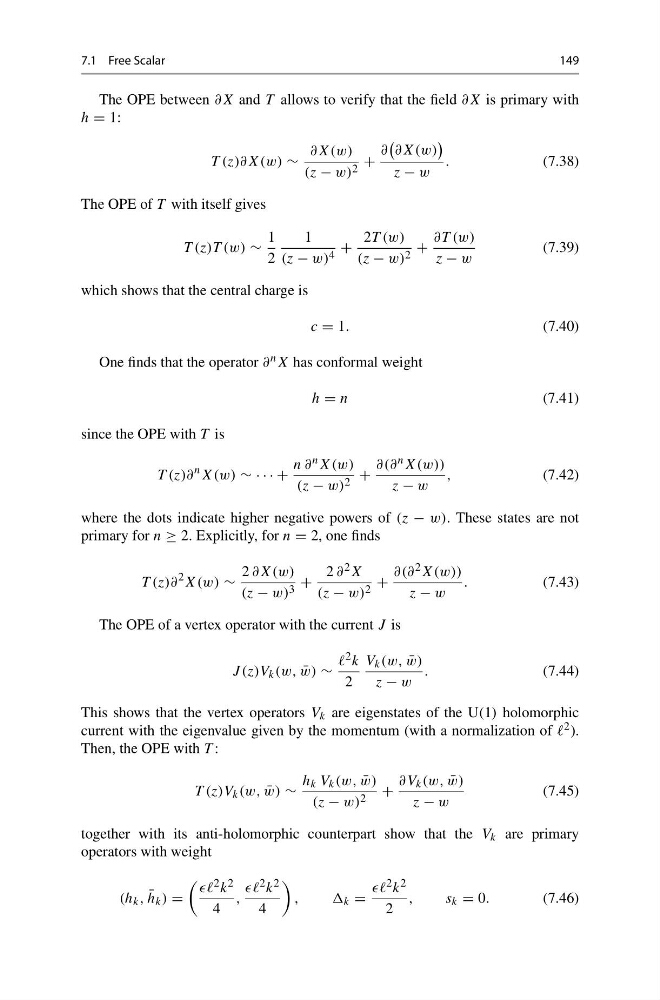
The OPE between ∂X and T allows to verify that the field ∂X is primary with
h = 1:
T (z)∂X(w) ∼
∂X(w)
(z − w) 2 +
∂
∂X(w)
z − w
.
(7.38)
The OPE of T with itself gives
T (z)T (w) ∼
1
2
1
(z − w) 4 +
2T (w)
(z − w) 2 +
∂T (w)
z − w
(7.39)
which shows that the central charge is
c = 1.
(7.40)
One finds that the operator ∂ n X has conformal weight
h = n
(7.41)
since the OPE with T is
T (z)∂
n X(w) ∼ · · · +
n ∂ n X(w)
(z − w) 2 +
∂(∂ n X(w))
z − w
,
(7.42)
where the dots indicate higher negative powers of (z − w). These states are not
primary for n ≥ 2. Explicitly, for n = 2, one finds
T (z)∂
2 X(w) ∼
2 ∂X(w)
(z − w) 3 +
2 ∂ 2 X
(z − w) 2 +
∂(∂ 2 X(w))
z − w
.
(7.43)
The OPE of a vertex operator with the current J is
J (z)V k (w, ¯
w) ∼
2 k
2
V k (w, ¯
w)
z − w
.
(7.44)
This shows that the vertex operators V k are eigenstates of the U(1) holomorphic
current with the eigenvalue given by the momentum (with a normalization of 2 ).
Then, the OPE with T :
T (z)V k (w, ¯
w) ∼
h k V k (w, ¯
w)
(z − w) 2 +
∂V k (w, ¯
w)
z − w
(7.45)
together with its anti-holomorphic counterpart show that the V k are primary
operators with weight
(h k , ¯
h k ) =
2 k 2
4
,
2 k 2
4
,
, k =
2 k 2
2
,
s k = 0.
(7.46)
149
The OPE between ∂X and T allows to verify that the field ∂X is primary with
h = 1:
T (z)∂X(w) ∼
∂X(w)
(z − w) 2 +
∂
∂X(w)
z − w
.
(7.38)
The OPE of T with itself gives
T (z)T (w) ∼
1
2
1
(z − w) 4 +
2T (w)
(z − w) 2 +
∂T (w)
z − w
(7.39)
which shows that the central charge is
c = 1.
(7.40)
One finds that the operator ∂ n X has conformal weight
h = n
(7.41)
since the OPE with T is
T (z)∂
n X(w) ∼ · · · +
n ∂ n X(w)
(z − w) 2 +
∂(∂ n X(w))
z − w
,
(7.42)
where the dots indicate higher negative powers of (z − w). These states are not
primary for n ≥ 2. Explicitly, for n = 2, one finds
T (z)∂
2 X(w) ∼
2 ∂X(w)
(z − w) 3 +
2 ∂ 2 X
(z − w) 2 +
∂(∂ 2 X(w))
z − w
.
(7.43)
The OPE of a vertex operator with the current J is
J (z)V k (w, ¯
w) ∼
2 k
2
V k (w, ¯
w)
z − w
.
(7.44)
This shows that the vertex operators V k are eigenstates of the U(1) holomorphic
current with the eigenvalue given by the momentum (with a normalization of 2 ).
Then, the OPE with T :
T (z)V k (w, ¯
w) ∼
h k V k (w, ¯
w)
(z − w) 2 +
∂V k (w, ¯
w)
z − w
(7.45)
together with its anti-holomorphic counterpart show that the V k are primary
operators with weight
(h k , ¯
h k ) =
2 k 2
4
,
2 k 2
4
,
, k =
2 k 2
2
,
s k = 0.
(7.46)