

7.1 Free Scalar
147
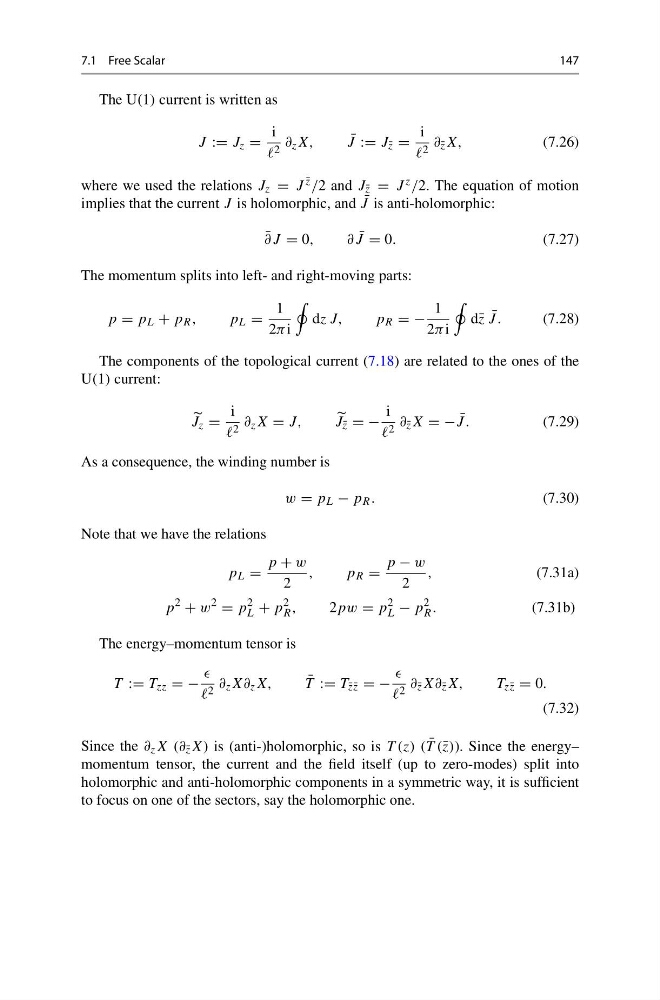
The U(1) current is written as
J := J z =
i
2 ∂ z X,
¯
J := J ¯
z =
i
2 ∂ ¯
z X,
(7.26)
where we used the relations J z = J ¯
z /2 and J ¯
z = J z /2. The equation of motion
implies that the current J is holomorphic, and ¯
J is anti-holomorphic:
¯
∂J = 0,
∂ ¯
J = 0.
(7.27)
The momentum splits into left- and right-moving parts:
p = p L + p R ,
p L =
1
2π i
dz J,
p R = −
1
2π i
d¯ z ¯
J .
(7.28)
The components of the topological current (7.18) are related to the ones of the
U(1) current:
J z =
i
2 ∂ z X = J,
J ¯
z = −
i
2 ∂ ¯
z X = − ¯
J .
(7.29)
As a consequence, the winding number is
w = p L − p R .
(7.30)
Note that we have the relations
p L =
p + w
2
,
p R =
p − w
2
,
(7.31a)
p
2
+ w
2
= p
2
L + p
2
R ,
2pw = p
2
L − p
2
R .
(7.31b)
The energy–momentum tensor is
T := T zz = −
2 ∂ z X∂ z X,
¯
T := T ¯
z¯ z = −
2 ∂ ¯
z X∂ ¯
z X,
T z¯ z = 0.
(7.32)
Since the ∂ z X (∂ ¯
z X) is (anti-)holomorphic, so is T (z) ( ¯
T (¯ z)). Since the energy–
momentum tensor, the current and the field itself (up to zero-modes) split into
holomorphic and anti-holomorphic components in a symmetric way, it is sufficient
to focus on one of the sectors, say the holomorphic one.
147
The U(1) current is written as
J := J z =
i
2 ∂ z X,
¯
J := J ¯
z =
i
2 ∂ ¯
z X,
(7.26)
where we used the relations J z = J ¯
z /2 and J ¯
z = J z /2. The equation of motion
implies that the current J is holomorphic, and ¯
J is anti-holomorphic:
¯
∂J = 0,
∂ ¯
J = 0.
(7.27)
The momentum splits into left- and right-moving parts:
p = p L + p R ,
p L =
1
2π i
dz J,
p R = −
1
2π i
d¯ z ¯
J .
(7.28)
The components of the topological current (7.18) are related to the ones of the
U(1) current:
J z =
i
2 ∂ z X = J,
J ¯
z = −
i
2 ∂ ¯
z X = − ¯
J .
(7.29)
As a consequence, the winding number is
w = p L − p R .
(7.30)
Note that we have the relations
p L =
p + w
2
,
p R =
p − w
2
,
(7.31a)
p
2
+ w
2
= p
2
L + p
2
R ,
2pw = p
2
L − p
2
R .
(7.31b)
The energy–momentum tensor is
T := T zz = −
2 ∂ z X∂ z X,
¯
T := T ¯
z¯ z = −
2 ∂ ¯
z X∂ ¯
z X,
T z¯ z = 0.
(7.32)
Since the ∂ z X (∂ ¯
z X) is (anti-)holomorphic, so is T (z) ( ¯
T (¯ z)). Since the energy–
momentum tensor, the current and the field itself (up to zero-modes) split into
holomorphic and anti-holomorphic components in a symmetric way, it is sufficient
to focus on one of the sectors, say the holomorphic one.