

126
6 Conformal Field Theory on the Plane
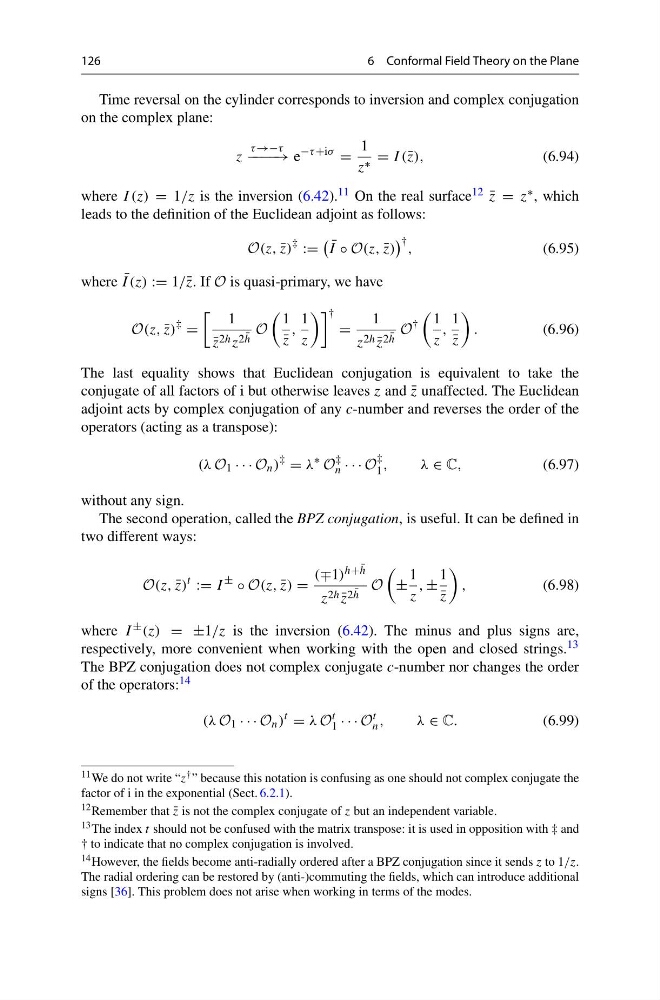
Time reversal on the cylinder corresponds to inversion and complex conjugation
on the complex plane:
z
τ →−τ
− −−− → e
−τ +iσ
=
1
z ∗ = I (¯ z),
(6.94)
where I (z) = 1/z is the inversion (6.42). 11 On the real surface 12 ¯
z = z ∗ , which
leads to the definition of the Euclidean adjoint as follows:
O(z, ¯
z)
‡
:=
¯
I ◦ O(z, ¯
z)
† ,
(6.95)
where ¯
I (z) := 1/¯ z. If O is quasi-primary, we have
O(z, ¯
z)
‡
=
1
¯
z 2h z 2 ¯
h
O
1
¯
z
,
1
z
†
=
1
z 2h ¯
z 2 ¯
h
O
†
1
z
,
1
¯
z
.
(6.96)
The last equality shows that Euclidean conjugation is equivalent to take the
conjugate of all factors of i but otherwise leaves z and ¯
z unaffected. The Euclidean
adjoint acts by complex conjugation of any c-number and reverses the order of the
operators (acting as a transpose):
(λ O 1 · · · O n )
‡
= λ
∗
O
‡
n · · · O
‡
1 ,
λ∈ C,
(6.97)
without any sign.
The second operation, called the BPZ conjugation, is useful. It can be defined in
two different ways:
O(z, ¯
z)
t
:= I
±
◦ O(z, ¯
z) =
(∓1) h+ ¯
h
z 2h ¯
z 2 ¯
h
O
±
1
z
, ±
1
¯
z
,
(6.98)
where I ± (z) = ±1/z is the inversion (6.42). The minus and plus signs are,
respectively, more convenient when working with the open and closed strings. 13
The BPZ conjugation does not complex conjugate c-number nor changes the order
of the operators: 14
(λ O 1 · · · O n )
t
= λ O
t
1 · · · O
t
n ,
λ∈ C.
(6.99)
11 We do not write “z † ” because this notation is confusing as one should not complex conjugate the
factor of i in the exponential (Sect. 6.2.1).
12 Remember that ¯
z is not the complex conjugate of z but an independent variable.
13 The index t should not be confused with the matrix transpose: it is used in opposition with ‡ and
† to indicate that no complex conjugation is involved.
14 However, the fields become anti-radially ordered after a BPZ conjugation since it sends z to 1/z.
The radial ordering can be restored by (anti-)commuting the fields, which can introduce additional
signs [36]. This problem does not arise when working in terms of the modes.
6 Conformal Field Theory on the Plane
Time reversal on the cylinder corresponds to inversion and complex conjugation
on the complex plane:
z
τ →−τ
− −−− → e
−τ +iσ
=
1
z ∗ = I (¯ z),
(6.94)
where I (z) = 1/z is the inversion (6.42). 11 On the real surface 12 ¯
z = z ∗ , which
leads to the definition of the Euclidean adjoint as follows:
O(z, ¯
z)
‡
:=
¯
I ◦ O(z, ¯
z)
† ,
(6.95)
where ¯
I (z) := 1/¯ z. If O is quasi-primary, we have
O(z, ¯
z)
‡
=
1
¯
z 2h z 2 ¯
h
O
1
¯
z
,
1
z
†
=
1
z 2h ¯
z 2 ¯
h
O
†
1
z
,
1
¯
z
.
(6.96)
The last equality shows that Euclidean conjugation is equivalent to take the
conjugate of all factors of i but otherwise leaves z and ¯
z unaffected. The Euclidean
adjoint acts by complex conjugation of any c-number and reverses the order of the
operators (acting as a transpose):
(λ O 1 · · · O n )
‡
= λ
∗
O
‡
n · · · O
‡
1 ,
λ∈ C,
(6.97)
without any sign.
The second operation, called the BPZ conjugation, is useful. It can be defined in
two different ways:
O(z, ¯
z)
t
:= I
±
◦ O(z, ¯
z) =
(∓1) h+ ¯
h
z 2h ¯
z 2 ¯
h
O
±
1
z
, ±
1
¯
z
,
(6.98)
where I ± (z) = ±1/z is the inversion (6.42). The minus and plus signs are,
respectively, more convenient when working with the open and closed strings. 13
The BPZ conjugation does not complex conjugate c-number nor changes the order
of the operators: 14
(λ O 1 · · · O n )
t
= λ O
t
1 · · · O
t
n ,
λ∈ C.
(6.99)
11 We do not write “z † ” because this notation is confusing as one should not complex conjugate the
factor of i in the exponential (Sect. 6.2.1).
12 Remember that ¯
z is not the complex conjugate of z but an independent variable.
13 The index t should not be confused with the matrix transpose: it is used in opposition with ‡ and
† to indicate that no complex conjugation is involved.
14 However, the fields become anti-radially ordered after a BPZ conjugation since it sends z to 1/z.
The radial ordering can be restored by (anti-)commuting the fields, which can introduce additional
signs [36]. This problem does not arise when working in terms of the modes.