

124
6 Conformal Field Theory on the Plane
singular terms multiplying singular terms). Explicit contractions of operators
through the OPE are also denoted by a bracket when there are other operators.
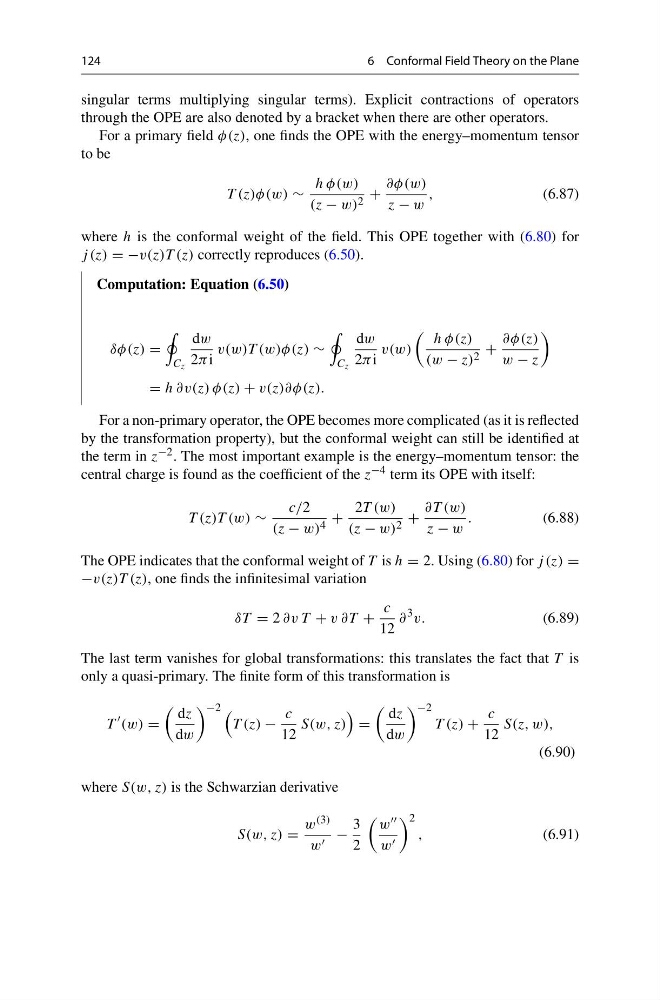
For a primary field φ(z), one finds the OPE with the energy–momentum tensor
to be
T (z)φ(w) ∼
h φ(w)
(z − w) 2 +
∂φ(w)
z − w
,
(6.87)
where h is the conformal weight of the field. This OPE together with (6.80) for
j (z) = −v(z)T (z) correctly reproduces (6.50).
Computation: Equation (6.50)
δφ(z) =
C z
dw
2π i
v(w)T (w)φ(z) ∼
C z
dw
2π i
v(w)
h φ(z)
(w − z) 2 +
∂φ(z)
w − z
= h ∂v(z) φ(z) + v(z)∂φ(z).
For a non-primary operator, the OPE becomes more complicated (as it is reflected
by the transformation property), but the conformal weight can still be identified at
the term in z −2 . The most important example is the energy–momentum tensor: the
central charge is found as the coefficient of the z −4 term its OPE with itself:
T (z)T (w) ∼
c/2
(z − w) 4 +
2T (w)
(z − w) 2 +
∂T (w)
z − w
.
(6.88)
The OPE indicates that the conformal weight of T is h = 2. Using (6.80) for j (z) =
−v(z)T (z), one finds the infinitesimal variation
δT = 2 ∂v T + v ∂T +
c
12
∂
3 v.
(6.89)
The last term vanishes for global transformations: this translates the fact that T is
only a quasi-primary. The finite form of this transformation is
T
(w) =
dz
dw
−2
T (z) −
c
12
S(w, z)
=
dz
dw
−2
T (z) +
c
12
S(z, w),
(6.90)
where S(w, z) is the Schwarzian derivative
S(w, z) =
w (3)
w −
3
2
w
w
2
,
(6.91)
6 Conformal Field Theory on the Plane
singular terms multiplying singular terms). Explicit contractions of operators
through the OPE are also denoted by a bracket when there are other operators.
For a primary field φ(z), one finds the OPE with the energy–momentum tensor
to be
T (z)φ(w) ∼
h φ(w)
(z − w) 2 +
∂φ(w)
z − w
,
(6.87)
where h is the conformal weight of the field. This OPE together with (6.80) for
j (z) = −v(z)T (z) correctly reproduces (6.50).
Computation: Equation (6.50)
δφ(z) =
C z
dw
2π i
v(w)T (w)φ(z) ∼
C z
dw
2π i
v(w)
h φ(z)
(w − z) 2 +
∂φ(z)
w − z
= h ∂v(z) φ(z) + v(z)∂φ(z).
For a non-primary operator, the OPE becomes more complicated (as it is reflected
by the transformation property), but the conformal weight can still be identified at
the term in z −2 . The most important example is the energy–momentum tensor: the
central charge is found as the coefficient of the z −4 term its OPE with itself:
T (z)T (w) ∼
c/2
(z − w) 4 +
2T (w)
(z − w) 2 +
∂T (w)
z − w
.
(6.88)
The OPE indicates that the conformal weight of T is h = 2. Using (6.80) for j (z) =
−v(z)T (z), one finds the infinitesimal variation
δT = 2 ∂v T + v ∂T +
c
12
∂
3 v.
(6.89)
The last term vanishes for global transformations: this translates the fact that T is
only a quasi-primary. The finite form of this transformation is
T
(w) =
dz
dw
−2
T (z) −
c
12
S(w, z)
=
dz
dw
−2
T (z) +
c
12
S(z, w),
(6.90)
where S(w, z) is the Schwarzian derivative
S(w, z) =
w (3)
w −
3
2
w
w
2
,
(6.91)