

112
6 Conformal Field Theory on the Plane
conjugation, the bar will generically denote an independent variable). In that case,
the two algebras are also related by complex conjugation.
Note that the variation of the metric (B.6) under a meromorphic change of
coordinates (6.22) becomes
δg z¯ z = ∂v + ¯
∂ ¯
v,
δg zz = δg ¯
z¯ z = 0.
(6.27)
6.2.2 PSL(2, C) Conformal Group
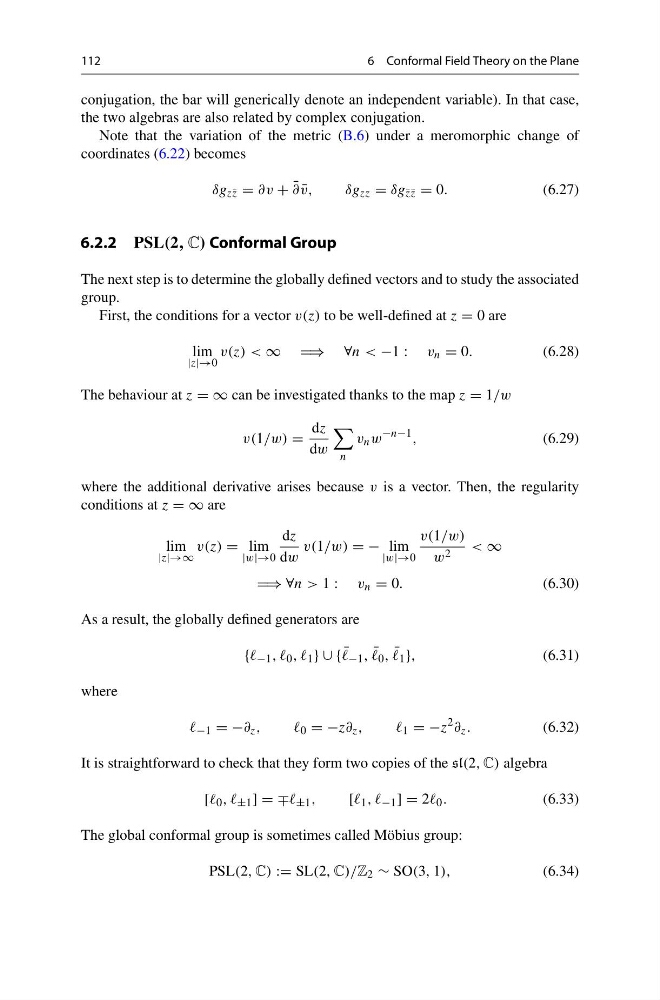
The next step is to determine the globally defined vectors and to study the associated
group.
First, the conditions for a vector v(z) to be well-defined at z = 0 are
lim
|z|→0
v(z) < ∞ ∞⇒ ∀n < −1 : v n = 0.
(6.28)
The behaviour at z = ∞ can be investigated thanks to the map z = 1/w
v(1/w) =
dz
dw
n
v n w
−n−1 ,
(6.29)
where the additional derivative arises because v is a vector. Then, the regularity
conditions at z = ∞ are
lim
|z|→∞
v(z) = lim
|w|→0
dz
dw
v(1/w) = − lim
|w|→0
v(1/w)
w 2 < ∞
⇒ ∀n > 1 : v n = 0.
(6.30)
As a result, the globally defined generators are
{ −1 , , 0 , , 1 } ∪ { ¯
−1 , ¯
0 , ¯
1 },
(6.31)
where
−1 = −∂ z ,
, 0 = −z∂ z ,
, 1 = −z
2 ∂ z .
(6.32)
It is straightforward to check that they form two copies of the sl(2, C) algebra
[ 0 , , ±1 ] = ∓ ±1 ,
[ 1 , , −1 ] = 2 0 .
(6.33)
The global conformal group is sometimes called Möbius group:
PSL(2, C) := SL(2, C)/Z 2 ∼ SO(3, 1),
(6.34)
6 Conformal Field Theory on the Plane
conjugation, the bar will generically denote an independent variable). In that case,
the two algebras are also related by complex conjugation.
Note that the variation of the metric (B.6) under a meromorphic change of
coordinates (6.22) becomes
δg z¯ z = ∂v + ¯
∂ ¯
v,
δg zz = δg ¯
z¯ z = 0.
(6.27)
6.2.2 PSL(2, C) Conformal Group
The next step is to determine the globally defined vectors and to study the associated
group.
First, the conditions for a vector v(z) to be well-defined at z = 0 are
lim
|z|→0
v(z) < ∞ ∞⇒ ∀n < −1 : v n = 0.
(6.28)
The behaviour at z = ∞ can be investigated thanks to the map z = 1/w
v(1/w) =
dz
dw
n
v n w
−n−1 ,
(6.29)
where the additional derivative arises because v is a vector. Then, the regularity
conditions at z = ∞ are
lim
|z|→∞
v(z) = lim
|w|→0
dz
dw
v(1/w) = − lim
|w|→0
v(1/w)
w 2 < ∞
⇒ ∀n > 1 : v n = 0.
(6.30)
As a result, the globally defined generators are
{ −1 , , 0 , , 1 } ∪ { ¯
−1 , ¯
0 , ¯
1 },
(6.31)
where
−1 = −∂ z ,
, 0 = −z∂ z ,
, 1 = −z
2 ∂ z .
(6.32)
It is straightforward to check that they form two copies of the sl(2, C) algebra
[ 0 , , ±1 ] = ∓ ±1 ,
[ 1 , , −1 ] = 2 0 .
(6.33)
The global conformal group is sometimes called Möbius group:
PSL(2, C) := SL(2, C)/Z 2 ∼ SO(3, 1),
(6.34)