

6.1 The Riemann Sphere
109
and the corresponding metric is
ds
2
=
L
2π
2 dzd¯ z
|z| 2 .
(6.18)
A conformal transformation brings this metric to the flat metric (6.5). The conventions for the various coordinates and maps vary in the different textbooks. We have
gathered in Table A.1 the three main conventions and which references use which.
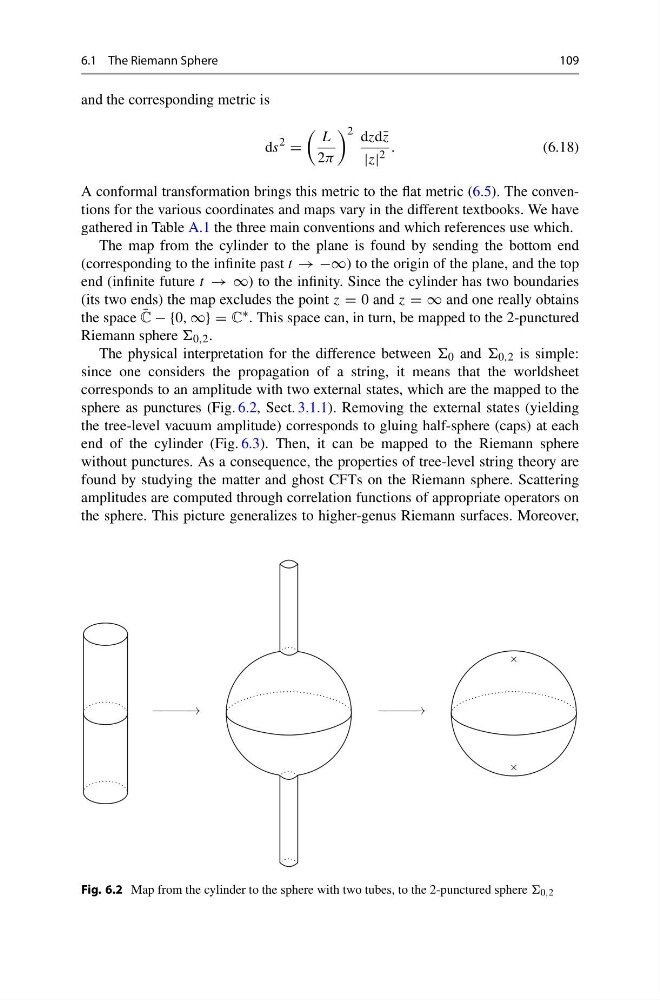
The map from the cylinder to the plane is found by sending the bottom end
(corresponding to the infinite past t → −∞) to the origin of the plane, and the top
end (infinite future t → ∞) to the infinity. Since the cylinder has two boundaries
(its two ends) the map excludes the point z = 0 and z = ∞ and one really obtains
the space ¯
C − {0, ∞} = C ∗ . This space can, in turn, be mapped to the 2-punctured
Riemann sphere 0,2 .
The physical interpretation for the difference between 0 and 0,2 is simple:
since one considers the propagation of a string, it means that the worldsheet
corresponds to an amplitude with two external states, which are the mapped to the
sphere as punctures (Fig. 6.2, Sect. 3.1.1). Removing the external states (yielding
the tree-level vacuum amplitude) corresponds to gluing half-sphere (caps) at each
end of the cylinder (Fig. 6.3). Then, it can be mapped to the Riemann sphere
without punctures. As a consequence, the properties of tree-level string theory are
found by studying the matter and ghost CFTs on the Riemann sphere. Scattering
amplitudes are computed through correlation functions of appropriate operators on
the sphere. This picture generalizes to higher-genus Riemann surfaces. Moreover,
− −−−− →
− −−−− →
Fig. 6.2 Map from the cylinder to the sphere with two tubes, to the 2-punctured sphere 0,2
109
and the corresponding metric is
ds
2
=
L
2π
2 dzd¯ z
|z| 2 .
(6.18)
A conformal transformation brings this metric to the flat metric (6.5). The conventions for the various coordinates and maps vary in the different textbooks. We have
gathered in Table A.1 the three main conventions and which references use which.
The map from the cylinder to the plane is found by sending the bottom end
(corresponding to the infinite past t → −∞) to the origin of the plane, and the top
end (infinite future t → ∞) to the infinity. Since the cylinder has two boundaries
(its two ends) the map excludes the point z = 0 and z = ∞ and one really obtains
the space ¯
C − {0, ∞} = C ∗ . This space can, in turn, be mapped to the 2-punctured
Riemann sphere 0,2 .
The physical interpretation for the difference between 0 and 0,2 is simple:
since one considers the propagation of a string, it means that the worldsheet
corresponds to an amplitude with two external states, which are the mapped to the
sphere as punctures (Fig. 6.2, Sect. 3.1.1). Removing the external states (yielding
the tree-level vacuum amplitude) corresponds to gluing half-sphere (caps) at each
end of the cylinder (Fig. 6.3). Then, it can be mapped to the Riemann sphere
without punctures. As a consequence, the properties of tree-level string theory are
found by studying the matter and ghost CFTs on the Riemann sphere. Scattering
amplitudes are computed through correlation functions of appropriate operators on
the sphere. This picture generalizes to higher-genus Riemann surfaces. Moreover,
− −−−− →
− −−−− →
Fig. 6.2 Map from the cylinder to the sphere with two tubes, to the 2-punctured sphere 0,2