

5.2 CFT on Minkowski Space
103
transformation, which cannot be an element of the group. These notions are
sometimes confused in physics and the term of “group” is used instead of “algebra”.
We shall be careful in distinguishing both concepts.
Remark 5.1 (Isometries of M ⊂ R p,q ) In order to find the conformal isometries
of a manifold M which is a subset of R p,q defined in (5.10), it is sufficient to
restrict the transformations of R p,q to the subset M [4]. In the process, not all
global transformations generically survive. On the other hand, the algebra of local
(infinitesimal) transformations for M and R p,q are identical since M is locally like
R p,q .
5.2
CFT on Minkowski Space
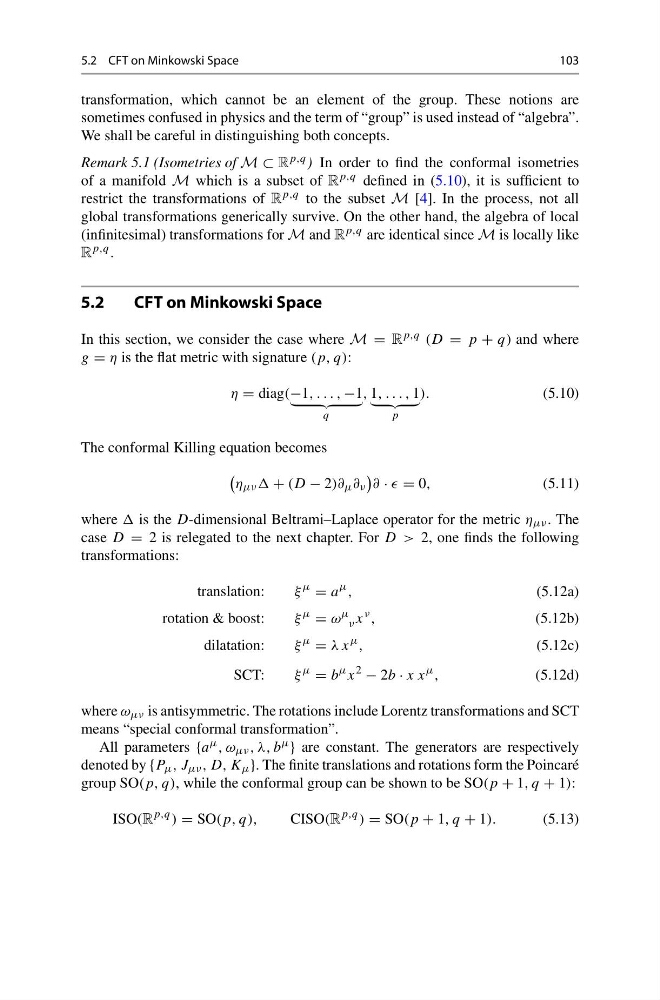
In this section, we consider the case where M = R p,q (D = p + q) and where
g = η is the flat metric with signature (p, q):
η = diag(−1, . . . , −1
q
, 1, . . . , 1
p
).
(5.10)
The conformal Killing equation becomes
η μν + (D − 2)∂ μ ∂ ν
∂ · = 0,
(5.11)
where is the D-dimensional Beltrami–Laplace operator for the metric η μν . The
case D = 2 is relegated to the next chapter. For D > 2, one finds the following
transformations:
translation:
ξ
μ
= a
μ ,
(5.12a)
rotation & boost:
ξ
μ
= ω
μ
ν x
ν ,
(5.12b)
dilatation:
ξ
μ
= λ x
μ ,
(5.12c)
SCT:
ξ
μ
= b
μ x
2
− 2b · x x
μ ,
(5.12d)
where ω μν is antisymmetric. The rotations include Lorentz transformations and SCT
means “special conformal transformation”.
All parameters {a μ , ω μν , λ, b μ } are constant. The generators are respectively
denoted by {P μ , J μν , D, K μ }. The finite translations and rotations form the Poincaré
group SO(p, q), while the conformal group can be shown to be SO(p + 1, q + 1):
ISO(R
p,q ) = SO(p, q),
CISO(R
p,q ) = SO(p + 1, q + 1).
(5.13)
103
transformation, which cannot be an element of the group. These notions are
sometimes confused in physics and the term of “group” is used instead of “algebra”.
We shall be careful in distinguishing both concepts.
Remark 5.1 (Isometries of M ⊂ R p,q ) In order to find the conformal isometries
of a manifold M which is a subset of R p,q defined in (5.10), it is sufficient to
restrict the transformations of R p,q to the subset M [4]. In the process, not all
global transformations generically survive. On the other hand, the algebra of local
(infinitesimal) transformations for M and R p,q are identical since M is locally like
R p,q .
5.2
CFT on Minkowski Space
In this section, we consider the case where M = R p,q (D = p + q) and where
g = η is the flat metric with signature (p, q):
η = diag(−1, . . . , −1
q
, 1, . . . , 1
p
).
(5.10)
The conformal Killing equation becomes
η μν + (D − 2)∂ μ ∂ ν
∂ · = 0,
(5.11)
where is the D-dimensional Beltrami–Laplace operator for the metric η μν . The
case D = 2 is relegated to the next chapter. For D > 2, one finds the following
transformations:
translation:
ξ
μ
= a
μ ,
(5.12a)
rotation & boost:
ξ
μ
= ω
μ
ν x
ν ,
(5.12b)
dilatation:
ξ
μ
= λ x
μ ,
(5.12c)
SCT:
ξ
μ
= b
μ x
2
− 2b · x x
μ ,
(5.12d)
where ω μν is antisymmetric. The rotations include Lorentz transformations and SCT
means “special conformal transformation”.
All parameters {a μ , ω μν , λ, b μ } are constant. The generators are respectively
denoted by {P μ , J μν , D, K μ }. The finite translations and rotations form the Poincaré
group SO(p, q), while the conformal group can be shown to be SO(p + 1, q + 1):
ISO(R
p,q ) = SO(p, q),
CISO(R
p,q ) = SO(p + 1, q + 1).
(5.13)