

98
4 Worldsheet Path Integral: Complex Coordinates
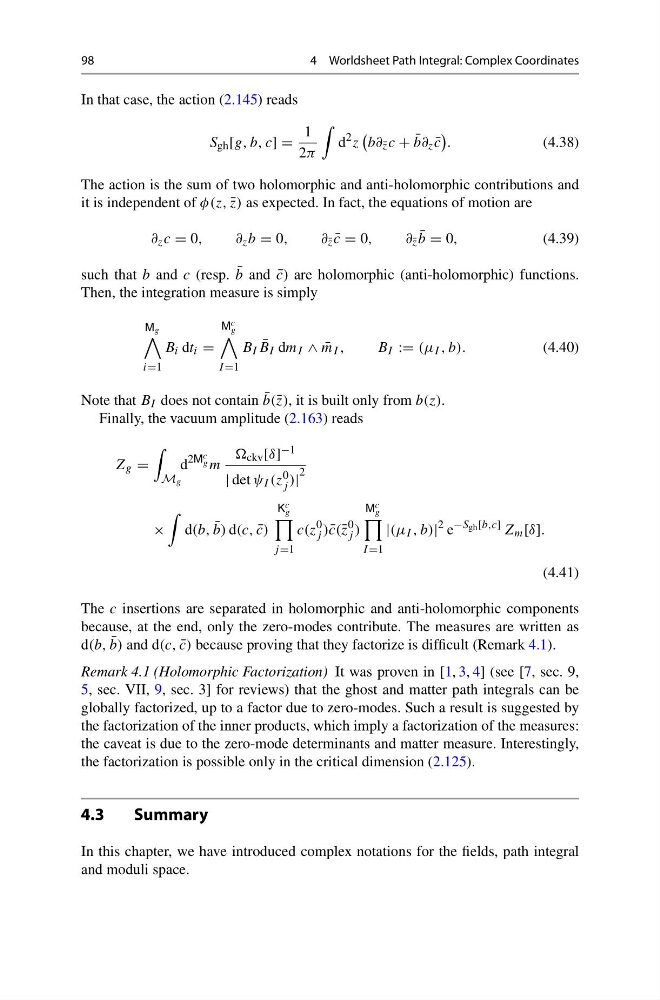
In that case, the action (2.145) reads
S gh [g, b, c] =
1
2π
d
2 z
b∂ ¯
z c + ¯
b∂ z ¯
c
.
(4.38)
The action is the sum of two holomorphic and anti-holomorphic contributions and
it is independent of φ(z, ¯
z) as expected. In fact, the equations of motion are
∂ z c = 0,
∂ z b = 0,
∂ ¯
z ¯
c = 0,
∂ ¯
z ¯
b = 0,
(4.39)
such that b and c (resp. ¯
b and ¯
c) are holomorphic (anti-holomorphic) functions.
Then, the integration measure is simply
M g
i=1
B i dt i =
M c
g
I =1
B I ¯
B I dm I ∧ ¯
m I ,
B I := (μ I , b).
(4.40)
Note that B I does not contain ¯
b(¯ z), it is built only from b(z).
Finally, the vacuum amplitude (2.163) reads
Z g =
M g
d
2M c
g m
ckv [δ] −1
| det ψ I (z 0
j )|
2
×
d(b, ¯
b) d(c, ¯
c)
K c
g
j =1
c(z
0
j ) ¯
c(¯ z
0
j )
M c
g
I =1
|(μ I , b)|
2 e
−S gh [b,c] Z m [δ].
(4.41)
The c insertions are separated in holomorphic and anti-holomorphic components
because, at the end, only the zero-modes contribute. The measures are written as
d(b, ¯
b) and d(c, ¯
c) because proving that they factorize is difficult (Remark 4.1).
Remark 4.1 (Holomorphic Factorization) It was proven in [1, 3, 4] (see [7, sec. 9,
5, sec. VII, 9, sec. 3] for reviews) that the ghost and matter path integrals can be
globally factorized, up to a factor due to zero-modes. Such a result is suggested by
the factorization of the inner products, which imply a factorization of the measures:
the caveat is due to the zero-mode determinants and matter measure. Interestingly,
the factorization is possible only in the critical dimension (2.125).
4.3
Summary
In this chapter, we have introduced complex notations for the fields, path integral
and moduli space.
4 Worldsheet Path Integral: Complex Coordinates
In that case, the action (2.145) reads
S gh [g, b, c] =
1
2π
d
2 z
b∂ ¯
z c + ¯
b∂ z ¯
c
.
(4.38)
The action is the sum of two holomorphic and anti-holomorphic contributions and
it is independent of φ(z, ¯
z) as expected. In fact, the equations of motion are
∂ z c = 0,
∂ z b = 0,
∂ ¯
z ¯
c = 0,
∂ ¯
z ¯
b = 0,
(4.39)
such that b and c (resp. ¯
b and ¯
c) are holomorphic (anti-holomorphic) functions.
Then, the integration measure is simply
M g
i=1
B i dt i =
M c
g
I =1
B I ¯
B I dm I ∧ ¯
m I ,
B I := (μ I , b).
(4.40)
Note that B I does not contain ¯
b(¯ z), it is built only from b(z).
Finally, the vacuum amplitude (2.163) reads
Z g =
M g
d
2M c
g m
ckv [δ] −1
| det ψ I (z 0
j )|
2
×
d(b, ¯
b) d(c, ¯
c)
K c
g
j =1
c(z
0
j ) ¯
c(¯ z
0
j )
M c
g
I =1
|(μ I , b)|
2 e
−S gh [b,c] Z m [δ].
(4.41)
The c insertions are separated in holomorphic and anti-holomorphic components
because, at the end, only the zero-modes contribute. The measures are written as
d(b, ¯
b) and d(c, ¯
c) because proving that they factorize is difficult (Remark 4.1).
Remark 4.1 (Holomorphic Factorization) It was proven in [1, 3, 4] (see [7, sec. 9,
5, sec. VII, 9, sec. 3] for reviews) that the ghost and matter path integrals can be
globally factorized, up to a factor due to zero-modes. Such a result is suggested by
the factorization of the inner products, which imply a factorization of the measures:
the caveat is due to the zero-mode determinants and matter measure. Interestingly,
the factorization is possible only in the critical dimension (2.125).
4.3
Summary
In this chapter, we have introduced complex notations for the fields, path integral
and moduli space.