

92
4 Worldsheet Path Integral: Complex Coordinates
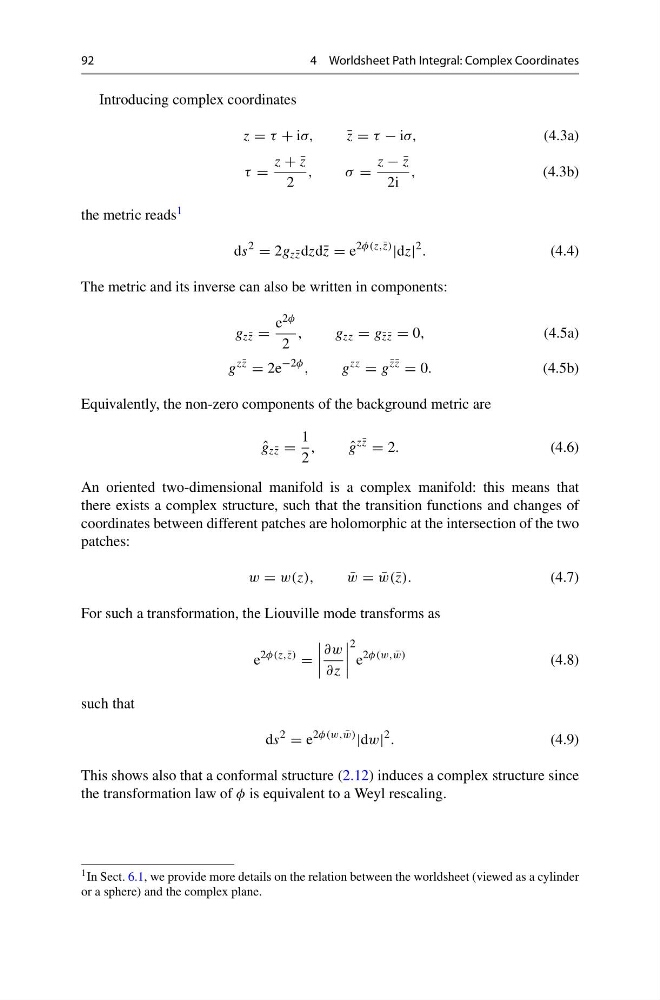
Introducing complex coordinates
z = τ + iσ,
¯
z = τ − iσ,
(4.3a)
τ =
z + ¯
z
2
,
σ =
z − ¯
z
2i
,
(4.3b)
the metric reads 1
ds
2
= 2g z¯ z dzd¯ z = e
2φ(z,¯ z)
|dz|
2 .
(4.4)
The metric and its inverse can also be written in components:
g z¯ z =
e 2φ
2
,
g zz = g ¯
z¯ z = 0,
(4.5a)
g
z¯ z
= 2e
−2φ ,
g
zz
= g
¯
z¯ z
= 0.
(4.5b)
Equivalently, the non-zero components of the background metric are
ˆ
g z¯ z =
1
2
,
ˆ
g
z¯ z
= 2.
(4.6)
An oriented two-dimensional manifold is a complex manifold: this means that
there exists a complex structure, such that the transition functions and changes of
coordinates between different patches are holomorphic at the intersection of the two
patches:
w = w(z),
¯
w = ¯
w(¯ z).
(4.7)
For such a transformation, the Liouville mode transforms as
e
2φ(z,¯ z)
=
∂w
∂z
2
e
2φ(w, ¯
w)
(4.8)
such that
ds
2
= e
2φ(w, ¯
w)
|dw|
2 .
(4.9)
This shows also that a conformal structure (2.12) induces a complex structure since
the transformation law of φ is equivalent to a Weyl rescaling.
1 In Sect. 6.1, we provide more details on the relation between the worldsheet (viewed as a cylinder
or a sphere) and the complex plane.
4 Worldsheet Path Integral: Complex Coordinates
Introducing complex coordinates
z = τ + iσ,
¯
z = τ − iσ,
(4.3a)
τ =
z + ¯
z
2
,
σ =
z − ¯
z
2i
,
(4.3b)
the metric reads 1
ds
2
= 2g z¯ z dzd¯ z = e
2φ(z,¯ z)
|dz|
2 .
(4.4)
The metric and its inverse can also be written in components:
g z¯ z =
e 2φ
2
,
g zz = g ¯
z¯ z = 0,
(4.5a)
g
z¯ z
= 2e
−2φ ,
g
zz
= g
¯
z¯ z
= 0.
(4.5b)
Equivalently, the non-zero components of the background metric are
ˆ
g z¯ z =
1
2
,
ˆ
g
z¯ z
= 2.
(4.6)
An oriented two-dimensional manifold is a complex manifold: this means that
there exists a complex structure, such that the transition functions and changes of
coordinates between different patches are holomorphic at the intersection of the two
patches:
w = w(z),
¯
w = ¯
w(¯ z).
(4.7)
For such a transformation, the Liouville mode transforms as
e
2φ(z,¯ z)
=
∂w
∂z
2
e
2φ(w, ¯
w)
(4.8)
such that
ds
2
= e
2φ(w, ¯
w)
|dw|
2 .
(4.9)
This shows also that a conformal structure (2.12) induces a complex structure since
the transformation law of φ is equivalent to a Weyl rescaling.
1 In Sect. 6.1, we provide more details on the relation between the worldsheet (viewed as a cylinder
or a sphere) and the complex plane.