

(3-methoxy-1,2-propanediol), a net positive effect can be obtained
[23]. Methoxy groups are more effective for vitrification in part
because of their superior ability to hydrogen bond with water and
in part because methoxy groups cannot hydrogen bond to other
methoxy groups, so the lone pair electrons of their oxygen atoms
are more free to interact with water. Hydroxyl groups, on the other
hand, can hydrogen bond to each other, and these self-associations
reduce interaction with water, thus requiring more pCPA to induce
vitrification. In 3-methoxy-1,2-propanediol, two hydroxyls are
present to maintain reasonable hydrophilicity, helping to offset
the hydrophobic effect of the methoxy moiety. This modality for
toxicity control appears effective [23] but has been little investigated to date.
Regarding cost function minimization [298, 300], the toxicity
of a cryoprotectant is accumulated over the course of its addition
and washout process and depends on the temperature and CPA
concentration profiles of the process over time. Consequently, all
contributions to toxicity can be minimized by appropriate choice of
a temperature profile coupled to addition of cryoprotectant while
the cell is maintained at or near its hypotonic volume limit. The
latter approach increases the gradient for pCPA uptake while
keeping the intracellular concentration as low as possible until the
final step of CPA addition. In the final step, the intracellular concentration is abruptly raised to the target value by osmotically
shrinking the cell, which is a rapid process since water crosses the
cell membrane very quickly. To remove the pCPA, the cell is again
immediately brought to its hypotonic volume limit, which immediately dilutes the intracellular pCPA, and the cell is maintained at this
hypotonic limit while pCPA concentrations are lowered, after
which the cell is restored to its desired volume, which transiently
increases the lingering intracellular pCPA concentration, thus
speeding its exit from the cell, while not raising its concentration
to a toxic level. This approach has yielded positive results with
oocytes, which were able to be loaded with Me 2 SO in a remarkably
short time yet recover very well [299].
Both empirically and theoretically, pCPAs that interact most
weakly with water are generally the ones that are the least damaging
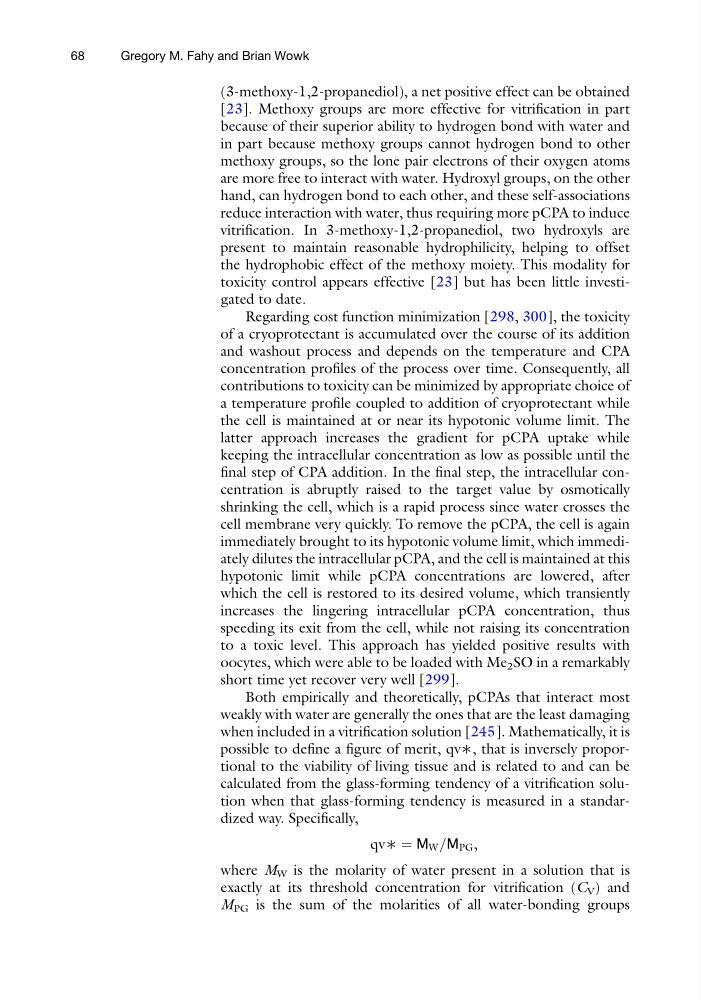
when included in a vitrification solution [245]. Mathematically, it is
possible to define a figure of merit, qv∗, that is inversely proportional to the viability of living tissue and is related to and can be
calculated from the glass-forming tendency of a vitrification solution when that glass-forming tendency is measured in a standardized way. Specifically,
qv∗ ¼ M W =M PG ,
where M W is the molarity of water present in a solution that is
exactly at its threshold concentration for vitrification (C V ) and
M PG is the sum of the molarities of all water-bonding groups
68
Gregory M. Fahy and Brian Wowk
[23]. Methoxy groups are more effective for vitrification in part
because of their superior ability to hydrogen bond with water and
in part because methoxy groups cannot hydrogen bond to other
methoxy groups, so the lone pair electrons of their oxygen atoms
are more free to interact with water. Hydroxyl groups, on the other
hand, can hydrogen bond to each other, and these self-associations
reduce interaction with water, thus requiring more pCPA to induce
vitrification. In 3-methoxy-1,2-propanediol, two hydroxyls are
present to maintain reasonable hydrophilicity, helping to offset
the hydrophobic effect of the methoxy moiety. This modality for
toxicity control appears effective [23] but has been little investigated to date.
Regarding cost function minimization [298, 300], the toxicity
of a cryoprotectant is accumulated over the course of its addition
and washout process and depends on the temperature and CPA
concentration profiles of the process over time. Consequently, all
contributions to toxicity can be minimized by appropriate choice of
a temperature profile coupled to addition of cryoprotectant while
the cell is maintained at or near its hypotonic volume limit. The
latter approach increases the gradient for pCPA uptake while
keeping the intracellular concentration as low as possible until the
final step of CPA addition. In the final step, the intracellular concentration is abruptly raised to the target value by osmotically
shrinking the cell, which is a rapid process since water crosses the
cell membrane very quickly. To remove the pCPA, the cell is again
immediately brought to its hypotonic volume limit, which immediately dilutes the intracellular pCPA, and the cell is maintained at this
hypotonic limit while pCPA concentrations are lowered, after
which the cell is restored to its desired volume, which transiently
increases the lingering intracellular pCPA concentration, thus
speeding its exit from the cell, while not raising its concentration
to a toxic level. This approach has yielded positive results with
oocytes, which were able to be loaded with Me 2 SO in a remarkably
short time yet recover very well [299].
Both empirically and theoretically, pCPAs that interact most
weakly with water are generally the ones that are the least damaging
when included in a vitrification solution [245]. Mathematically, it is
possible to define a figure of merit, qv∗, that is inversely proportional to the viability of living tissue and is related to and can be
calculated from the glass-forming tendency of a vitrification solution when that glass-forming tendency is measured in a standardized way. Specifically,
qv∗ ¼ M W =M PG ,
where M W is the molarity of water present in a solution that is
exactly at its threshold concentration for vitrification (C V ) and
M PG is the sum of the molarities of all water-bonding groups
68
Gregory M. Fahy and Brian Wowk