

extracellular [172] ice. Higher required warming rates have been
reported for rapidly cooled cryoprotected cells [200, 231, 232],
perhaps because lowered nucleation densities with cryoprotection
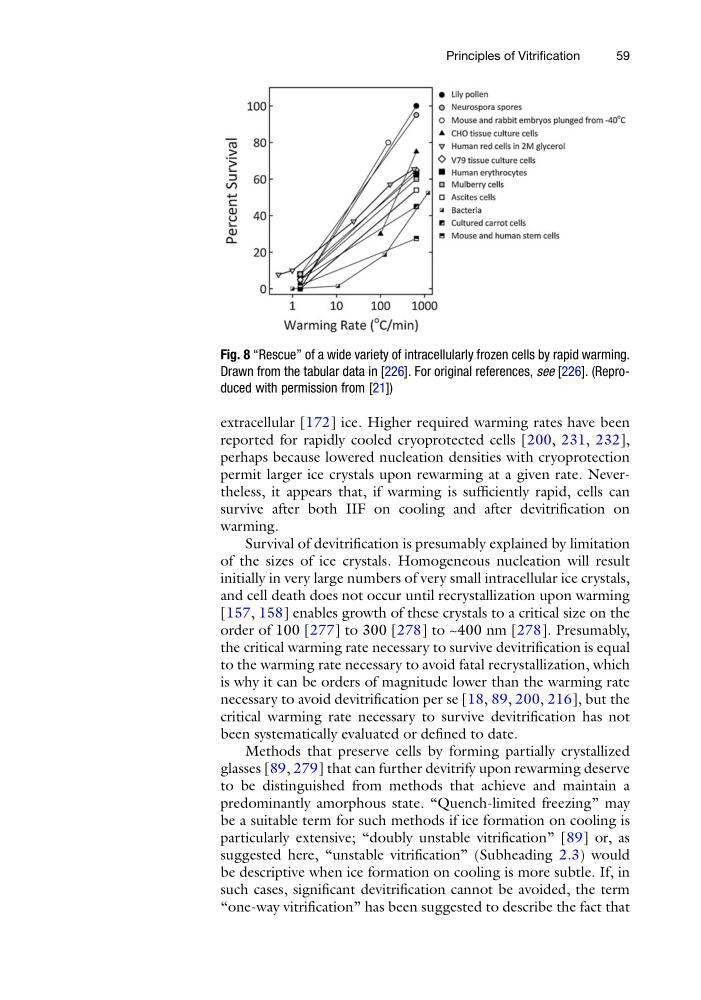
permit larger ice crystals upon rewarming at a given rate. Nevertheless, it appears that, if warming is sufficiently rapid, cells can
survive after both IIF on cooling and after devitrification on
warming.
Survival of devitrification is presumably explained by limitation
of the sizes of ice crystals. Homogeneous nucleation will result
initially in very large numbers of very small intracellular ice crystals,
and cell death does not occur until recrystallization upon warming
[157, 158] enables growth of these crystals to a critical size on the
order of 100 [277] to 300 [278] to ~400 nm [278]. Presumably,
the critical warming rate necessary to survive devitrification is equal
to the warming rate necessary to avoid fatal recrystallization, which
is why it can be orders of magnitude lower than the warming rate
necessary to avoid devitrification per se [18, 89, 200, 216], but the
critical warming rate necessary to survive devitrification has not
been systematically evaluated or defined to date.
Methods that preserve cells by forming partially crystallized
glasses [89, 279] that can further devitrify upon rewarming deserve
to be distinguished from methods that achieve and maintain a
predominantly amorphous state. “Quench-limited freezing” may
be a suitable term for such methods if ice formation on cooling is
particularly extensive; “doubly unstable vitrification” [89] or, as
suggested here, “unstable vitrification” (Subheading 2.3) would
be descriptive when ice formation on cooling is more subtle. If, in
such cases, significant devitrification cannot be avoided, the term
“one-way vitrification” has been suggested to describe the fact that
Fig. 8 “Rescue” of a wide variety of intracellularly frozen cells by rapid warming.
Drawn from the tabular data in [226]. For original references, see [226]. (Reproduced with permission from [21])
Principles of Vitrification
59
reported for rapidly cooled cryoprotected cells [200, 231, 232],
perhaps because lowered nucleation densities with cryoprotection
permit larger ice crystals upon rewarming at a given rate. Nevertheless, it appears that, if warming is sufficiently rapid, cells can
survive after both IIF on cooling and after devitrification on
warming.
Survival of devitrification is presumably explained by limitation
of the sizes of ice crystals. Homogeneous nucleation will result
initially in very large numbers of very small intracellular ice crystals,
and cell death does not occur until recrystallization upon warming
[157, 158] enables growth of these crystals to a critical size on the
order of 100 [277] to 300 [278] to ~400 nm [278]. Presumably,
the critical warming rate necessary to survive devitrification is equal
to the warming rate necessary to avoid fatal recrystallization, which
is why it can be orders of magnitude lower than the warming rate
necessary to avoid devitrification per se [18, 89, 200, 216], but the
critical warming rate necessary to survive devitrification has not
been systematically evaluated or defined to date.
Methods that preserve cells by forming partially crystallized
glasses [89, 279] that can further devitrify upon rewarming deserve
to be distinguished from methods that achieve and maintain a
predominantly amorphous state. “Quench-limited freezing” may
be a suitable term for such methods if ice formation on cooling is
particularly extensive; “doubly unstable vitrification” [89] or, as
suggested here, “unstable vitrification” (Subheading 2.3) would
be descriptive when ice formation on cooling is more subtle. If, in
such cases, significant devitrification cannot be avoided, the term
“one-way vitrification” has been suggested to describe the fact that
Fig. 8 “Rescue” of a wide variety of intracellularly frozen cells by rapid warming.
Drawn from the tabular data in [226]. For original references, see [226]. (Reproduced with permission from [21])
Principles of Vitrification
59