

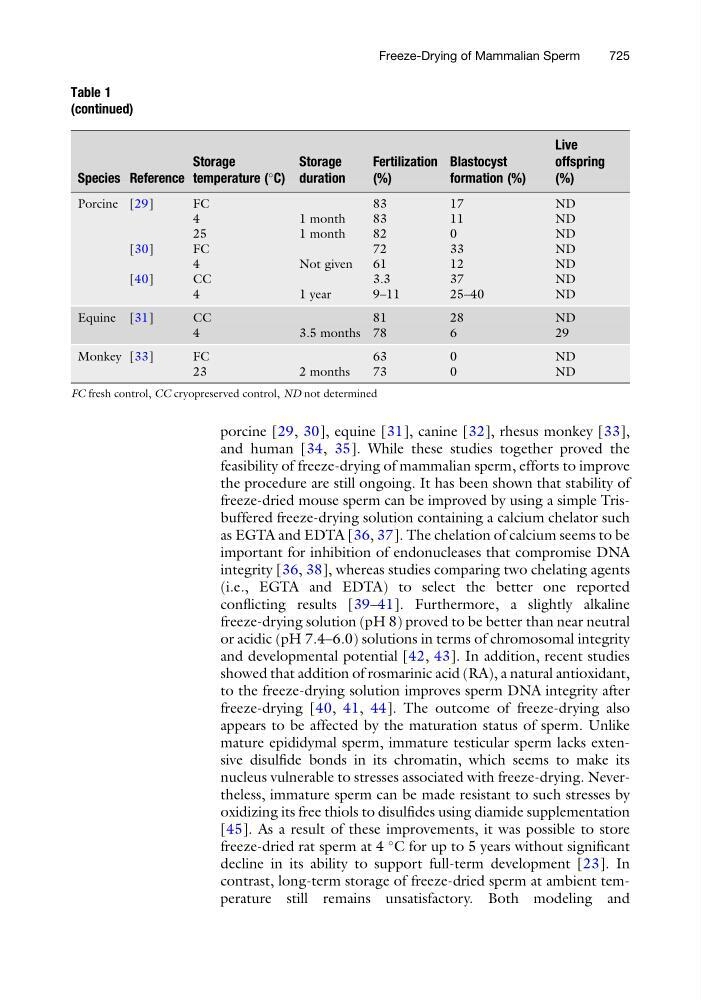
porcine [29, 30], equine [31], canine [32], rhesus monkey [33],
and human [34, 35]. While these studies together proved the
feasibility of freeze-drying of mammalian sperm, efforts to improve
the procedure are still ongoing. It has been shown that stability of
freeze-dried mouse sperm can be improved by using a simple Trisbuffered freeze-drying solution containing a calcium chelator such
as EGTA and EDTA [36, 37]. The chelation of calcium seems to be
important for inhibition of endonucleases that compromise DNA
integrity [36, 38], whereas studies comparing two chelating agents
(i.e., EGTA and EDTA) to select the better one reported
conflicting results [39–41]. Furthermore, a slightly alkaline
freeze-drying solution (pH 8) proved to be better than near neutral
or acidic (pH 7.4–6.0) solutions in terms of chromosomal integrity
and developmental potential [42, 43]. In addition, recent studies
showed that addition of rosmarinic acid (RA), a natural antioxidant,
to the freeze-drying solution improves sperm DNA integrity after
freeze-drying [40, 41, 44]. The outcome of freeze-drying also
appears to be affected by the maturation status of sperm. Unlike
mature epididymal sperm, immature testicular sperm lacks extensive disulfide bonds in its chromatin, which seems to make its
nucleus vulnerable to stresses associated with freeze-drying. Nevertheless, immature sperm can be made resistant to such stresses by
oxidizing its free thiols to disulfides using diamide supplementation
[45]. As a result of these improvements, it was possible to store
freeze-dried rat sperm at 4
C for up to 5 years without significant
decline in its ability to support full-term development [23]. In
contrast, long-term storage of freeze-dried sperm at ambient temperature still remains unsatisfactory. Both modeling and
Table 1
(continued)
Species Reference
Storage
temperature (
C)
Storage
duration
Fertilization
(%)
Blastocyst
formation (%)
Live
offspring
(%)
Porcine [29]
F C
8 3
1 7
N D
4
1 month
83
11
ND
25
1 month
82
0
ND
[30]
F C
7 2
3 3
N D
4
Not given
61
12
ND
[40]
CC
3.3
37
ND
4
1 year
9–11
25–40
ND
Equine [31]
C C
8 1
2 8
N D
4
3.5 months 78
6
29
Monkey [33]
F C
6 3
0
N D
23
2 months
73
0
ND
FC fresh control, CC cryopreserved control, ND not determined
Freeze-Drying of Mammalian Sperm
725