

established although success rates greatly vary among species and
are still not satisfactory in some cases [1, 7, 8].
While long-term storage of mammalian sperm in LN 2 is currently the method of choice, the ability to preserve sperm at higher
temperatures (ideally at ambient temperature) is preferred for a
number of reasons. It would significantly reduce the storage costs
and spaces, facilitate sample transport while reducing associated
expenses, and avoid the viral contamination risk among samples
[9, 10]. Furthermore, LN 2 is not readily accessible in some
countries. Consequently, there has been a long-term interest in
cell preservation methods that would allow storage of samples at
suprazero temperatures. Freeze-drying represents such a method
and brings samples to a dried state through a multistep process
involving primary and secondary drying and two phase transitions.
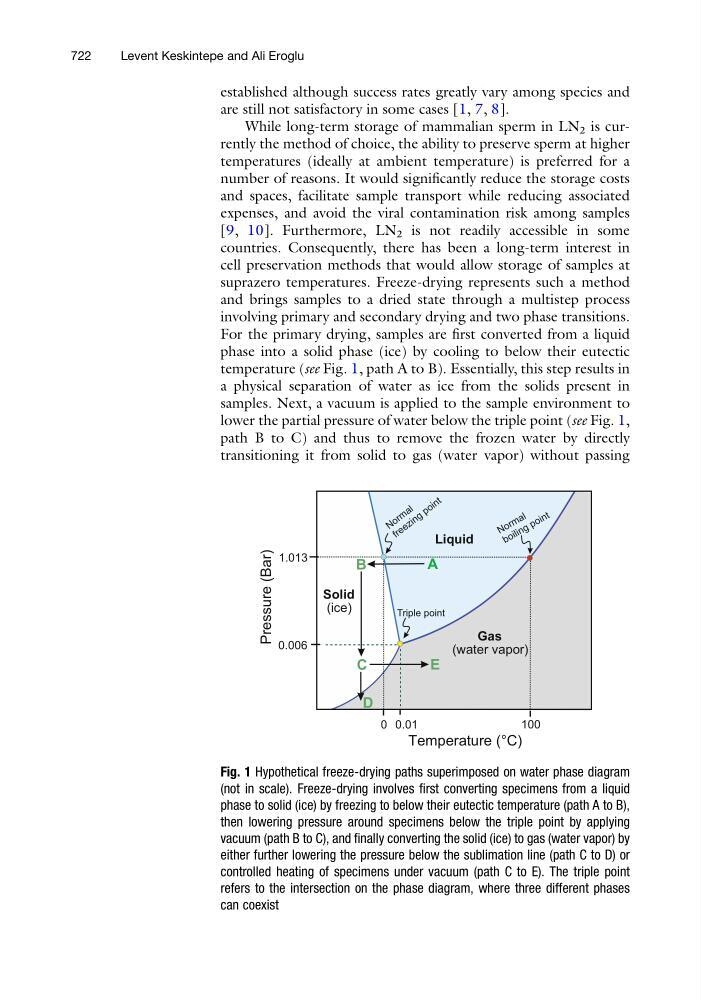
For the primary drying, samples are first converted from a liquid
phase into a solid phase (ice) by cooling to below their eutectic
temperature (see Fig. 1, path A to B). Essentially, this step results in
a physical separation of water as ice from the solids present in
samples. Next, a vacuum is applied to the sample environment to
lower the partial pressure of water below the triple point (see Fig. 1,
path B to C) and thus to remove the frozen water by directly
transitioning it from solid to gas (water vapor) without passing
0.01
Temperature (°C)
Liquid
Solid
(ice)
100
1.013
0.006
Pressure (Bar)
0
(water vapor)
Gas
A
B
C
D
E
N o r m a l
b o il in g p o in t
N o r m
a l
f r e e z in g
p o in t
Triple point
Fig. 1 Hypothetical freeze-drying paths superimposed on water phase diagram
(not in scale). Freeze-drying involves first converting specimens from a liquid
phase to solid (ice) by freezing to below their eutectic temperature (path A to B),
then lowering pressure around specimens below the triple point by applying
vacuum (path B to C), and finally converting the solid (ice) to gas (water vapor) by
either further lowering the pressure below the sublimation line (path C to D) or
controlled heating of specimens under vacuum (path C to E). The triple point
refers to the intersection on the phase diagram, where three different phases
can coexist
722
Levent Keskintepe and Ali Eroglu