

(a) Put ~20 mg of powder (m powder ) in a 4 mL glass vial, add
2 mL of dry methanol (m methanol ), and close the vial with
the septum and stopper. Precisely note the weight of both
the powder and methanol.
(b) Prepare three vials.
(c) Vortex the vials for 5 min (use a specific device for maintaining vials) (see Note 14).
(d) Take ~0.5 mL of sample with the syringe in a vial, rinse the
syringe with the sample, take ~0.8 mL of sample in the
same vial (m sample ), and inject this quantity in the Karl
Fisher titration vessel, note the measured quantity of
water (x sample ).
(e) Repeat this procedure for the two remaining vials.
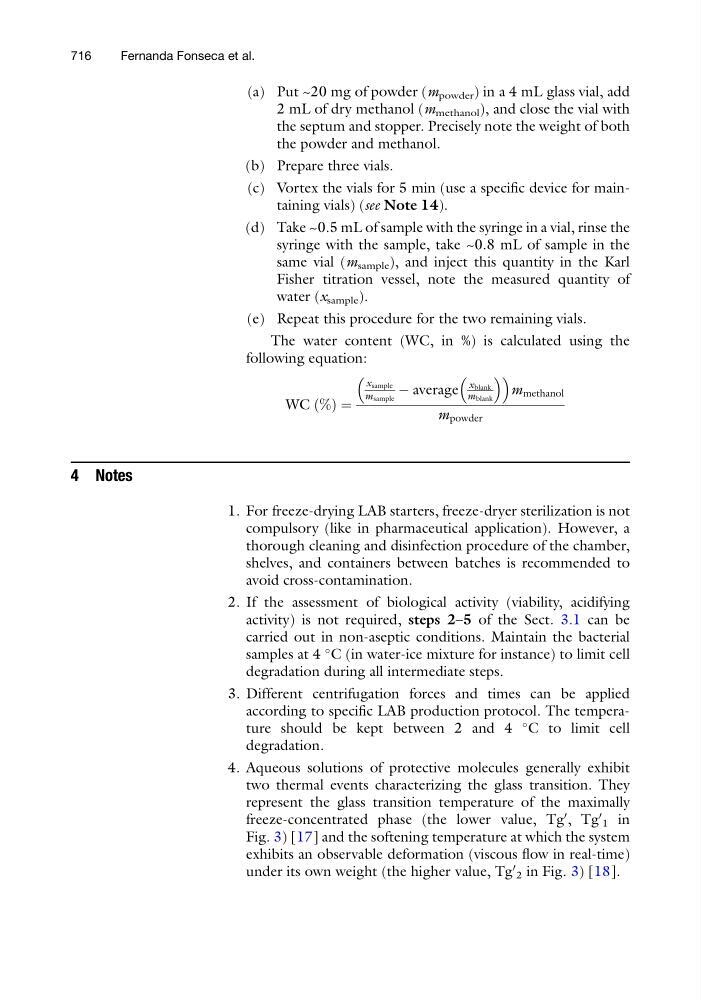
The water content (WC, in %) is calculated using the
following equation:
WC %
ð Þ ¼
x sample
m sample
À average
x blank
m blank
m methanol
m powder
4 Notes
1. For freeze-drying LAB starters, freeze-dryer sterilization is not
compulsory (like in pharmaceutical application). However, a
thorough cleaning and disinfection procedure of the chamber,
shelves, and containers between batches is recommended to
avoid cross-contamination.
2. If the assessment of biological activity (viability, acidifying
activity) is not required, steps 2–5 of the Sect. 3.1 can be
carried out in non-aseptic conditions. Maintain the bacterial
samples at 4
C (in water-ice mixture for instance) to limit cell
degradation during all intermediate steps.
3. Different centrifugation forces and times can be applied
according to specific LAB production protocol. The temperature should be kept between 2 and 4
C to limit cell
degradation.
4. Aqueous solutions of protective molecules generally exhibit
two thermal events characterizing the glass transition. They
represent the glass transition temperature of the maximally
freeze-concentrated phase (the lower value, Tg
0 , Tg
0
1 in
Fig. 3) [17] and the softening temperature at which the system
exhibits an observable deformation (viscous flow in real-time)
under its own weight (the higher value, Tg
0
2 in Fig. 3) [18].
716
Fernanda Fonseca et al.