

2 Materials
2.1 Differential
Scanning
Calorimeter (DSC)
1. A power compensation DSC Diamond (Perkin Elmer LLC,
Norwalk, CT, USA) equipped with a liquid nitrogen cooling
accessory (CryoFill, Perkin Elmer). Temperature calibration
was done using cyclohexane (crystal-crystal transition at
À87.1
C), mercury (melting point at À38.6
C), and
n-octadecane (melting point at 27.8
C). This equipment is
used for analyzing liquid samples.
2. A power compensation DSC Pyris 1 (Perkin Elmer LLC, Norwalk, CT, USA) equipped with a mechanical cooling system.
Temperature calibration was done using cyclohexane (melting
point at 6.5
C), n-octadecane (melting point at 27.8
C), and
indium (melting point at 156
C). This equipment is used for
analyzing freeze-dried samples.
3. 50 μL Perkin Elmer DSC aluminum pans and covers.
4. Perkin Elmer universal crimper press.
2.2 Freeze-Drying
Microscopy System
1. A Nikon Eclipse E600 polarized microscope (Nikon, Japan)
equipped with a 10Â magnification objective.
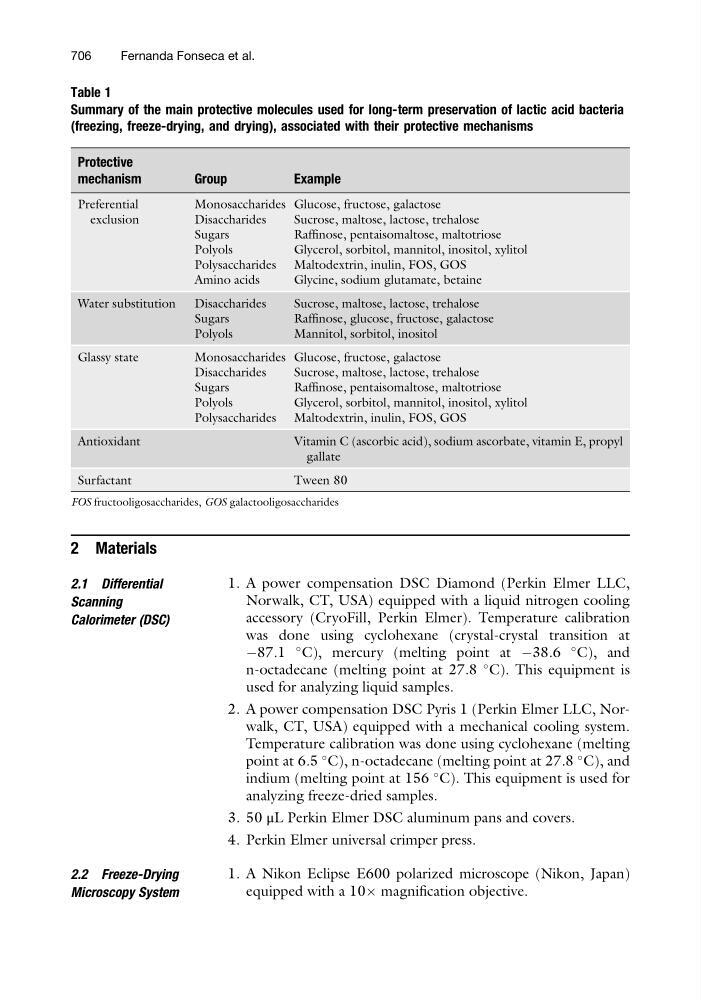
Table 1
Summary of the main protective molecules used for long-term preservation of lactic acid bacteria
(freezing, freeze-drying, and drying), associated with their protective mechanisms
Protective
mechanism
Group
Example
Preferential
exclusion
Monosaccharides Glucose, fructose, galactose
Disaccharides
Sucrose, maltose, lactose, trehalose
Sugars
Raffinose, pentaisomaltose, maltotriose
Polyols
Glycerol, sorbitol, mannitol, inositol, xylitol
Polysaccharides Maltodextrin, inulin, FOS, GOS
Amino acids
Glycine, sodium glutamate, betaine
Water substitution
Disaccharides
Sucrose, maltose, lactose, trehalose
Sugars
Raffinose, glucose, fructose, galactose
Polyols
Mannitol, sorbitol, inositol
Glassy state
Monosaccharides Glucose, fructose, galactose
Disaccharides
Sucrose, maltose, lactose, trehalose
Sugars
Raffinose, pentaisomaltose, maltotriose
Polyols
Glycerol, sorbitol, mannitol, inositol, xylitol
Polysaccharides Maltodextrin, inulin, FOS, GOS
Antioxidant
Vitamin C (ascorbic acid), sodium ascorbate, vitamin E, propyl
gallate
Surfactant
Tween 80
FOS fructooligosaccharides, GOS galactooligosaccharides
706
Fernanda Fonseca et al.