

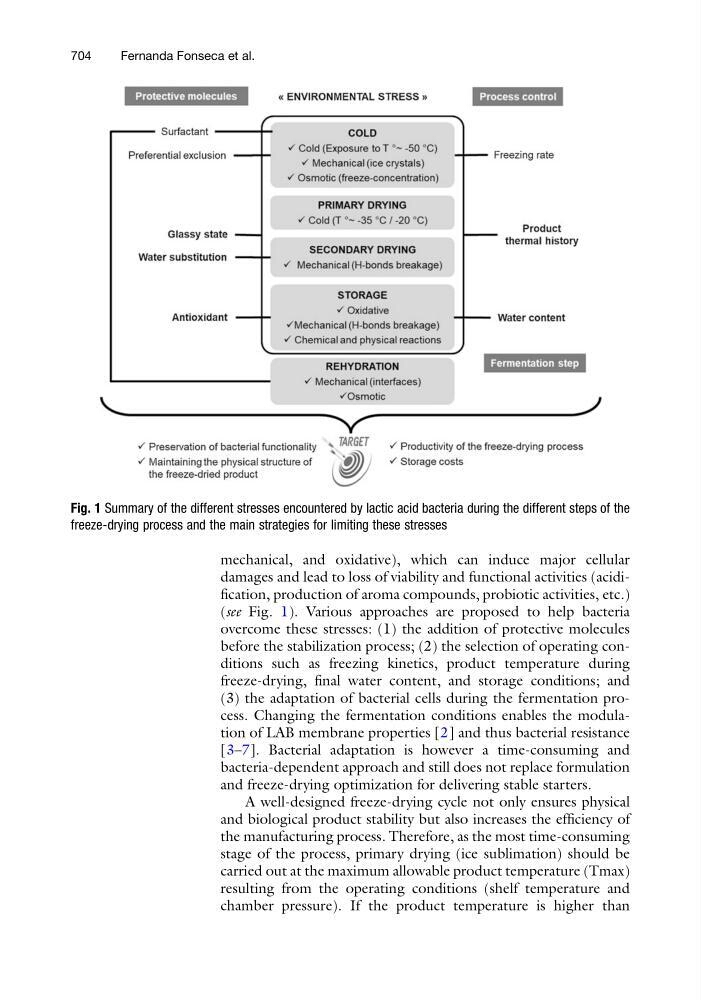
mechanical, and oxidative), which can induce major cellular
damages and lead to loss of viability and functional activities (acidification, production of aroma compounds, probiotic activities, etc.)
(see Fig. 1). Various approaches are proposed to help bacteria
overcome these stresses: (1) the addition of protective molecules
before the stabilization process; (2) the selection of operating conditions such as freezing kinetics, product temperature during
freeze-drying, final water content, and storage conditions; and
(3) the adaptation of bacterial cells during the fermentation process. Changing the fermentation conditions enables the modulation of LAB membrane properties [2] and thus bacterial resistance
[3–7]. Bacterial adaptation is however a time-consuming and
bacteria-dependent approach and still does not replace formulation
and freeze-drying optimization for delivering stable starters.
A well-designed freeze-drying cycle not only ensures physical
and biological product stability but also increases the efficiency of
the manufacturing process. Therefore, as the most time-consuming
stage of the process, primary drying (ice sublimation) should be
carried out at the maximum allowable product temperature (Tmax)
resulting from the operating conditions (shelf temperature and
chamber pressure). If the product temperature is higher than
Fig. 1 Summary of the different stresses encountered by lactic acid bacteria during the different steps of the
freeze-drying process and the main strategies for limiting these stresses
704
Fernanda Fonseca et al.