

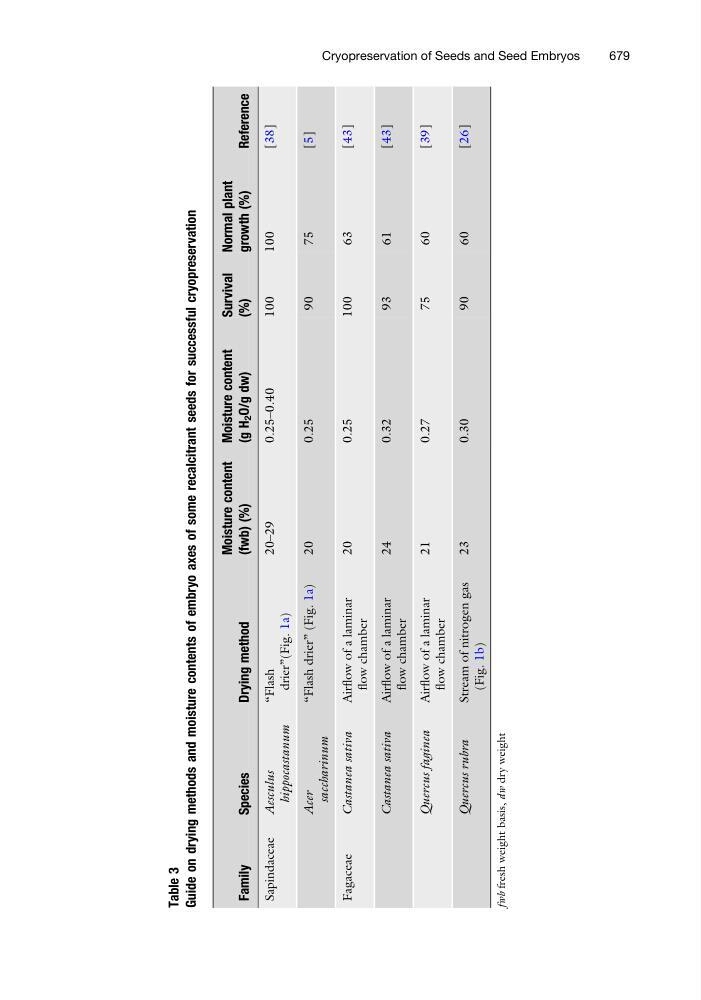
Table 3
Guide on drying methods and moisture contents of embryo axes of some recalcitrant seeds for successful cryopreservation
Family
Species
Drying method
Moisture content
(fwb) (%)
Moisture content
(g H
2 O/g dw)
Survival
(%)
Normal plant
growth (%)
Reference
Sapindaceae
Aesculus
hippocastanum
“Flash
drier”(Fig. 1a)
20–29
0.25–0.40
100
100
[38]
Acer
saccharinum
“Flash drier” (Fig. 1a)
20
0.25
90
75
[5]
Fagaceae
Castanea sativa
Airflow of a laminar
flow chamber
20
0.25
100
63
[43]
Castanea sativa
Airflow of a laminar
flow chamber
24
0.32
93
61
[43]
Quercus faginea
Airflow of a laminar
flow chamber
21
0.27
75
60
[39]
Quercus rubra
Stream of nitrogen gas
(Fig. 1b)
23
0.30
90
60
[26]
fwb fresh weight basis,
dw dry weight
Cryopreservation of Seeds and Seed Embryos
679