

Nowadays, vitrification-based protocols developed in Sakai’s
pioneering experiments [7] are state of the art. Here, shoot tips
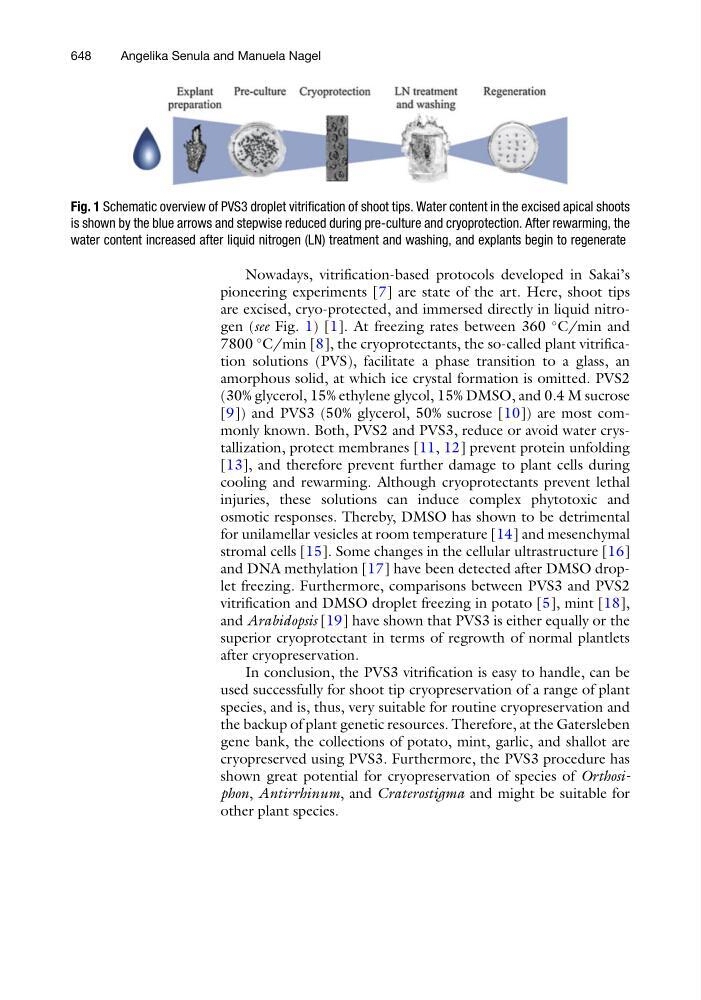
are excised, cryo-protected, and immersed directly in liquid nitrogen (see Fig. 1) [1]. At freezing rates between 360
C/min and
7800
C/min [8], the cryoprotectants, the so-called plant vitrification solutions (PVS), facilitate a phase transition to a glass, an
amorphous solid, at which ice crystal formation is omitted. PVS2
(30% glycerol, 15% ethylene glycol, 15% DMSO, and 0.4 M sucrose
[9]) and PVS3 (50% glycerol, 50% sucrose [10]) are most commonly known. Both, PVS2 and PVS3, reduce or avoid water crystallization, protect membranes [11, 12] prevent protein unfolding
[13], and therefore prevent further damage to plant cells during
cooling and rewarming. Although cryoprotectants prevent lethal
injuries, these solutions can induce complex phytotoxic and
osmotic responses. Thereby, DMSO has shown to be detrimental
for unilamellar vesicles at room temperature [14] and mesenchymal
stromal cells [15]. Some changes in the cellular ultrastructure [16]
and DNA methylation [17] have been detected after DMSO droplet freezing. Furthermore, comparisons between PVS3 and PVS2
vitrification and DMSO droplet freezing in potato [5], mint [18],
and Arabidopsis [19] have shown that PVS3 is either equally or the
superior cryoprotectant in terms of regrowth of normal plantlets
after cryopreservation.
In conclusion, the PVS3 vitrification is easy to handle, can be
used successfully for shoot tip cryopreservation of a range of plant
species, and is, thus, very suitable for routine cryopreservation and
the backup of plant genetic resources. Therefore, at the Gatersleben
gene bank, the collections of potato, mint, garlic, and shallot are
cryopreserved using PVS3. Furthermore, the PVS3 procedure has
shown great potential for cryopreservation of species of Orthosiphon, Antirrhinum, and Craterostigma and might be suitable for
other plant species.
Fig. 1 Schematic overview of PVS3 droplet vitrification of shoot tips. Water content in the excised apical shoots
is shown by the blue arrows and stepwise reduced during pre-culture and cryoprotection. After rewarming, the
water content increased after liquid nitrogen (LN) treatment and washing, and explants begin to regenerate
648
Angelika Senula and Manuela Nagel