

3.5 Pollen
Cryopreservation
for Pollen Sensitive
to Desiccation (e.g.,
Zea mays)
1. Collect freshly harvested pollen on paper by shaking the
anthers of spikes collected in the field (see Note 18).
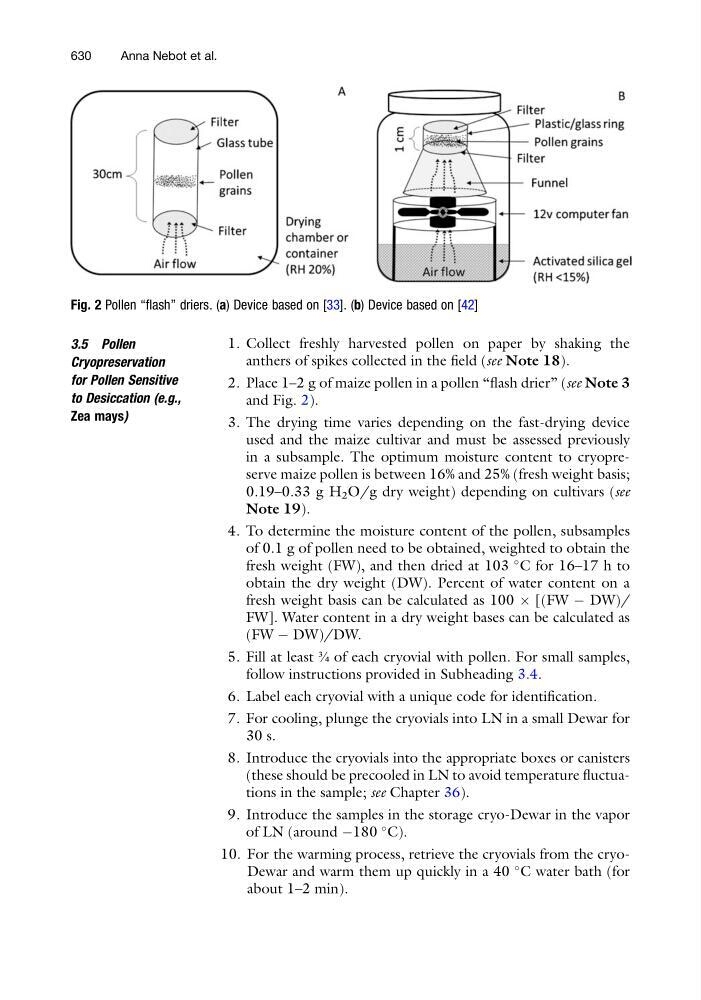
2. Place 1–2 g of maize pollen in a pollen “flash drier” (see Note 3
and Fig. 2).
3. The drying time varies depending on the fast-drying device
used and the maize cultivar and must be assessed previously
in a subsample. The optimum moisture content to cryopreserve maize pollen is between 16% and 25% (fresh weight basis;
0.19–0.33 g H 2 O/g dry weight) depending on cultivars (see
Note 19).
4. To determine the moisture content of the pollen, subsamples
of 0.1 g of pollen need to be obtained, weighted to obtain the
fresh weight (FW), and then dried at 103
C for 16–17 h to
obtain the dry weight (DW). Percent of water content on a
fresh weight basis can be calculated as 100 Â [(FW À DW)/
FW]. Water content in a dry weight bases can be calculated as
(FW À DW)/DW.
5. Fill at least ¾ of each cryovial with pollen. For small samples,
follow instructions provided in Subheading 3.4.
6. Label each cryovial with a unique code for identification.
7. For cooling, plunge the cryovials into LN in a small Dewar for
30 s.
8. Introduce the cryovials into the appropriate boxes or canisters
(these should be precooled in LN to avoid temperature fluctuations in the sample; see Chapter 36).
9. Introduce the samples in the storage cryo-Dewar in the vapor
of LN (around À180
C).
10. For the warming process, retrieve the cryovials from the cryoDewar and warm them up quickly in a 40
C water bath (for
about 1–2 min).
Fig. 2 Pollen “flash” driers. (a) Device based on [33]. (b) Device based on [42]
630
Anna Nebot et al.