

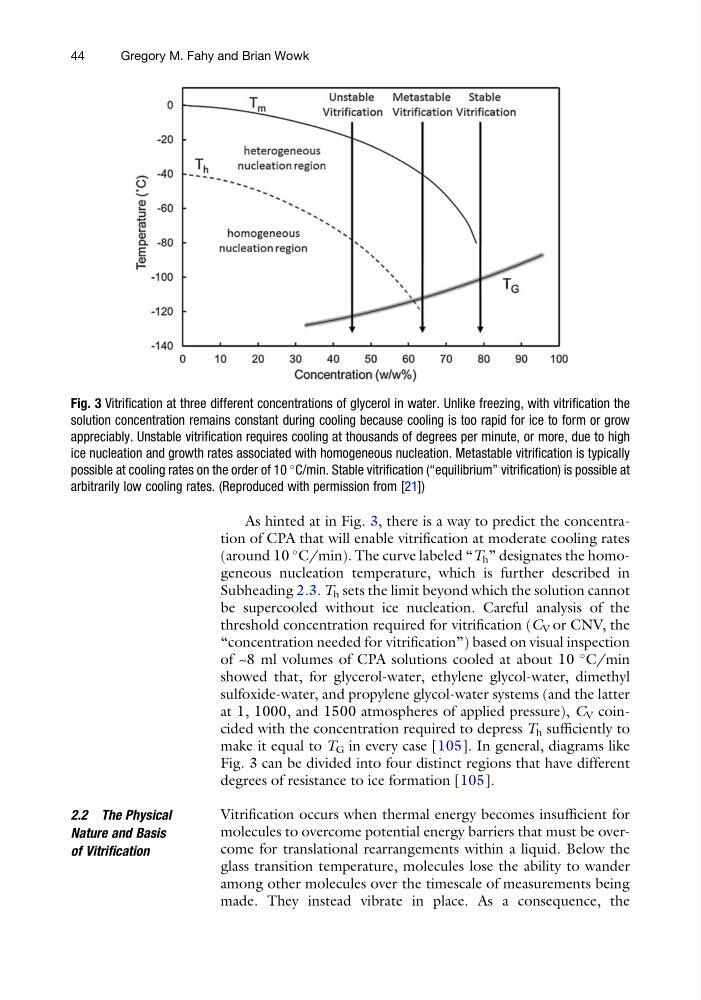
As hinted at in Fig. 3, there is a way to predict the concentration of CPA that will enable vitrification at moderate cooling rates
(around 10
C/min). The curve labeled “T h ” designates the homogeneous nucleation temperature, which is further described in
Subheading 2.3. T h sets the limit beyond which the solution cannot
be supercooled without ice nucleation. Careful analysis of the
threshold concentration required for vitrification (C V or CNV, the
“concentration needed for vitrification”) based on visual inspection
of ~8 ml volumes of CPA solutions cooled at about 10
C/min
showed that, for glycerol-water, ethylene glycol-water, dimethyl
sulfoxide-water, and propylene glycol-water systems (and the latter
at 1, 1000, and 1500 atmospheres of applied pressure), C V coincided with the concentration required to depress T h sufficiently to
make it equal to T G in every case [105]. In general, diagrams like
Fig. 3 can be divided into four distinct regions that have different
degrees of resistance to ice formation [105].
2.2 The Physical
Nature and Basis
of Vitrification
Vitrification occurs when thermal energy becomes insufficient for
molecules to overcome potential energy barriers that must be overcome for translational rearrangements within a liquid. Below the
glass transition temperature, molecules lose the ability to wander
among other molecules over the timescale of measurements being
made. They instead vibrate in place. As a consequence, the
Fig. 3 Vitrification at three different concentrations of glycerol in water. Unlike freezing, with vitrification the
solution concentration remains constant during cooling because cooling is too rapid for ice to form or grow
appreciably. Unstable vitrification requires cooling at thousands of degrees per minute, or more, due to high
ice nucleation and growth rates associated with homogeneous nucleation. Metastable vitrification is typically
possible at cooling rates on the order of 10
C/min. Stable vitrification (“equilibrium” vitrification) is possible at
arbitrarily low cooling rates. (Reproduced with permission from [21])
44
Gregory M. Fahy and Brian Wowk
(around 10
C/min). The curve labeled “T h ” designates the homogeneous nucleation temperature, which is further described in
Subheading 2.3. T h sets the limit beyond which the solution cannot
be supercooled without ice nucleation. Careful analysis of the
threshold concentration required for vitrification (C V or CNV, the
“concentration needed for vitrification”) based on visual inspection
of ~8 ml volumes of CPA solutions cooled at about 10
C/min
showed that, for glycerol-water, ethylene glycol-water, dimethyl
sulfoxide-water, and propylene glycol-water systems (and the latter
at 1, 1000, and 1500 atmospheres of applied pressure), C V coincided with the concentration required to depress T h sufficiently to
make it equal to T G in every case [105]. In general, diagrams like
Fig. 3 can be divided into four distinct regions that have different
degrees of resistance to ice formation [105].
2.2 The Physical
Nature and Basis
of Vitrification
Vitrification occurs when thermal energy becomes insufficient for
molecules to overcome potential energy barriers that must be overcome for translational rearrangements within a liquid. Below the
glass transition temperature, molecules lose the ability to wander
among other molecules over the timescale of measurements being
made. They instead vibrate in place. As a consequence, the
Fig. 3 Vitrification at three different concentrations of glycerol in water. Unlike freezing, with vitrification the
solution concentration remains constant during cooling because cooling is too rapid for ice to form or grow
appreciably. Unstable vitrification requires cooling at thousands of degrees per minute, or more, due to high
ice nucleation and growth rates associated with homogeneous nucleation. Metastable vitrification is typically
possible at cooling rates on the order of 10
C/min. Stable vitrification (“equilibrium” vitrification) is possible at
arbitrarily low cooling rates. (Reproduced with permission from [21])
44
Gregory M. Fahy and Brian Wowk