

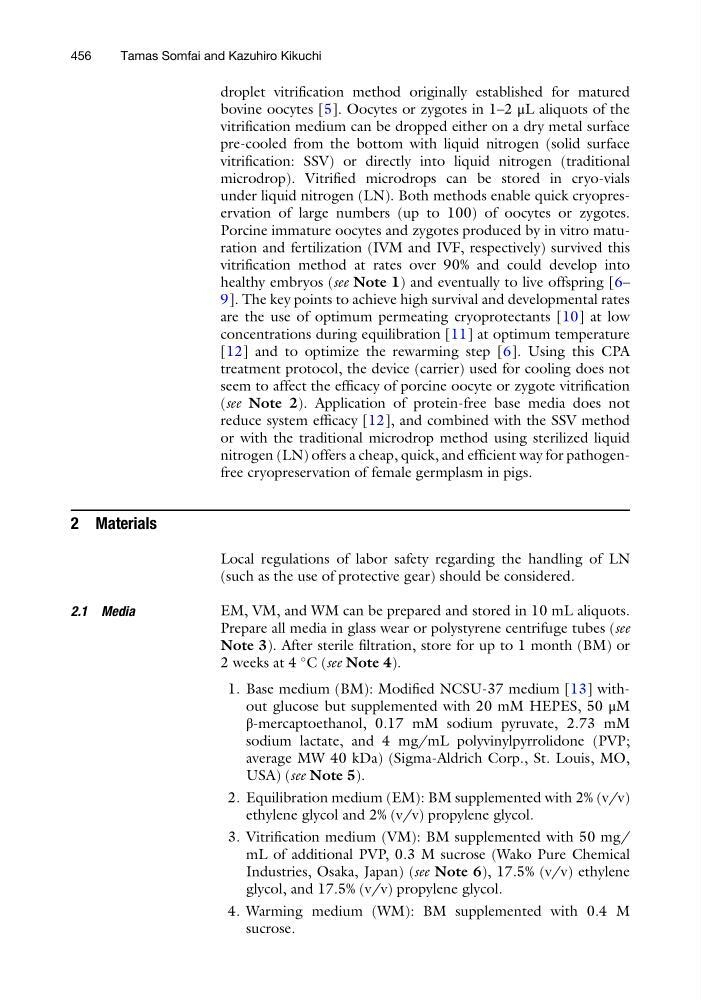
droplet vitrification method originally established for matured
bovine oocytes [5]. Oocytes or zygotes in 1–2 μL aliquots of the
vitrification medium can be dropped either on a dry metal surface
pre-cooled from the bottom with liquid nitrogen (solid surface
vitrification: SSV) or directly into liquid nitrogen (traditional
microdrop). Vitrified microdrops can be stored in cryo-vials
under liquid nitrogen (LN). Both methods enable quick cryopreservation of large numbers (up to 100) of oocytes or zygotes.
Porcine immature oocytes and zygotes produced by in vitro maturation and fertilization (IVM and IVF, respectively) survived this
vitrification method at rates over 90% and could develop into
healthy embryos (see Note 1) and eventually to live offspring [6–
9]. The key points to achieve high survival and developmental rates
are the use of optimum permeating cryoprotectants [10] at low
concentrations during equilibration [11] at optimum temperature
[12] and to optimize the rewarming step [6]. Using this CPA
treatment protocol, the device (carrier) used for cooling does not
seem to affect the efficacy of porcine oocyte or zygote vitrification
(see Note 2). Application of protein-free base media does not
reduce system efficacy [12], and combined with the SSV method
or with the traditional microdrop method using sterilized liquid
nitrogen (LN) offers a cheap, quick, and efficient way for pathogenfree cryopreservation of female germplasm in pigs.
2 Materials
Local regulations of labor safety regarding the handling of LN
(such as the use of protective gear) should be considered.
2.1 Media
EM, VM, and WM can be prepared and stored in 10 mL aliquots.
Prepare all media in glass wear or polystyrene centrifuge tubes (see
Note 3). After sterile filtration, store for up to 1 month (BM) or
2 weeks at 4
C (see Note 4).
1. Base medium (BM): Modified NCSU-37 medium [13] without glucose but supplemented with 20 mM HEPES, 50 μM
β-mercaptoethanol, 0.17 mM sodium pyruvate, 2.73 mM
sodium lactate, and 4 mg/mL polyvinylpyrrolidone (PVP;
average MW 40 kDa) (Sigma-Aldrich Corp., St. Louis, MO,
USA) (see Note 5).
2. Equilibration medium (EM): BM supplemented with 2% (v/v)
ethylene glycol and 2% (v/v) propylene glycol.
3. Vitrification medium (VM): BM supplemented with 50 mg/
mL of additional PVP, 0.3 M sucrose (Wako Pure Chemical
Industries, Osaka, Japan) (see Note 6), 17.5% (v/v) ethylene
glycol, and 17.5% (v/v) propylene glycol.
4. Warming medium (WM): BM supplemented with 0.4 M
sucrose.
456
Tamas Somfai and Kazuhiro Kikuchi
bovine oocytes [5]. Oocytes or zygotes in 1–2 μL aliquots of the
vitrification medium can be dropped either on a dry metal surface
pre-cooled from the bottom with liquid nitrogen (solid surface
vitrification: SSV) or directly into liquid nitrogen (traditional
microdrop). Vitrified microdrops can be stored in cryo-vials
under liquid nitrogen (LN). Both methods enable quick cryopreservation of large numbers (up to 100) of oocytes or zygotes.
Porcine immature oocytes and zygotes produced by in vitro maturation and fertilization (IVM and IVF, respectively) survived this
vitrification method at rates over 90% and could develop into
healthy embryos (see Note 1) and eventually to live offspring [6–
9]. The key points to achieve high survival and developmental rates
are the use of optimum permeating cryoprotectants [10] at low
concentrations during equilibration [11] at optimum temperature
[12] and to optimize the rewarming step [6]. Using this CPA
treatment protocol, the device (carrier) used for cooling does not
seem to affect the efficacy of porcine oocyte or zygote vitrification
(see Note 2). Application of protein-free base media does not
reduce system efficacy [12], and combined with the SSV method
or with the traditional microdrop method using sterilized liquid
nitrogen (LN) offers a cheap, quick, and efficient way for pathogenfree cryopreservation of female germplasm in pigs.
2 Materials
Local regulations of labor safety regarding the handling of LN
(such as the use of protective gear) should be considered.
2.1 Media
EM, VM, and WM can be prepared and stored in 10 mL aliquots.
Prepare all media in glass wear or polystyrene centrifuge tubes (see
Note 3). After sterile filtration, store for up to 1 month (BM) or
2 weeks at 4
C (see Note 4).
1. Base medium (BM): Modified NCSU-37 medium [13] without glucose but supplemented with 20 mM HEPES, 50 μM
β-mercaptoethanol, 0.17 mM sodium pyruvate, 2.73 mM
sodium lactate, and 4 mg/mL polyvinylpyrrolidone (PVP;
average MW 40 kDa) (Sigma-Aldrich Corp., St. Louis, MO,
USA) (see Note 5).
2. Equilibration medium (EM): BM supplemented with 2% (v/v)
ethylene glycol and 2% (v/v) propylene glycol.
3. Vitrification medium (VM): BM supplemented with 50 mg/
mL of additional PVP, 0.3 M sucrose (Wako Pure Chemical
Industries, Osaka, Japan) (see Note 6), 17.5% (v/v) ethylene
glycol, and 17.5% (v/v) propylene glycol.
4. Warming medium (WM): BM supplemented with 0.4 M
sucrose.
456
Tamas Somfai and Kazuhiro Kikuchi