

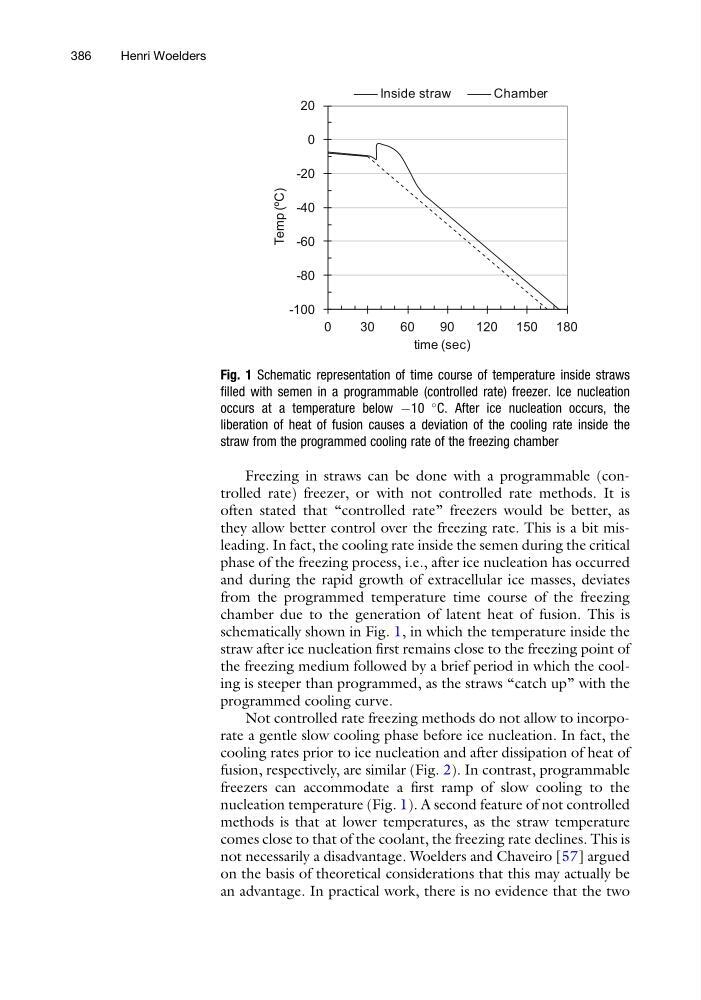
Freezing in straws can be done with a programmable (controlled rate) freezer, or with not controlled rate methods. It is
often stated that “controlled rate” freezers would be better, as
they allow better control over the freezing rate. This is a bit misleading. In fact, the cooling rate inside the semen during the critical
phase of the freezing process, i.e., after ice nucleation has occurred
and during the rapid growth of extracellular ice masses, deviates
from the programmed temperature time course of the freezing
chamber due to the generation of latent heat of fusion. This is
schematically shown in Fig. 1, in which the temperature inside the
straw after ice nucleation first remains close to the freezing point of
the freezing medium followed by a brief period in which the cooling is steeper than programmed, as the straws “catch up” with the
programmed cooling curve.
Not controlled rate freezing methods do not allow to incorporate a gentle slow cooling phase before ice nucleation. In fact, the
cooling rates prior to ice nucleation and after dissipation of heat of
fusion, respectively, are similar (Fig. 2). In contrast, programmable
freezers can accommodate a first ramp of slow cooling to the
nucleation temperature (Fig. 1). A second feature of not controlled
methods is that at lower temperatures, as the straw temperature
comes close to that of the coolant, the freezing rate declines. This is
not necessarily a disadvantage. Woelders and Chaveiro [57] argued
on the basis of theoretical considerations that this may actually be
an advantage. In practical work, there is no evidence that the two
-100
-80
-60
-40
-20
0
20
0
30
60
90
120 150 180
Temp (ºC)
time (sec)
Inside straw
Chamber
Fig. 1 Schematic representation of time course of temperature inside straws
filled with semen in a programmable (controlled rate) freezer. Ice nucleation
occurs at a temperature below À10
C. After ice nucleation occurs, the
liberation of heat of fusion causes a deviation of the cooling rate inside the
straw from the programmed cooling rate of the freezing chamber
386
Henri Woelders
often stated that “controlled rate” freezers would be better, as
they allow better control over the freezing rate. This is a bit misleading. In fact, the cooling rate inside the semen during the critical
phase of the freezing process, i.e., after ice nucleation has occurred
and during the rapid growth of extracellular ice masses, deviates
from the programmed temperature time course of the freezing
chamber due to the generation of latent heat of fusion. This is
schematically shown in Fig. 1, in which the temperature inside the
straw after ice nucleation first remains close to the freezing point of
the freezing medium followed by a brief period in which the cooling is steeper than programmed, as the straws “catch up” with the
programmed cooling curve.
Not controlled rate freezing methods do not allow to incorporate a gentle slow cooling phase before ice nucleation. In fact, the
cooling rates prior to ice nucleation and after dissipation of heat of
fusion, respectively, are similar (Fig. 2). In contrast, programmable
freezers can accommodate a first ramp of slow cooling to the
nucleation temperature (Fig. 1). A second feature of not controlled
methods is that at lower temperatures, as the straw temperature
comes close to that of the coolant, the freezing rate declines. This is
not necessarily a disadvantage. Woelders and Chaveiro [57] argued
on the basis of theoretical considerations that this may actually be
an advantage. In practical work, there is no evidence that the two
-100
-80
-60
-40
-20
0
20
0
30
60
90
120 150 180
Temp (ºC)
time (sec)
Inside straw
Chamber
Fig. 1 Schematic representation of time course of temperature inside straws
filled with semen in a programmable (controlled rate) freezer. Ice nucleation
occurs at a temperature below À10
C. After ice nucleation occurs, the
liberation of heat of fusion causes a deviation of the cooling rate inside the
straw from the programmed cooling rate of the freezing chamber
386
Henri Woelders