

dependent on the water content. The function of many
non-permeating CPAs is to increase T g so that samples reach the
glassy state at higher subzero temperatures. The T g
0 and T g of
sugars, proteins (e.g., albumin), synthetic polymers (e.g., Polyvinylpyrrolidone or PVP, Ficoll), and polysaccharides (e.g.,
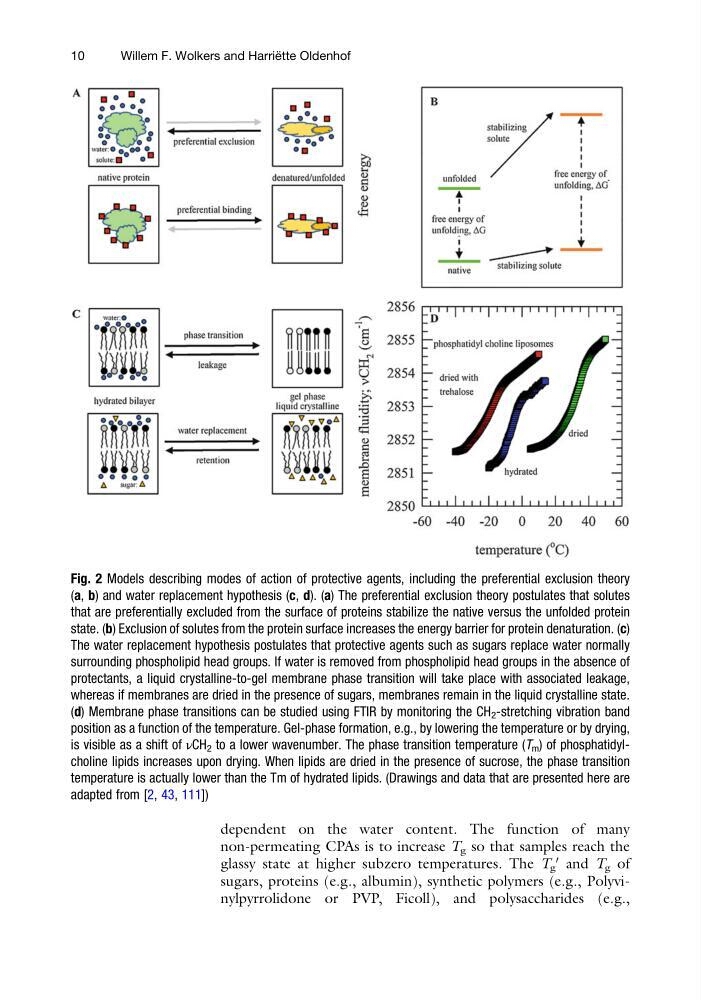
Fig. 2 Models describing modes of action of protective agents, including the preferential exclusion theory
(a, b) and water replacement hypothesis (c, d). (a) The preferential exclusion theory postulates that solutes
that are preferentially excluded from the surface of proteins stabilize the native versus the unfolded protein
state. (b) Exclusion of solutes from the protein surface increases the energy barrier for protein denaturation. (c)
The water replacement hypothesis postulates that protective agents such as sugars replace water normally
surrounding phospholipid head groups. If water is removed from phospholipid head groups in the absence of
protectants, a liquid crystalline-to-gel membrane phase transition will take place with associated leakage,
whereas if membranes are dried in the presence of sugars, membranes remain in the liquid crystalline state.
(d) Membrane phase transitions can be studied using FTIR by monitoring the CH 2 -stretching vibration band
position as a function of the temperature. Gel-phase formation, e.g., by lowering the temperature or by drying,
is visible as a shift of νCH 2 to a lower wavenumber. The phase transition temperature (T m ) of phosphatidylcholine lipids increases upon drying. When lipids are dried in the presence of sucrose, the phase transition
temperature is actually lower than the Tm of hydrated lipids. (Drawings and data that are presented here are
adapted from [2, 43, 111])
10
Willem F. Wolkers and Harrie ¨ tte Oldenhof
non-permeating CPAs is to increase T g so that samples reach the
glassy state at higher subzero temperatures. The T g
0 and T g of
sugars, proteins (e.g., albumin), synthetic polymers (e.g., Polyvinylpyrrolidone or PVP, Ficoll), and polysaccharides (e.g.,
Fig. 2 Models describing modes of action of protective agents, including the preferential exclusion theory
(a, b) and water replacement hypothesis (c, d). (a) The preferential exclusion theory postulates that solutes
that are preferentially excluded from the surface of proteins stabilize the native versus the unfolded protein
state. (b) Exclusion of solutes from the protein surface increases the energy barrier for protein denaturation. (c)
The water replacement hypothesis postulates that protective agents such as sugars replace water normally
surrounding phospholipid head groups. If water is removed from phospholipid head groups in the absence of
protectants, a liquid crystalline-to-gel membrane phase transition will take place with associated leakage,
whereas if membranes are dried in the presence of sugars, membranes remain in the liquid crystalline state.
(d) Membrane phase transitions can be studied using FTIR by monitoring the CH 2 -stretching vibration band
position as a function of the temperature. Gel-phase formation, e.g., by lowering the temperature or by drying,
is visible as a shift of νCH 2 to a lower wavenumber. The phase transition temperature (T m ) of phosphatidylcholine lipids increases upon drying. When lipids are dried in the presence of sucrose, the phase transition
temperature is actually lower than the Tm of hydrated lipids. (Drawings and data that are presented here are
adapted from [2, 43, 111])
10
Willem F. Wolkers and Harrie ¨ tte Oldenhof