

1.4.4 Raman
Spectroscopy
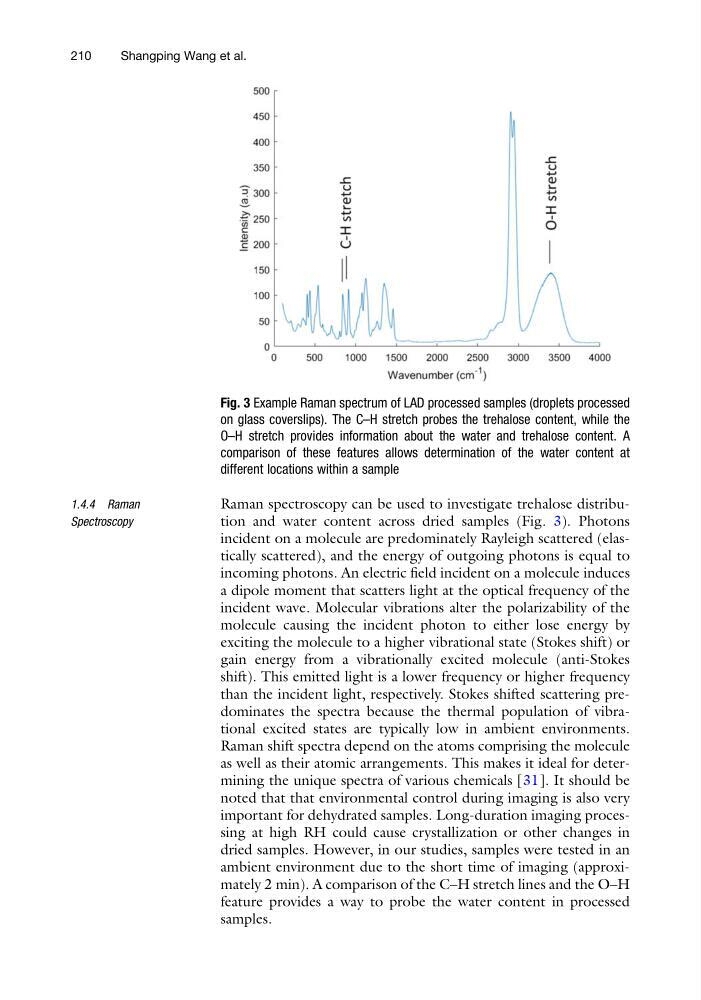
Raman spectroscopy can be used to investigate trehalose distribution and water content across dried samples (Fig. 3). Photons
incident on a molecule are predominately Rayleigh scattered (elastically scattered), and the energy of outgoing photons is equal to
incoming photons. An electric field incident on a molecule induces
a dipole moment that scatters light at the optical frequency of the
incident wave. Molecular vibrations alter the polarizability of the
molecule causing the incident photon to either lose energy by
exciting the molecule to a higher vibrational state (Stokes shift) or
gain energy from a vibrationally excited molecule (anti-Stokes
shift). This emitted light is a lower frequency or higher frequency
than the incident light, respectively. Stokes shifted scattering predominates the spectra because the thermal population of vibrational excited states are typically low in ambient environments.
Raman shift spectra depend on the atoms comprising the molecule
as well as their atomic arrangements. This makes it ideal for determining the unique spectra of various chemicals [31]. It should be
noted that that environmental control during imaging is also very
important for dehydrated samples. Long-duration imaging processing at high RH could cause crystallization or other changes in
dried samples. However, in our studies, samples were tested in an
ambient environment due to the short time of imaging (approximately 2 min). A comparison of the C–H stretch lines and the O–H
feature provides a way to probe the water content in processed
samples.
Fig. 3 Example Raman spectrum of LAD processed samples (droplets processed
on glass coverslips). The C–H stretch probes the trehalose content, while the
O–H stretch provides information about the water and trehalose content. A
comparison of these features allows determination of the water content at
different locations within a sample
210
Shangping Wang et al.
Spectroscopy
Raman spectroscopy can be used to investigate trehalose distribution and water content across dried samples (Fig. 3). Photons
incident on a molecule are predominately Rayleigh scattered (elastically scattered), and the energy of outgoing photons is equal to
incoming photons. An electric field incident on a molecule induces
a dipole moment that scatters light at the optical frequency of the
incident wave. Molecular vibrations alter the polarizability of the
molecule causing the incident photon to either lose energy by
exciting the molecule to a higher vibrational state (Stokes shift) or
gain energy from a vibrationally excited molecule (anti-Stokes
shift). This emitted light is a lower frequency or higher frequency
than the incident light, respectively. Stokes shifted scattering predominates the spectra because the thermal population of vibrational excited states are typically low in ambient environments.
Raman shift spectra depend on the atoms comprising the molecule
as well as their atomic arrangements. This makes it ideal for determining the unique spectra of various chemicals [31]. It should be
noted that that environmental control during imaging is also very
important for dehydrated samples. Long-duration imaging processing at high RH could cause crystallization or other changes in
dried samples. However, in our studies, samples were tested in an
ambient environment due to the short time of imaging (approximately 2 min). A comparison of the C–H stretch lines and the O–H
feature provides a way to probe the water content in processed
samples.
Fig. 3 Example Raman spectrum of LAD processed samples (droplets processed
on glass coverslips). The C–H stretch probes the trehalose content, while the
O–H stretch provides information about the water and trehalose content. A
comparison of these features allows determination of the water content at
different locations within a sample
210
Shangping Wang et al.