

initial concentration of protective agents increases the osmotic
strength of solutions, which may put constraints on the sample
preparation steps prior to drying. The balance between fast drying
time and acceptable osmosis stress should thus be considered for
any given application.
In our studies involving the drying of oocytes and sperm,
trehalose, which is typically membrane impermeable, was introduced into cells by pore formation using α-hemolysin in order to
ensure formation of a glassy state on both sides of the cell membrane. In both cell types, the goal was to preserve the genome for
assisted reproduction techniques, and thus an irreversibly porated
membrane did not compromise the ultimate desired outcome.
When loading trehalose into cells for which the membrane integrity
is critical for functionality, other reversible methods of loading
trehalose into cell should be considered, including a combination
of a genetically engineered mutant of a pore protein (e.g., Staphylococcus aureus α-hemolysin) to create pores and extracellular Zn
2+ to
close the pores [11–13], genetic expression of trehalose synthase
genes [14, 15], thermotropic phase transition [16, 17], microinjection [18], activation of native channels [19], or
endocytosis [20].
1.2
Microwave-Assisted
Drying
Microwaves are electromagnetic waves that have operating frequencies anywhere from 0.3 to 300 GHz [21]. Microwave-induced
dipole rotations at the molecular level can rapidly dehydrate samples containing polarized molecules like water. When these radiofrequency waves are absorbed by water, they are converted directly
into heat. If the microwave exposure is such that the temperature of
the system escalates above certain limits, biological degradation will
certainly occur. For this reason, the heating effect of microwave
exposure needs to be closely controlled while processing cells and
cellular materials. If this energy delivery is modulated to provide a
modest amount of energy to facilitate the movement of water to the
surface of the sample without allowing thermal excursions above
acceptable limits, sample drying can be enhanced without detriment to biological materials. Therefore, modulating microwave
energy delivery to minimize the heating effect is essential for dehydration success.
Power modulation is usually constructed as the initial step for
determination of an optimal drying process. The sample warms
faster as the power level is increased, which can influence the drying
rate and the temperature of samples. Measurement of the power
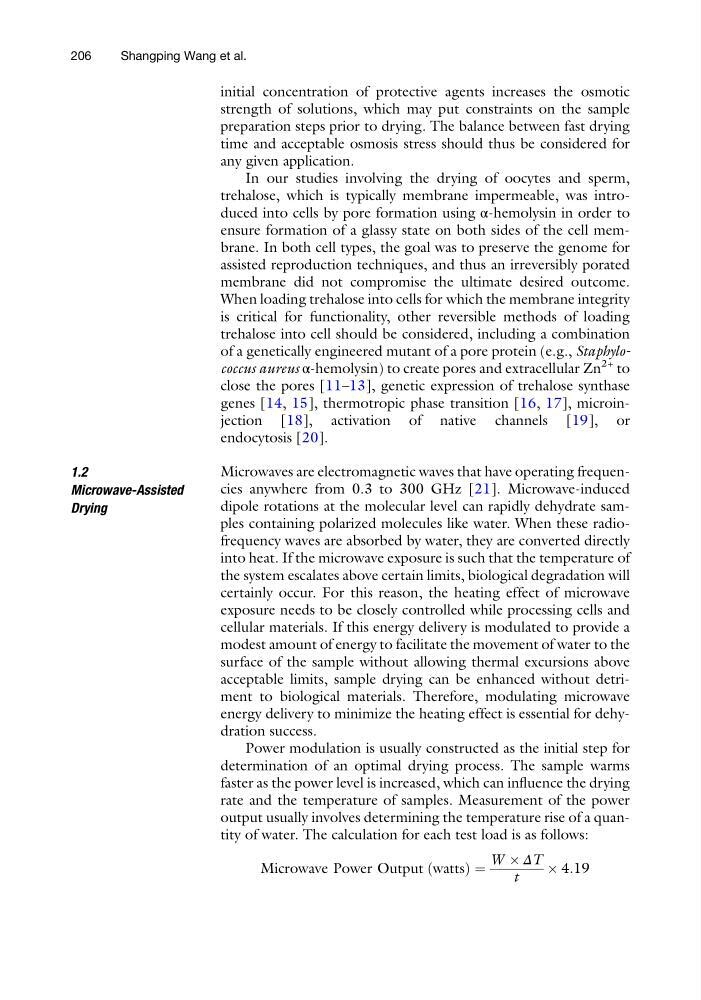
output usually involves determining the temperature rise of a quantity of water. The calculation for each test load is as follows:
Microwave Power Output watts
ð
Þ¼
W Â ΔT
t
 4:19
206
Shangping Wang et al.
strength of solutions, which may put constraints on the sample
preparation steps prior to drying. The balance between fast drying
time and acceptable osmosis stress should thus be considered for
any given application.
In our studies involving the drying of oocytes and sperm,
trehalose, which is typically membrane impermeable, was introduced into cells by pore formation using α-hemolysin in order to
ensure formation of a glassy state on both sides of the cell membrane. In both cell types, the goal was to preserve the genome for
assisted reproduction techniques, and thus an irreversibly porated
membrane did not compromise the ultimate desired outcome.
When loading trehalose into cells for which the membrane integrity
is critical for functionality, other reversible methods of loading
trehalose into cell should be considered, including a combination
of a genetically engineered mutant of a pore protein (e.g., Staphylococcus aureus α-hemolysin) to create pores and extracellular Zn
2+ to
close the pores [11–13], genetic expression of trehalose synthase
genes [14, 15], thermotropic phase transition [16, 17], microinjection [18], activation of native channels [19], or
endocytosis [20].
1.2
Microwave-Assisted
Drying
Microwaves are electromagnetic waves that have operating frequencies anywhere from 0.3 to 300 GHz [21]. Microwave-induced
dipole rotations at the molecular level can rapidly dehydrate samples containing polarized molecules like water. When these radiofrequency waves are absorbed by water, they are converted directly
into heat. If the microwave exposure is such that the temperature of
the system escalates above certain limits, biological degradation will
certainly occur. For this reason, the heating effect of microwave
exposure needs to be closely controlled while processing cells and
cellular materials. If this energy delivery is modulated to provide a
modest amount of energy to facilitate the movement of water to the
surface of the sample without allowing thermal excursions above
acceptable limits, sample drying can be enhanced without detriment to biological materials. Therefore, modulating microwave
energy delivery to minimize the heating effect is essential for dehydration success.
Power modulation is usually constructed as the initial step for
determination of an optimal drying process. The sample warms
faster as the power level is increased, which can influence the drying
rate and the temperature of samples. Measurement of the power
output usually involves determining the temperature rise of a quantity of water. The calculation for each test load is as follows:
Microwave Power Output watts
ð
Þ¼
W Â ΔT
t
 4:19
206
Shangping Wang et al.