

2 Methods for Preservation of Cells and Tissues
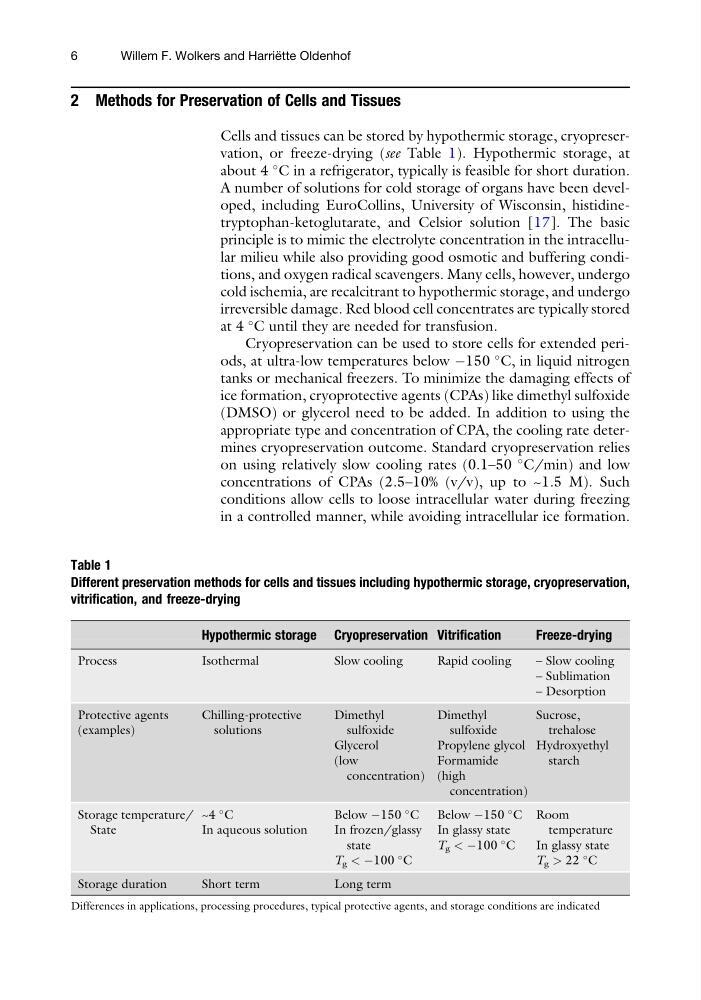
Cells and tissues can be stored by hypothermic storage, cryopreservation, or freeze-drying (see Table 1). Hypothermic storage, at
about 4
C in a refrigerator, typically is feasible for short duration.
A number of solutions for cold storage of organs have been developed, including EuroCollins, University of Wisconsin, histidinetryptophan-ketoglutarate, and Celsior solution [17]. The basic
principle is to mimic the electrolyte concentration in the intracellular milieu while also providing good osmotic and buffering conditions, and oxygen radical scavengers. Many cells, however, undergo
cold ischemia, are recalcitrant to hypothermic storage, and undergo
irreversible damage. Red blood cell concentrates are typically stored
at 4
C until they are needed for transfusion.
Cryopreservation can be used to store cells for extended periods, at ultra-low temperatures below À150
C, in liquid nitrogen
tanks or mechanical freezers. To minimize the damaging effects of
ice formation, cryoprotective agents (CPAs) like dimethyl sulfoxide
(DMSO) or glycerol need to be added. In addition to using the
appropriate type and concentration of CPA, the cooling rate determines cryopreservation outcome. Standard cryopreservation relies
on using relatively slow cooling rates (0.1–50
C/min) and low
concentrations of CPAs (2.5–10% (v/v), up to ~1.5 M). Such
conditions allow cells to loose intracellular water during freezing
in a controlled manner, while avoiding intracellular ice formation.
Table 1
Different preservation methods for cells and tissues including hypothermic storage, cryopreservation,
vitrification, and freeze-drying
Hypothermic storage Cryopreservation Vitrification
Freeze-drying
Process
Isothermal
Slow cooling
Rapid cooling
– Slow cooling
– Sublimation
– Desorption
Protective agents
(examples)
Chilling-protective
solutions
Dimethyl
sulfoxide
Glycerol
(low
concentration)
Dimethyl
sulfoxide
Propylene glycol
Formamide
(high
concentration)
Sucrose,
trehalose
Hydroxyethyl
starch
Storage temperature/
State
~4
C
In aqueous solution
Below À150
C
In frozen/glassy
state
T g < À100
C
Below À150
C
In glassy state
T g < À100
C
Room
temperature
In glassy state
T g > 22
C
Storage duration
Short term
Long term
Differences in applications, processing procedures, typical protective agents, and storage conditions are indicated
6
Willem F. Wolkers and Harrie ¨ tte Oldenhof
Cells and tissues can be stored by hypothermic storage, cryopreservation, or freeze-drying (see Table 1). Hypothermic storage, at
about 4
C in a refrigerator, typically is feasible for short duration.
A number of solutions for cold storage of organs have been developed, including EuroCollins, University of Wisconsin, histidinetryptophan-ketoglutarate, and Celsior solution [17]. The basic
principle is to mimic the electrolyte concentration in the intracellular milieu while also providing good osmotic and buffering conditions, and oxygen radical scavengers. Many cells, however, undergo
cold ischemia, are recalcitrant to hypothermic storage, and undergo
irreversible damage. Red blood cell concentrates are typically stored
at 4
C until they are needed for transfusion.
Cryopreservation can be used to store cells for extended periods, at ultra-low temperatures below À150
C, in liquid nitrogen
tanks or mechanical freezers. To minimize the damaging effects of
ice formation, cryoprotective agents (CPAs) like dimethyl sulfoxide
(DMSO) or glycerol need to be added. In addition to using the
appropriate type and concentration of CPA, the cooling rate determines cryopreservation outcome. Standard cryopreservation relies
on using relatively slow cooling rates (0.1–50
C/min) and low
concentrations of CPAs (2.5–10% (v/v), up to ~1.5 M). Such
conditions allow cells to loose intracellular water during freezing
in a controlled manner, while avoiding intracellular ice formation.
Table 1
Different preservation methods for cells and tissues including hypothermic storage, cryopreservation,
vitrification, and freeze-drying
Hypothermic storage Cryopreservation Vitrification
Freeze-drying
Process
Isothermal
Slow cooling
Rapid cooling
– Slow cooling
– Sublimation
– Desorption
Protective agents
(examples)
Chilling-protective
solutions
Dimethyl
sulfoxide
Glycerol
(low
concentration)
Dimethyl
sulfoxide
Propylene glycol
Formamide
(high
concentration)
Sucrose,
trehalose
Hydroxyethyl
starch
Storage temperature/
State
~4
C
In aqueous solution
Below À150
C
In frozen/glassy
state
T g < À100
C
Below À150
C
In glassy state
T g < À100
C
Room
temperature
In glassy state
T g > 22
C
Storage duration
Short term
Long term
Differences in applications, processing procedures, typical protective agents, and storage conditions are indicated
6
Willem F. Wolkers and Harrie ¨ tte Oldenhof