

for the cryopreservation of generic immortalized and cryo-resistant
cell lines. Starting in the 1970s, the need for accurately controlled
and variable cooling rates led to the development of controlled-rate
freezers (CRF) [1–3]. The first of these systems used heaters and
liquid nitrogen (LN 2 ) to control cooling rates that could be
adjusted for different cell lines. More recently, systems that avoid
the need for LN 2 have become more common [4].
A suitable storage temperature for cryopreserved (but not
dried), biological samples must be below the glass transition temperature of the extracellular solution (~À120
C for DMSO-based
cryoprotectants), to prevent time-sensitive cellular degradation [5–
9]. When cryopreservation emerged as a discipline in its own right
(in the early 1950s), eukaryotic samples were routinely stored in
dry ice containers (~À78
C), significantly limiting viable storage
time. In modern times secure long-term storage is in either liquid
nitrogen or the vapor phase immediately above it. Mechanical,
ultra-low freezers (~À150
C) are also widely used.
The final step in a cold chain before therapeutic or research use
is thawing which is, typically, the least-controlled part of the process. Viability and performance can be lost here as easily as in any
other phase of the cryopreservation process. The most commonly
used thawing procedure is direct immersion of the frozen sample
container in a warmed water bath (37
C), which produces rapid
thawing. Dry thawing systems have also been developed in
response to constraints imposed by current cleanroom procedures
and clinical practice [10–12].
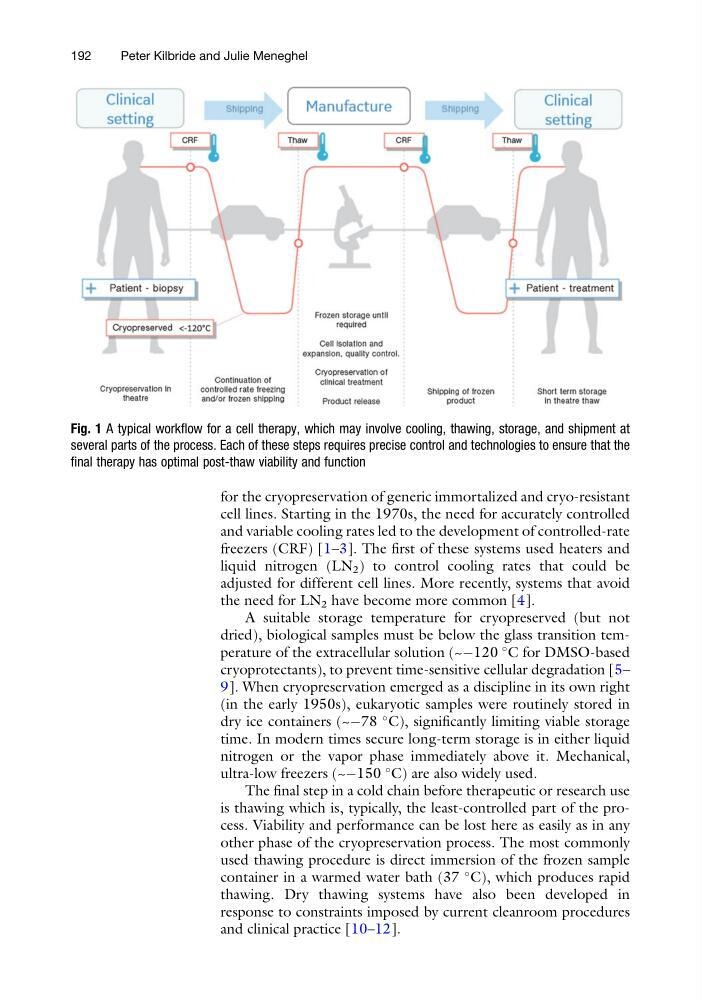
Fig. 1 A typical workflow for a cell therapy, which may involve cooling, thawing, storage, and shipment at
several parts of the process. Each of these steps requires precise control and technologies to ensure that the
final therapy has optimal post-thaw viability and function
192
Peter Kilbride and Julie Meneghel
cell lines. Starting in the 1970s, the need for accurately controlled
and variable cooling rates led to the development of controlled-rate
freezers (CRF) [1–3]. The first of these systems used heaters and
liquid nitrogen (LN 2 ) to control cooling rates that could be
adjusted for different cell lines. More recently, systems that avoid
the need for LN 2 have become more common [4].
A suitable storage temperature for cryopreserved (but not
dried), biological samples must be below the glass transition temperature of the extracellular solution (~À120
C for DMSO-based
cryoprotectants), to prevent time-sensitive cellular degradation [5–
9]. When cryopreservation emerged as a discipline in its own right
(in the early 1950s), eukaryotic samples were routinely stored in
dry ice containers (~À78
C), significantly limiting viable storage
time. In modern times secure long-term storage is in either liquid
nitrogen or the vapor phase immediately above it. Mechanical,
ultra-low freezers (~À150
C) are also widely used.
The final step in a cold chain before therapeutic or research use
is thawing which is, typically, the least-controlled part of the process. Viability and performance can be lost here as easily as in any
other phase of the cryopreservation process. The most commonly
used thawing procedure is direct immersion of the frozen sample
container in a warmed water bath (37
C), which produces rapid
thawing. Dry thawing systems have also been developed in
response to constraints imposed by current cleanroom procedures
and clinical practice [10–12].
Fig. 1 A typical workflow for a cell therapy, which may involve cooling, thawing, storage, and shipment at
several parts of the process. Each of these steps requires precise control and technologies to ensure that the
final therapy has optimal post-thaw viability and function
192
Peter Kilbride and Julie Meneghel