

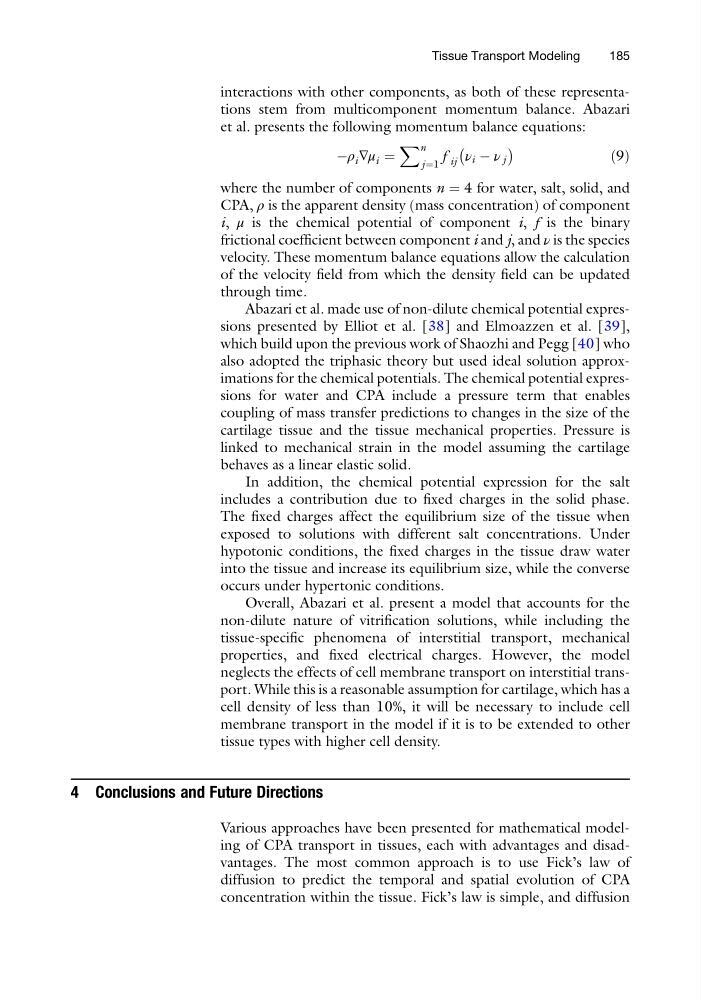
interactions with other components, as both of these representations stem from multicomponent momentum balance. Abazari
et al. presents the following momentum balance equations:
Àρ i ∇μ i ¼
X n
j ¼1
f ij ν i À ν j
À
Á
ð9Þ
where the number of components n ¼ 4 for water, salt, solid, and
CPA, ρ is the apparent density (mass concentration) of component
i, μ is the chemical potential of component i, f is the binary
frictional coefficient between component i and j, and ν is the species
velocity. These momentum balance equations allow the calculation
of the velocity field from which the density field can be updated
through time.
Abazari et al. made use of non-dilute chemical potential expressions presented by Elliot et al. [38] and Elmoazzen et al. [39],
which build upon the previous work of Shaozhi and Pegg [40] who
also adopted the triphasic theory but used ideal solution approximations for the chemical potentials. The chemical potential expressions for water and CPA include a pressure term that enables
coupling of mass transfer predictions to changes in the size of the
cartilage tissue and the tissue mechanical properties. Pressure is
linked to mechanical strain in the model assuming the cartilage
behaves as a linear elastic solid.
In addition, the chemical potential expression for the salt
includes a contribution due to fixed charges in the solid phase.
The fixed charges affect the equilibrium size of the tissue when
exposed to solutions with different salt concentrations. Under
hypotonic conditions, the fixed charges in the tissue draw water
into the tissue and increase its equilibrium size, while the converse
occurs under hypertonic conditions.
Overall, Abazari et al. present a model that accounts for the
non-dilute nature of vitrification solutions, while including the
tissue-specific phenomena of interstitial transport, mechanical
properties, and fixed electrical charges. However, the model
neglects the effects of cell membrane transport on interstitial transport. While this is a reasonable assumption for cartilage, which has a
cell density of less than 10%, it will be necessary to include cell
membrane transport in the model if it is to be extended to other
tissue types with higher cell density.
4 Conclusions and Future Directions
Various approaches have been presented for mathematical modeling of CPA transport in tissues, each with advantages and disadvantages. The most common approach is to use Fick’s law of
diffusion to predict the temporal and spatial evolution of CPA
concentration within the tissue. Fick’s law is simple, and diffusion
Tissue Transport Modeling
185
et al. presents the following momentum balance equations:
Àρ i ∇μ i ¼
X n
j ¼1
f ij ν i À ν j
À
Á
ð9Þ
where the number of components n ¼ 4 for water, salt, solid, and
CPA, ρ is the apparent density (mass concentration) of component
i, μ is the chemical potential of component i, f is the binary
frictional coefficient between component i and j, and ν is the species
velocity. These momentum balance equations allow the calculation
of the velocity field from which the density field can be updated
through time.
Abazari et al. made use of non-dilute chemical potential expressions presented by Elliot et al. [38] and Elmoazzen et al. [39],
which build upon the previous work of Shaozhi and Pegg [40] who
also adopted the triphasic theory but used ideal solution approximations for the chemical potentials. The chemical potential expressions for water and CPA include a pressure term that enables
coupling of mass transfer predictions to changes in the size of the
cartilage tissue and the tissue mechanical properties. Pressure is
linked to mechanical strain in the model assuming the cartilage
behaves as a linear elastic solid.
In addition, the chemical potential expression for the salt
includes a contribution due to fixed charges in the solid phase.
The fixed charges affect the equilibrium size of the tissue when
exposed to solutions with different salt concentrations. Under
hypotonic conditions, the fixed charges in the tissue draw water
into the tissue and increase its equilibrium size, while the converse
occurs under hypertonic conditions.
Overall, Abazari et al. present a model that accounts for the
non-dilute nature of vitrification solutions, while including the
tissue-specific phenomena of interstitial transport, mechanical
properties, and fixed electrical charges. However, the model
neglects the effects of cell membrane transport on interstitial transport. While this is a reasonable assumption for cartilage, which has a
cell density of less than 10%, it will be necessary to include cell
membrane transport in the model if it is to be extended to other
tissue types with higher cell density.
4 Conclusions and Future Directions
Various approaches have been presented for mathematical modeling of CPA transport in tissues, each with advantages and disadvantages. The most common approach is to use Fick’s law of
diffusion to predict the temporal and spatial evolution of CPA
concentration within the tissue. Fick’s law is simple, and diffusion
Tissue Transport Modeling
185