

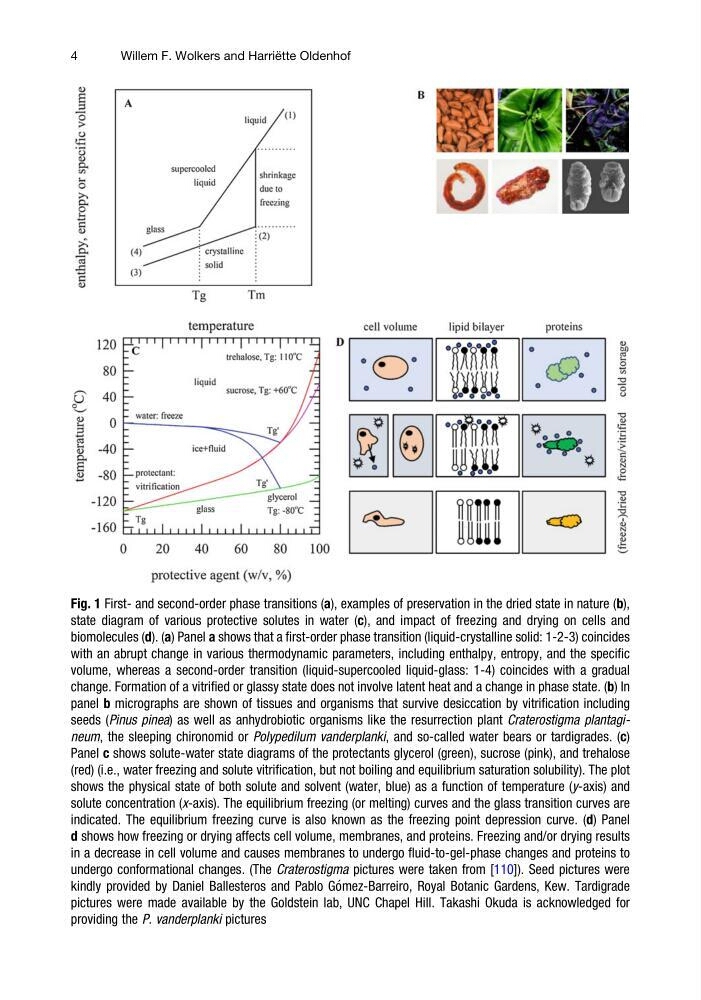
Fig. 1 First- and second-order phase transitions (a), examples of preservation in the dried state in nature (b),
state diagram of various protective solutes in water (c), and impact of freezing and drying on cells and
biomolecules (d). (a) Panel a shows that a first-order phase transition (liquid-crystalline solid: 1-2-3) coincides
with an abrupt change in various thermodynamic parameters, including enthalpy, entropy, and the specific
volume, whereas a second-order transition (liquid-supercooled liquid-glass: 1-4) coincides with a gradual
change. Formation of a vitrified or glassy state does not involve latent heat and a change in phase state. (b) In
panel b micrographs are shown of tissues and organisms that survive desiccation by vitrification including
seeds (Pinus pinea) as well as anhydrobiotic organisms like the resurrection plant Craterostigma plantagineum, the sleeping chironomid or Polypedilum vanderplanki, and so-called water bears or tardigrades. (c)
Panel c shows solute-water state diagrams of the protectants glycerol (green), sucrose (pink), and trehalose
(red) (i.e., water freezing and solute vitrification, but not boiling and equilibrium saturation solubility). The plot
shows the physical state of both solute and solvent (water, blue) as a function of temperature (y-axis) and
solute concentration (x-axis). The equilibrium freezing (or melting) curves and the glass transition curves are
indicated. The equilibrium freezing curve is also known as the freezing point depression curve. (d) Panel
d shows how freezing or drying affects cell volume, membranes, and proteins. Freezing and/or drying results
in a decrease in cell volume and causes membranes to undergo fluid-to-gel-phase changes and proteins to
undergo conformational changes. (The Craterostigma pictures were taken from [110]). Seed pictures were
kindly provided by Daniel Ballesteros and Pablo Go ´ mez-Barreiro, Royal Botanic Gardens, Kew. Tardigrade
pictures were made available by the Goldstein lab, UNC Chapel Hill. Takashi Okuda is acknowledged for
providing the P. vanderplanki pictures
4
Willem F. Wolkers and Harrie ¨ tte Oldenhof
state diagram of various protective solutes in water (c), and impact of freezing and drying on cells and
biomolecules (d). (a) Panel a shows that a first-order phase transition (liquid-crystalline solid: 1-2-3) coincides
with an abrupt change in various thermodynamic parameters, including enthalpy, entropy, and the specific
volume, whereas a second-order transition (liquid-supercooled liquid-glass: 1-4) coincides with a gradual
change. Formation of a vitrified or glassy state does not involve latent heat and a change in phase state. (b) In
panel b micrographs are shown of tissues and organisms that survive desiccation by vitrification including
seeds (Pinus pinea) as well as anhydrobiotic organisms like the resurrection plant Craterostigma plantagineum, the sleeping chironomid or Polypedilum vanderplanki, and so-called water bears or tardigrades. (c)
Panel c shows solute-water state diagrams of the protectants glycerol (green), sucrose (pink), and trehalose
(red) (i.e., water freezing and solute vitrification, but not boiling and equilibrium saturation solubility). The plot
shows the physical state of both solute and solvent (water, blue) as a function of temperature (y-axis) and
solute concentration (x-axis). The equilibrium freezing (or melting) curves and the glass transition curves are
indicated. The equilibrium freezing curve is also known as the freezing point depression curve. (d) Panel
d shows how freezing or drying affects cell volume, membranes, and proteins. Freezing and/or drying results
in a decrease in cell volume and causes membranes to undergo fluid-to-gel-phase changes and proteins to
undergo conformational changes. (The Craterostigma pictures were taken from [110]). Seed pictures were
kindly provided by Daniel Ballesteros and Pablo Go ´ mez-Barreiro, Royal Botanic Gardens, Kew. Tardigrade
pictures were made available by the Goldstein lab, UNC Chapel Hill. Takashi Okuda is acknowledged for
providing the P. vanderplanki pictures
4
Willem F. Wolkers and Harrie ¨ tte Oldenhof