

enough to avoid intracellular ice formation. In particular, injury
due to slow cooling is the accumulation of the so-called deleterious
solution effects. The premise is that even at subzero temperatures,
exposures to extremely high concentrations of solutes causes irreparable damage to cells. This damage mechanism provides a first rule
for cooling rate optimization:
Cool as quickly as possible to avoid solution effects injury.
Unfortunately, under too-fast cooling protocols, the intracellular
water may not exit fast enough and the intracellular freezing point
depression will not be enough to prevent intracellular ice formation. Therefore, a second rule of cooling rate optimization is:
Cool slowly enough to avoid intracellular formation.
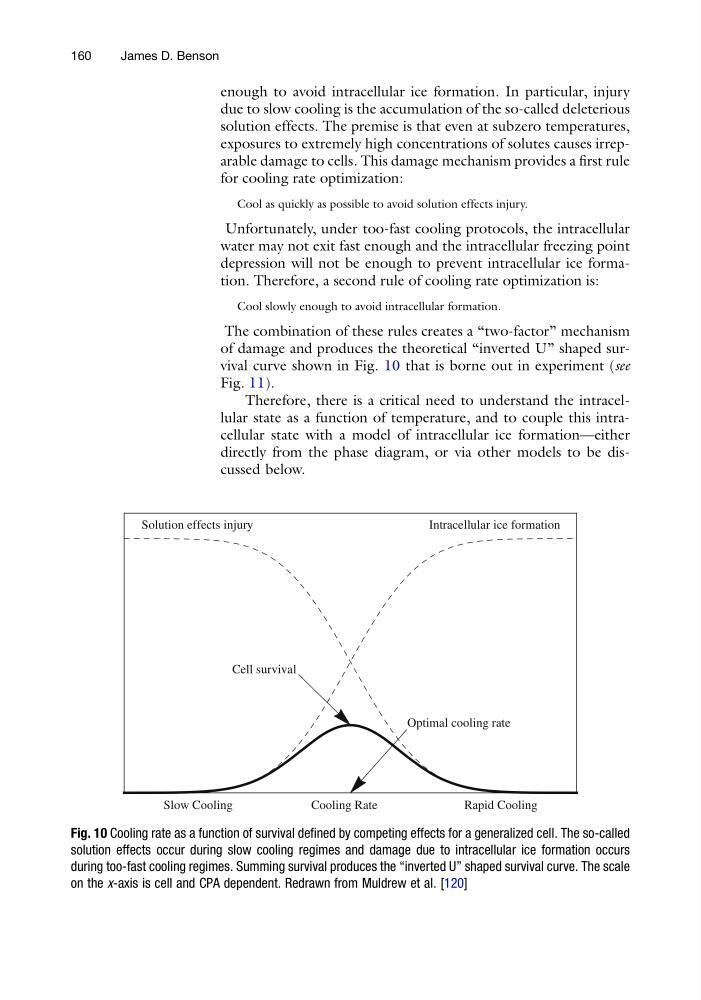
The combination of these rules creates a “two-factor” mechanism
of damage and produces the theoretical “inverted U” shaped survival curve shown in Fig. 10 that is borne out in experiment (see
Fig. 11).
Therefore, there is a critical need to understand the intracellular state as a function of temperature, and to couple this intracellular state with a model of intracellular ice formation—either
directly from the phase diagram, or via other models to be discussed below.
Solution effects injury
Intracellular ice formation
Optimal cooling rate
Cell survival
Slow Cooling
Cooling Rate
Rapid Cooling
Fig. 10 Cooling rate as a function of survival defined by competing effects for a generalized cell. The so-called
solution effects occur during slow cooling regimes and damage due to intracellular ice formation occurs
during too-fast cooling regimes. Summing survival produces the “inverted U” shaped survival curve. The scale
on the x-axis is cell and CPA dependent. Redrawn from Muldrew et al. [120]
160
James D. Benson
due to slow cooling is the accumulation of the so-called deleterious
solution effects. The premise is that even at subzero temperatures,
exposures to extremely high concentrations of solutes causes irreparable damage to cells. This damage mechanism provides a first rule
for cooling rate optimization:
Cool as quickly as possible to avoid solution effects injury.
Unfortunately, under too-fast cooling protocols, the intracellular
water may not exit fast enough and the intracellular freezing point
depression will not be enough to prevent intracellular ice formation. Therefore, a second rule of cooling rate optimization is:
Cool slowly enough to avoid intracellular formation.
The combination of these rules creates a “two-factor” mechanism
of damage and produces the theoretical “inverted U” shaped survival curve shown in Fig. 10 that is borne out in experiment (see
Fig. 11).
Therefore, there is a critical need to understand the intracellular state as a function of temperature, and to couple this intracellular state with a model of intracellular ice formation—either
directly from the phase diagram, or via other models to be discussed below.
Solution effects injury
Intracellular ice formation
Optimal cooling rate
Cell survival
Slow Cooling
Cooling Rate
Rapid Cooling
Fig. 10 Cooling rate as a function of survival defined by competing effects for a generalized cell. The so-called
solution effects occur during slow cooling regimes and damage due to intracellular ice formation occurs
during too-fast cooling regimes. Summing survival produces the “inverted U” shaped survival curve. The scale
on the x-axis is cell and CPA dependent. Redrawn from Muldrew et al. [120]
160
James D. Benson