

an eye opening illustration, see ref. 29. With this in mind, however,
transport occurs essentially as expected in the “sack of saline”
simply because the rate of diffusion of water and solutes through
the membrane is the limiting factor in cellular transport, and the
radius of a cell (typically 4–8 μm) is small enough that even in the
presence of a somewhat dense cytoplasm, diffusion of water and
solutes in the cell is faster than through the cell membrane.
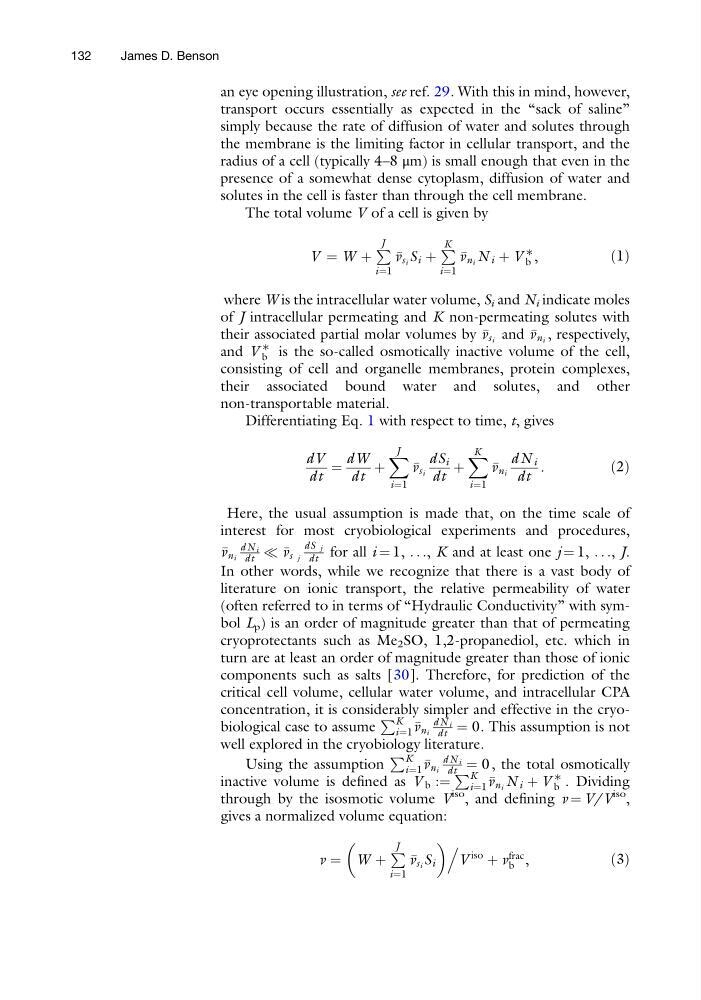
The total volume V of a cell is given by
V ¼ W þ
P J
i¼1
v s i S i þ
P K
i¼1
v n i N i þ V
∗
b ,
ð1Þ
where W is the intracellular water volume, S i and N i indicate moles
of J intracellular permeating and K non-permeating solutes with
their associated partial molar volumes by
v s i and
v n i , respectively,
and V
∗
b is the so-called osmotically inactive volume of the cell,
consisting of cell and organelle membranes, protein complexes,
their associated bound water and solutes, and other
non-transportable material.
Differentiating Eq. 1 with respect to time, t, gives
dV
dt
¼
dW
dt
þ
X J
i¼1
v s i
dS i
dt
þ
X K
i¼1
v n i
dN i
dt
:
ð2Þ
Here, the usual assumption is made that, on the time scale of
interest for most cryobiological experiments and procedures,
v n i
dN i
dt (
v s j
dS j
dt for all i ¼ 1, . . ., K and at least one j ¼ 1, . . ., J.
In other words, while we recognize that there is a vast body of
literature on ionic transport, the relative permeability of water
(often referred to in terms of “Hydraulic Conductivity” with symbol L p ) is an order of magnitude greater than that of permeating
cryoprotectants such as Me 2 SO, 1,2-propanediol, etc. which in
turn are at least an order of magnitude greater than those of ionic
components such as salts [30]. Therefore, for prediction of the
critical cell volume, cellular water volume, and intracellular CPA
concentration, it is considerably simpler and effective in the cryobiological case to assume
P K
i¼1
v n i
dN i
dt ¼ 0. This assumption is not
well explored in the cryobiology literature.
Using the assumption
P K
i¼1
v n i
dN i
dt ¼ 0 , the total osmotically
inactive volume is defined as V b :¼
P K
i¼1
v n i N i þ V
∗
b . Dividing
through by the isosmotic volume V
iso
, and defining v ¼ V/V
iso
,
gives a normalized volume equation:
v ¼ W þ
P J
i¼1
v s i S i
.
V
iso
þ v
frac
b ,
ð3Þ
132
James D. Benson
transport occurs essentially as expected in the “sack of saline”
simply because the rate of diffusion of water and solutes through
the membrane is the limiting factor in cellular transport, and the
radius of a cell (typically 4–8 μm) is small enough that even in the
presence of a somewhat dense cytoplasm, diffusion of water and
solutes in the cell is faster than through the cell membrane.
The total volume V of a cell is given by
V ¼ W þ
P J
i¼1
v s i S i þ
P K
i¼1
v n i N i þ V
∗
b ,
ð1Þ
where W is the intracellular water volume, S i and N i indicate moles
of J intracellular permeating and K non-permeating solutes with
their associated partial molar volumes by
v s i and
v n i , respectively,
and V
∗
b is the so-called osmotically inactive volume of the cell,
consisting of cell and organelle membranes, protein complexes,
their associated bound water and solutes, and other
non-transportable material.
Differentiating Eq. 1 with respect to time, t, gives
dV
dt
¼
dW
dt
þ
X J
i¼1
v s i
dS i
dt
þ
X K
i¼1
v n i
dN i
dt
:
ð2Þ
Here, the usual assumption is made that, on the time scale of
interest for most cryobiological experiments and procedures,
v n i
dN i
dt (
v s j
dS j
dt for all i ¼ 1, . . ., K and at least one j ¼ 1, . . ., J.
In other words, while we recognize that there is a vast body of
literature on ionic transport, the relative permeability of water
(often referred to in terms of “Hydraulic Conductivity” with symbol L p ) is an order of magnitude greater than that of permeating
cryoprotectants such as Me 2 SO, 1,2-propanediol, etc. which in
turn are at least an order of magnitude greater than those of ionic
components such as salts [30]. Therefore, for prediction of the
critical cell volume, cellular water volume, and intracellular CPA
concentration, it is considerably simpler and effective in the cryobiological case to assume
P K
i¼1
v n i
dN i
dt ¼ 0. This assumption is not
well explored in the cryobiology literature.
Using the assumption
P K
i¼1
v n i
dN i
dt ¼ 0 , the total osmotically
inactive volume is defined as V b :¼
P K
i¼1
v n i N i þ V
∗
b . Dividing
through by the isosmotic volume V
iso
, and defining v ¼ V/V
iso
,
gives a normalized volume equation:
v ¼ W þ
P J
i¼1
v s i S i
.
V
iso
þ v
frac
b ,
ð3Þ
132
James D. Benson