

1.7 Summary of the “Structure” of Water and Ice
43
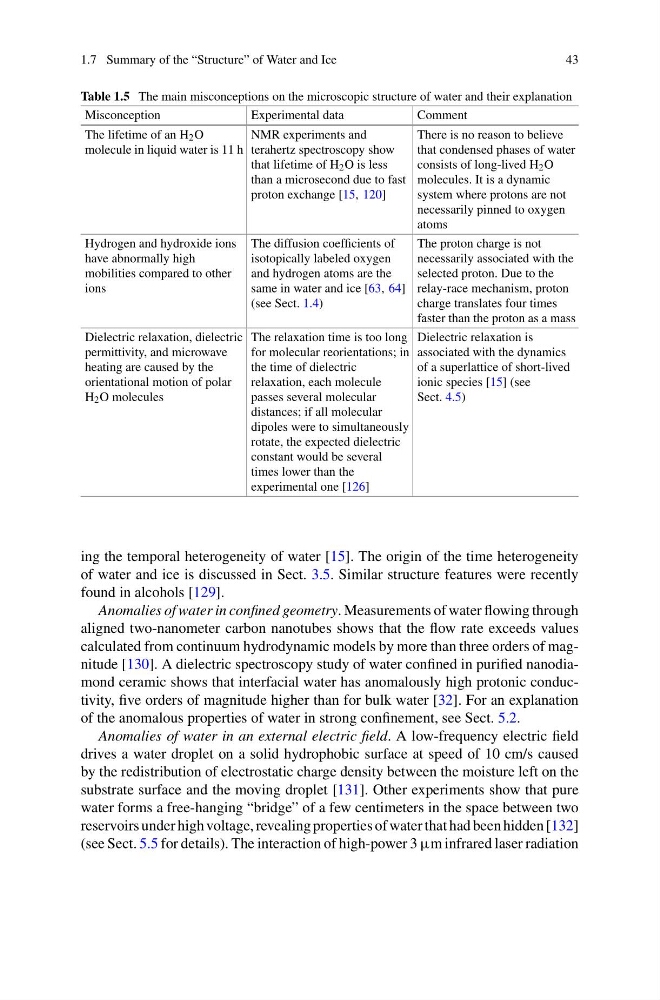
Table 1.5 The main misconceptions on the microscopic structure of water and their explanation
Misconception
Experimental data
Comment
The lifetime of an H 2 O
molecule in liquid water is 11 h
NMR experiments and
terahertz spectroscopy show
that lifetime of H 2 O is less
than a microsecond due to fast
proton exchange [15, 120]
There is no reason to believe
that condensed phases of water
consists of long-lived H 2 O
molecules. It is a dynamic
system where protons are not
necessarily pinned to oxygen
atoms
Hydrogen and hydroxide ions
have abnormally high
mobilities compared to other
ions
The diffusion coefficients of
isotopically labeled oxygen
and hydrogen atoms are the
same in water and ice [63, 64]
(see Sect. 1.4)
The proton charge is not
necessarily associated with the
selected proton. Due to the
relay-race mechanism, proton
charge translates four times
faster than the proton as a mass
Dielectric relaxation, dielectric
permittivity, and microwave
heating are caused by the
orientational motion of polar
H 2 O molecules
The relaxation time is too long
for molecular reorientations; in
the time of dielectric
relaxation, each molecule
passes several molecular
distances; if all molecular
dipoles were to simultaneously
rotate, the expected dielectric
constant would be several
times lower than the
experimental one [126]
Dielectric relaxation is
associated with the dynamics
of a superlattice of short-lived
ionic species [15] (see
Sect. 4.5)
ing the temporal heterogeneity of water [15]. The origin of the time heterogeneity
of water and ice is discussed in Sect. 3.5. Similar structure features were recently
found in alcohols [129].
Anomalies of water in confined geometry. Measurements of water flowing through
aligned two-nanometer carbon nanotubes shows that the flow rate exceeds values
calculated from continuum hydrodynamic models by more than three orders of magnitude [130]. A dielectric spectroscopy study of water confined in purified nanodiamond ceramic shows that interfacial water has anomalously high protonic conductivity, five orders of magnitude higher than for bulk water [32]. For an explanation
of the anomalous properties of water in strong confinement, see Sect. 5.2.
Anomalies of water in an external electric field. A low-frequency electric field
drives a water droplet on a solid hydrophobic surface at speed of 10 cm/s caused
by the redistribution of electrostatic charge density between the moisture left on the
substrate surface and the moving droplet [131]. Other experiments show that pure
water forms a free-hanging “bridge” of a few centimeters in the space between two
reservoirs under high voltage, revealing properties of water that had been hidden [132]
(see Sect. 5.5 for details). The interaction of high-power 3 µm infrared laser radiation
43
Table 1.5 The main misconceptions on the microscopic structure of water and their explanation
Misconception
Experimental data
Comment
The lifetime of an H 2 O
molecule in liquid water is 11 h
NMR experiments and
terahertz spectroscopy show
that lifetime of H 2 O is less
than a microsecond due to fast
proton exchange [15, 120]
There is no reason to believe
that condensed phases of water
consists of long-lived H 2 O
molecules. It is a dynamic
system where protons are not
necessarily pinned to oxygen
atoms
Hydrogen and hydroxide ions
have abnormally high
mobilities compared to other
ions
The diffusion coefficients of
isotopically labeled oxygen
and hydrogen atoms are the
same in water and ice [63, 64]
(see Sect. 1.4)
The proton charge is not
necessarily associated with the
selected proton. Due to the
relay-race mechanism, proton
charge translates four times
faster than the proton as a mass
Dielectric relaxation, dielectric
permittivity, and microwave
heating are caused by the
orientational motion of polar
H 2 O molecules
The relaxation time is too long
for molecular reorientations; in
the time of dielectric
relaxation, each molecule
passes several molecular
distances; if all molecular
dipoles were to simultaneously
rotate, the expected dielectric
constant would be several
times lower than the
experimental one [126]
Dielectric relaxation is
associated with the dynamics
of a superlattice of short-lived
ionic species [15] (see
Sect. 4.5)
ing the temporal heterogeneity of water [15]. The origin of the time heterogeneity
of water and ice is discussed in Sect. 3.5. Similar structure features were recently
found in alcohols [129].
Anomalies of water in confined geometry. Measurements of water flowing through
aligned two-nanometer carbon nanotubes shows that the flow rate exceeds values
calculated from continuum hydrodynamic models by more than three orders of magnitude [130]. A dielectric spectroscopy study of water confined in purified nanodiamond ceramic shows that interfacial water has anomalously high protonic conductivity, five orders of magnitude higher than for bulk water [32]. For an explanation
of the anomalous properties of water in strong confinement, see Sect. 5.2.
Anomalies of water in an external electric field. A low-frequency electric field
drives a water droplet on a solid hydrophobic surface at speed of 10 cm/s caused
by the redistribution of electrostatic charge density between the moisture left on the
substrate surface and the moving droplet [131]. Other experiments show that pure
water forms a free-hanging “bridge” of a few centimeters in the space between two
reservoirs under high voltage, revealing properties of water that had been hidden [132]
(see Sect. 5.5 for details). The interaction of high-power 3 µm infrared laser radiation