

1.6 Water in Molecular-Dynamic Simulations
39
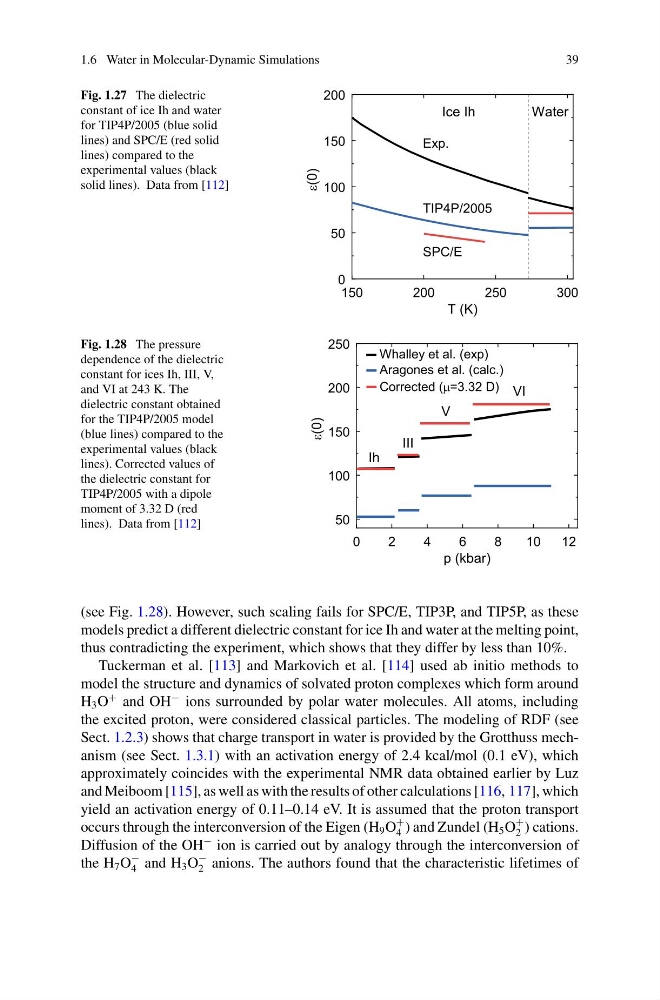
Fig. 1.27 The dielectric
constant of ice Ih and water
for TIP4P/2005 (blue solid
lines) and SPC/E (red solid
lines) compared to the
experimental values (black
solid lines). Data from [112]
Fig. 1.28 The pressure
dependence of the dielectric
constant for ices Ih, III, V,
and VI at 243 K. The
dielectric constant obtained
for the TIP4P/2005 model
(blue lines) compared to the
experimental values (black
lines). Corrected values of
the dielectric constant for
TIP4P/2005 with a dipole
moment of 3.32 D (red
lines). Data from [112]
(see Fig. 1.28). However, such scaling fails for SPC/E, TIP3P, and TIP5P, as these
models predict a different dielectric constant for ice Ih and water at the melting point,
thus contradicting the experiment, which shows that they differ by less than 10%.
Tuckerman et al. [113] and Markovich et al. [114] used ab initio methods to
model the structure and dynamics of solvated proton complexes which form around
H 3 O
+ and OH
− ions surrounded by polar water molecules. All atoms, including
the excited proton, were considered classical particles. The modeling of RDF (see
Sect. 1.2.3) shows that charge transport in water is provided by the Grotthuss mechanism (see Sect. 1.3.1) with an activation energy of 2.4 kcal/mol (0.1 eV), which
approximately coincides with the experimental NMR data obtained earlier by Luz
and Meiboom [115], as well as with the results of other calculations [116, 117], which
yield an activation energy of 0.11–0.14 eV. It is assumed that the proton transport
occurs through the interconversion of the Eigen (H 9 O
+
4 ) and Zundel (H 5 O
+
2 ) cations.
Diffusion of the OH
− ion is carried out by analogy through the interconversion of
the H 7 O
−
4 and H 3 O
−
2 anions. The authors found that the characteristic lifetimes of
39
Fig. 1.27 The dielectric
constant of ice Ih and water
for TIP4P/2005 (blue solid
lines) and SPC/E (red solid
lines) compared to the
experimental values (black
solid lines). Data from [112]
Fig. 1.28 The pressure
dependence of the dielectric
constant for ices Ih, III, V,
and VI at 243 K. The
dielectric constant obtained
for the TIP4P/2005 model
(blue lines) compared to the
experimental values (black
lines). Corrected values of
the dielectric constant for
TIP4P/2005 with a dipole
moment of 3.32 D (red
lines). Data from [112]
(see Fig. 1.28). However, such scaling fails for SPC/E, TIP3P, and TIP5P, as these
models predict a different dielectric constant for ice Ih and water at the melting point,
thus contradicting the experiment, which shows that they differ by less than 10%.
Tuckerman et al. [113] and Markovich et al. [114] used ab initio methods to
model the structure and dynamics of solvated proton complexes which form around
H 3 O
+ and OH
− ions surrounded by polar water molecules. All atoms, including
the excited proton, were considered classical particles. The modeling of RDF (see
Sect. 1.2.3) shows that charge transport in water is provided by the Grotthuss mechanism (see Sect. 1.3.1) with an activation energy of 2.4 kcal/mol (0.1 eV), which
approximately coincides with the experimental NMR data obtained earlier by Luz
and Meiboom [115], as well as with the results of other calculations [116, 117], which
yield an activation energy of 0.11–0.14 eV. It is assumed that the proton transport
occurs through the interconversion of the Eigen (H 9 O
+
4 ) and Zundel (H 5 O
+
2 ) cations.
Diffusion of the OH
− ion is carried out by analogy through the interconversion of
the H 7 O
−
4 and H 3 O
−
2 anions. The authors found that the characteristic lifetimes of