

1.3 Direct Current Conductivity and pH of Water
21
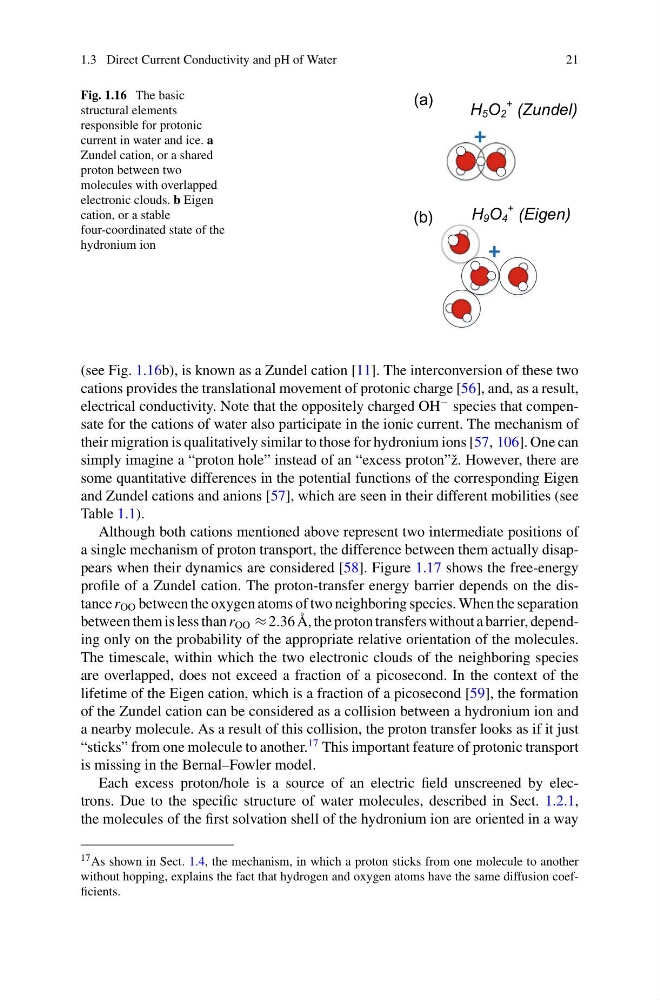
Fig. 1.16 The basic
structural elements
responsible for protonic
current in water and ice. a
Zundel cation, or a shared
proton between two
molecules with overlapped
electronic clouds. b Eigen
cation, or a stable
four-coordinated state of the
hydronium ion
+
(a)
(b)
H 5 O 2
+ (Zundel)
H 9 O 4
+ (Eigen)
+
(see Fig. 1.16b), is known as a Zundel cation [11]. The interconversion of these two
cations provides the translational movement of protonic charge [56], and, as a result,
electrical conductivity. Note that the oppositely charged OH
− species that compensate for the cations of water also participate in the ionic current. The mechanism of
their migration is qualitatively similar to those for hydronium ions [57, 106]. One can
simply imagine a “proton hole” instead of an “excess proton”ž. However, there are
some quantitative differences in the potential functions of the corresponding Eigen
and Zundel cations and anions [57], which are seen in their different mobilities (see
Table 1.1).
Although both cations mentioned above represent two intermediate positions of
a single mechanism of proton transport, the difference between them actually disappears when their dynamics are considered [58]. Figure 1.17 shows the free-energy
profile of a Zundel cation. The proton-transfer energy barrier depends on the distance r OO between the oxygen atoms of two neighboring species. When the separation
between them is less than r OO ≈ 2.36 Å, the proton transfers without a barrier, depending only on the probability of the appropriate relative orientation of the molecules.
The timescale, within which the two electronic clouds of the neighboring species
are overlapped, does not exceed a fraction of a picosecond. In the context of the
lifetime of the Eigen cation, which is a fraction of a picosecond [59], the formation
of the Zundel cation can be considered as a collision between a hydronium ion and
a nearby molecule. As a result of this collision, the proton transfer looks as if it just
“sticks” from one molecule to another.
17 This important feature of protonic transport
is missing in the Bernal–Fowler model.
Each excess proton/hole is a source of an electric field unscreened by electrons. Due to the specific structure of water molecules, described in Sect. 1.2.1,
the molecules of the first solvation shell of the hydronium ion are oriented in a way
17 As shown in Sect. 1.4, the mechanism, in which a proton sticks from one molecule to another
without hopping, explains the fact that hydrogen and oxygen atoms have the same diffusion coefficients.
21
Fig. 1.16 The basic
structural elements
responsible for protonic
current in water and ice. a
Zundel cation, or a shared
proton between two
molecules with overlapped
electronic clouds. b Eigen
cation, or a stable
four-coordinated state of the
hydronium ion
+
(a)
(b)
H 5 O 2
+ (Zundel)
H 9 O 4
+ (Eigen)
+
(see Fig. 1.16b), is known as a Zundel cation [11]. The interconversion of these two
cations provides the translational movement of protonic charge [56], and, as a result,
electrical conductivity. Note that the oppositely charged OH
− species that compensate for the cations of water also participate in the ionic current. The mechanism of
their migration is qualitatively similar to those for hydronium ions [57, 106]. One can
simply imagine a “proton hole” instead of an “excess proton”ž. However, there are
some quantitative differences in the potential functions of the corresponding Eigen
and Zundel cations and anions [57], which are seen in their different mobilities (see
Table 1.1).
Although both cations mentioned above represent two intermediate positions of
a single mechanism of proton transport, the difference between them actually disappears when their dynamics are considered [58]. Figure 1.17 shows the free-energy
profile of a Zundel cation. The proton-transfer energy barrier depends on the distance r OO between the oxygen atoms of two neighboring species. When the separation
between them is less than r OO ≈ 2.36 Å, the proton transfers without a barrier, depending only on the probability of the appropriate relative orientation of the molecules.
The timescale, within which the two electronic clouds of the neighboring species
are overlapped, does not exceed a fraction of a picosecond. In the context of the
lifetime of the Eigen cation, which is a fraction of a picosecond [59], the formation
of the Zundel cation can be considered as a collision between a hydronium ion and
a nearby molecule. As a result of this collision, the proton transfer looks as if it just
“sticks” from one molecule to another.
17 This important feature of protonic transport
is missing in the Bernal–Fowler model.
Each excess proton/hole is a source of an electric field unscreened by electrons. Due to the specific structure of water molecules, described in Sect. 1.2.1,
the molecules of the first solvation shell of the hydronium ion are oriented in a way
17 As shown in Sect. 1.4, the mechanism, in which a proton sticks from one molecule to another
without hopping, explains the fact that hydrogen and oxygen atoms have the same diffusion coefficients.