

5.6 Water in Electrochemical Energy Systems
211
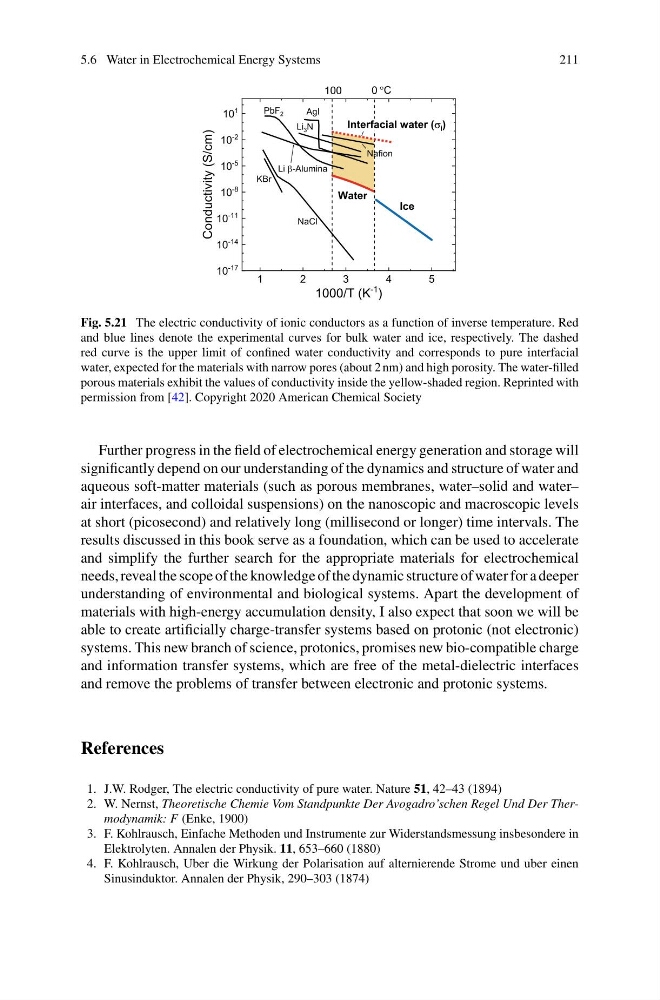
Fig. 5.21 The electric conductivity of ionic conductors as a function of inverse temperature. Red
and blue lines denote the experimental curves for bulk water and ice, respectively. The dashed
red curve is the upper limit of confined water conductivity and corresponds to pure interfacial
water, expected for the materials with narrow pores (about 2 nm) and high porosity. The water-filled
porous materials exhibit the values of conductivity inside the yellow-shaded region. Reprinted with
permission from [42]. Copyright 2020 American Chemical Society
Further progress in the field of electrochemical energy generation and storage will
significantly depend on our understanding of the dynamics and structure of water and
aqueous soft-matter materials (such as porous membranes, water–solid and water–
air interfaces, and colloidal suspensions) on the nanoscopic and macroscopic levels
at short (picosecond) and relatively long (millisecond or longer) time intervals. The
results discussed in this book serve as a foundation, which can be used to accelerate
and simplify the further search for the appropriate materials for electrochemical
needs, reveal the scope of the knowledge of the dynamic structure of water for a deeper
understanding of environmental and biological systems. Apart the development of
materials with high-energy accumulation density, I also expect that soon we will be
able to create artificially charge-transfer systems based on protonic (not electronic)
systems. This new branch of science, protonics, promises new bio-compatible charge
and information transfer systems, which are free of the metal-dielectric interfaces
and remove the problems of transfer between electronic and protonic systems.
References
1. J.W. Rodger, The electric conductivity of pure water. Nature 51, 42–43 (1894)
2. W. Nernst, Theoretische Chemie Vom Standpunkte Der Avogadro’schen Regel Und Der Thermodynamik: F (Enke, 1900)
3. F. Kohlrausch, Einfache Methoden und Instrumente zur Widerstandsmessung insbesondere in
Elektrolyten. Annalen der Physik. 11, 653–660 (1880)
4. F. Kohlrausch, Uber die Wirkung der Polarisation auf alternierende Strome und uber einen
Sinusinduktor. Annalen der Physik, 290–303 (1874)
211
Fig. 5.21 The electric conductivity of ionic conductors as a function of inverse temperature. Red
and blue lines denote the experimental curves for bulk water and ice, respectively. The dashed
red curve is the upper limit of confined water conductivity and corresponds to pure interfacial
water, expected for the materials with narrow pores (about 2 nm) and high porosity. The water-filled
porous materials exhibit the values of conductivity inside the yellow-shaded region. Reprinted with
permission from [42]. Copyright 2020 American Chemical Society
Further progress in the field of electrochemical energy generation and storage will
significantly depend on our understanding of the dynamics and structure of water and
aqueous soft-matter materials (such as porous membranes, water–solid and water–
air interfaces, and colloidal suspensions) on the nanoscopic and macroscopic levels
at short (picosecond) and relatively long (millisecond or longer) time intervals. The
results discussed in this book serve as a foundation, which can be used to accelerate
and simplify the further search for the appropriate materials for electrochemical
needs, reveal the scope of the knowledge of the dynamic structure of water for a deeper
understanding of environmental and biological systems. Apart the development of
materials with high-energy accumulation density, I also expect that soon we will be
able to create artificially charge-transfer systems based on protonic (not electronic)
systems. This new branch of science, protonics, promises new bio-compatible charge
and information transfer systems, which are free of the metal-dielectric interfaces
and remove the problems of transfer between electronic and protonic systems.
References
1. J.W. Rodger, The electric conductivity of pure water. Nature 51, 42–43 (1894)
2. W. Nernst, Theoretische Chemie Vom Standpunkte Der Avogadro’schen Regel Und Der Thermodynamik: F (Enke, 1900)
3. F. Kohlrausch, Einfache Methoden und Instrumente zur Widerstandsmessung insbesondere in
Elektrolyten. Annalen der Physik. 11, 653–660 (1880)
4. F. Kohlrausch, Uber die Wirkung der Polarisation auf alternierende Strome und uber einen
Sinusinduktor. Annalen der Physik, 290–303 (1874)