

5.2 The Electrodynamics of Confined Water
189
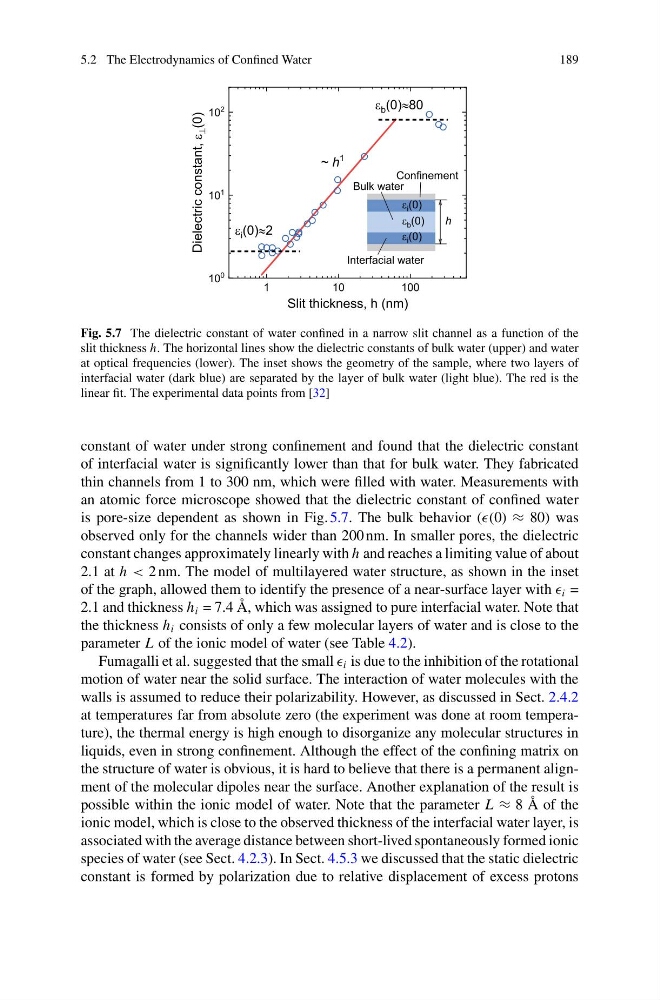
Fig. 5.7 The dielectric constant of water confined in a narrow slit channel as a function of the
slit thickness h. The horizontal lines show the dielectric constants of bulk water (upper) and water
at optical frequencies (lower). The inset shows the geometry of the sample, where two layers of
interfacial water (dark blue) are separated by the layer of bulk water (light blue). The red is the
linear fit. The experimental data points from [32]
constant of water under strong confinement and found that the dielectric constant
of interfacial water is significantly lower than that for bulk water. They fabricated
thin channels from 1 to 300 nm, which were filled with water. Measurements with
an atomic force microscope showed that the dielectric constant of confined water
is pore-size dependent as shown in Fig. 5.7. The bulk behavior ((0) ≈ 80) was
observed only for the channels wider than 200 nm. In smaller pores, the dielectric
constant changes approximately linearly with h and reaches a limiting value of about
2.1 at h < 2 nm. The model of multilayered water structure, as shown in the inset
of the graph, allowed them to identify the presence of a near-surface layer with i =
2.1 and thickness h i = 7.4 Å, which was assigned to pure interfacial water. Note that
the thickness h i consists of only a few molecular layers of water and is close to the
parameter L of the ionic model of water (see Table 4.2).
Fumagalli et al. suggested that the small i is due to the inhibition of the rotational
motion of water near the solid surface. The interaction of water molecules with the
walls is assumed to reduce their polarizability. However, as discussed in Sect. 2.4.2
at temperatures far from absolute zero (the experiment was done at room temperature), the thermal energy is high enough to disorganize any molecular structures in
liquids, even in strong confinement. Although the effect of the confining matrix on
the structure of water is obvious, it is hard to believe that there is a permanent alignment of the molecular dipoles near the surface. Another explanation of the result is
possible within the ionic model of water. Note that the parameter L ≈ 8 Å of the
ionic model, which is close to the observed thickness of the interfacial water layer, is
associated with the average distance between short-lived spontaneously formed ionic
species of water (see Sect. 4.2.3). In Sect. 4.5.3 we discussed that the static dielectric
constant is formed by polarization due to relative displacement of excess protons
189
Fig. 5.7 The dielectric constant of water confined in a narrow slit channel as a function of the
slit thickness h. The horizontal lines show the dielectric constants of bulk water (upper) and water
at optical frequencies (lower). The inset shows the geometry of the sample, where two layers of
interfacial water (dark blue) are separated by the layer of bulk water (light blue). The red is the
linear fit. The experimental data points from [32]
constant of water under strong confinement and found that the dielectric constant
of interfacial water is significantly lower than that for bulk water. They fabricated
thin channels from 1 to 300 nm, which were filled with water. Measurements with
an atomic force microscope showed that the dielectric constant of confined water
is pore-size dependent as shown in Fig. 5.7. The bulk behavior ((0) ≈ 80) was
observed only for the channels wider than 200 nm. In smaller pores, the dielectric
constant changes approximately linearly with h and reaches a limiting value of about
2.1 at h < 2 nm. The model of multilayered water structure, as shown in the inset
of the graph, allowed them to identify the presence of a near-surface layer with i =
2.1 and thickness h i = 7.4 Å, which was assigned to pure interfacial water. Note that
the thickness h i consists of only a few molecular layers of water and is close to the
parameter L of the ionic model of water (see Table 4.2).
Fumagalli et al. suggested that the small i is due to the inhibition of the rotational
motion of water near the solid surface. The interaction of water molecules with the
walls is assumed to reduce their polarizability. However, as discussed in Sect. 2.4.2
at temperatures far from absolute zero (the experiment was done at room temperature), the thermal energy is high enough to disorganize any molecular structures in
liquids, even in strong confinement. Although the effect of the confining matrix on
the structure of water is obvious, it is hard to believe that there is a permanent alignment of the molecular dipoles near the surface. Another explanation of the result is
possible within the ionic model of water. Note that the parameter L ≈ 8 Å of the
ionic model, which is close to the observed thickness of the interfacial water layer, is
associated with the average distance between short-lived spontaneously formed ionic
species of water (see Sect. 4.2.3). In Sect. 4.5.3 we discussed that the static dielectric
constant is formed by polarization due to relative displacement of excess protons