

4.2 A Phenomenological Model for the Broadband Dielectric Response
143
dynamics of spontaneously appearing short-lived ionic species in sub-femtosecond
timescales, with the collective relaxation effects lasting up to microseconds.
Thus, within the ionic model, the electrodynamics of water is determined by
the thermal motion of short-lived ions and molecules. The main (Debye) dielectric
relaxation is a result of the separation of H 3 O
+ and OH
− ions (the polarization of
the ionic atmosphere). The secondary relaxation is caused by the adjustment of the
coordination sphere (solvation shell) of an ion following the spontaneous charge
displacement. Static conductivity results from the migration of only long-lived ions,
thus, is determined by the lifetime distribution of ionic species. The water structure
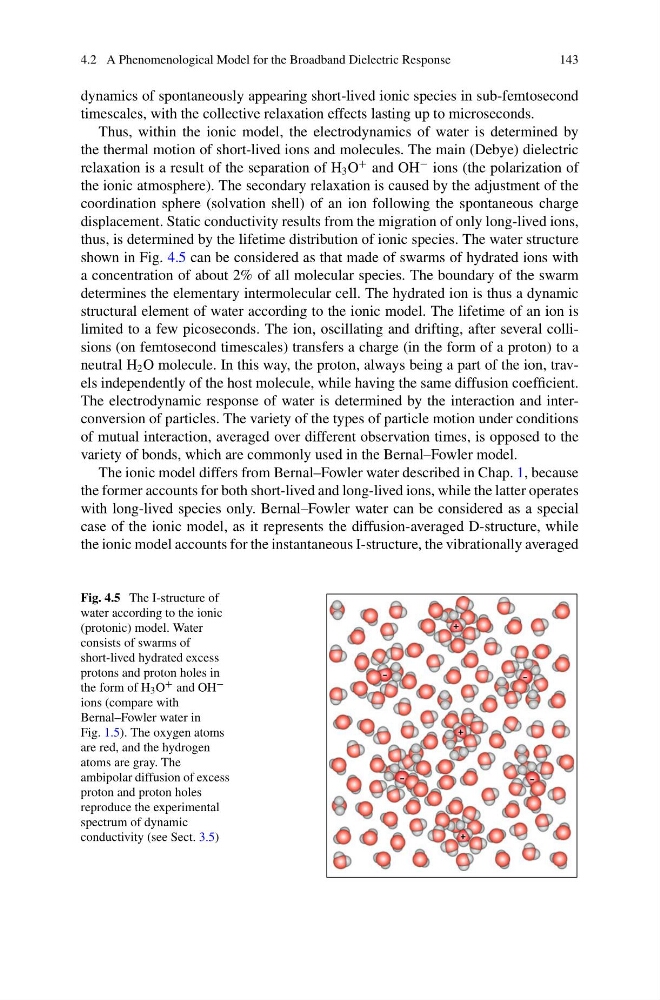
shown in Fig. 4.5 can be considered as that made of swarms of hydrated ions with
a concentration of about 2% of all molecular species. The boundary of the swarm
determines the elementary intermolecular cell. The hydrated ion is thus a dynamic
structural element of water according to the ionic model. The lifetime of an ion is
limited to a few picoseconds. The ion, oscillating and drifting, after several collisions (on femtosecond timescales) transfers a charge (in the form of a proton) to a
neutral H 2 O molecule. In this way, the proton, always being a part of the ion, travels independently of the host molecule, while having the same diffusion coefficient.
The electrodynamic response of water is determined by the interaction and interconversion of particles. The variety of the types of particle motion under conditions
of mutual interaction, averaged over different observation times, is opposed to the
variety of bonds, which are commonly used in the Bernal–Fowler model.
The ionic model differs from Bernal–Fowler water described in Chap. 1, because
the former accounts for both short-lived and long-lived ions, while the latter operates
with long-lived species only. Bernal–Fowler water can be considered as a special
case of the ionic model, as it represents the diffusion-averaged D-structure, while
the ionic model accounts for the instantaneous I-structure, the vibrationally averaged
Fig. 4.5 The I-structure of
water according to the ionic
(protonic) model. Water
consists of swarms of
short-lived hydrated excess
protons and proton holes in
the form of H 3 O + and OH −
ions (compare with
Bernal–Fowler water in
Fig. 1.5). The oxygen atoms
are red, and the hydrogen
atoms are gray. The
ambipolar diffusion of excess
proton and proton holes
reproduce the experimental
spectrum of dynamic
conductivity (see Sect. 3.5)
-
143
dynamics of spontaneously appearing short-lived ionic species in sub-femtosecond
timescales, with the collective relaxation effects lasting up to microseconds.
Thus, within the ionic model, the electrodynamics of water is determined by
the thermal motion of short-lived ions and molecules. The main (Debye) dielectric
relaxation is a result of the separation of H 3 O
+ and OH
− ions (the polarization of
the ionic atmosphere). The secondary relaxation is caused by the adjustment of the
coordination sphere (solvation shell) of an ion following the spontaneous charge
displacement. Static conductivity results from the migration of only long-lived ions,
thus, is determined by the lifetime distribution of ionic species. The water structure
shown in Fig. 4.5 can be considered as that made of swarms of hydrated ions with
a concentration of about 2% of all molecular species. The boundary of the swarm
determines the elementary intermolecular cell. The hydrated ion is thus a dynamic
structural element of water according to the ionic model. The lifetime of an ion is
limited to a few picoseconds. The ion, oscillating and drifting, after several collisions (on femtosecond timescales) transfers a charge (in the form of a proton) to a
neutral H 2 O molecule. In this way, the proton, always being a part of the ion, travels independently of the host molecule, while having the same diffusion coefficient.
The electrodynamic response of water is determined by the interaction and interconversion of particles. The variety of the types of particle motion under conditions
of mutual interaction, averaged over different observation times, is opposed to the
variety of bonds, which are commonly used in the Bernal–Fowler model.
The ionic model differs from Bernal–Fowler water described in Chap. 1, because
the former accounts for both short-lived and long-lived ions, while the latter operates
with long-lived species only. Bernal–Fowler water can be considered as a special
case of the ionic model, as it represents the diffusion-averaged D-structure, while
the ionic model accounts for the instantaneous I-structure, the vibrationally averaged
Fig. 4.5 The I-structure of
water according to the ionic
(protonic) model. Water
consists of swarms of
short-lived hydrated excess
protons and proton holes in
the form of H 3 O + and OH −
ions (compare with
Bernal–Fowler water in
Fig. 1.5). The oxygen atoms
are red, and the hydrogen
atoms are gray. The
ambipolar diffusion of excess
proton and proton holes
reproduce the experimental
spectrum of dynamic
conductivity (see Sect. 3.5)
-