

134
4 The Dielectric Properties and Dynamic Structure of Water and Ice
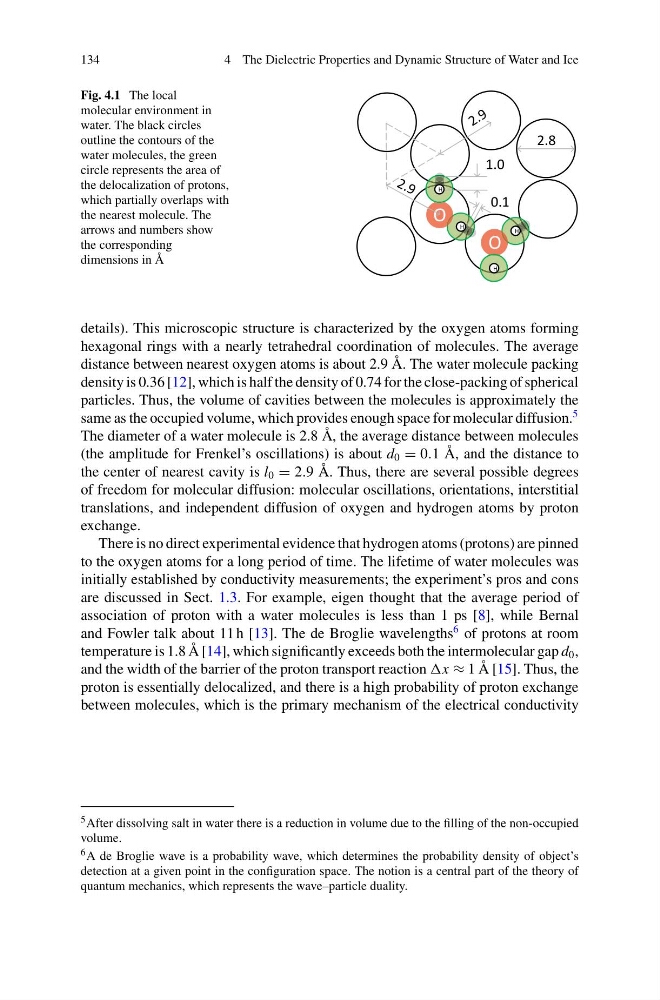
Fig. 4.1 The local
molecular environment in
water. The black circles
outline the contours of the
water molecules, the green
circle represents the area of
the delocalization of protons,
which partially overlaps with
the nearest molecule. The
arrows and numbers show
the corresponding
dimensions in Å
0.1
O
1.0
O
H
H
H
2.8
H
details). This microscopic structure is characterized by the oxygen atoms forming
hexagonal rings with a nearly tetrahedral coordination of molecules. The average
distance between nearest oxygen atoms is about 2.9 Å. The water molecule packing
density is 0.36 [12], which is half the density of 0.74 for the close-packing of spherical
particles. Thus, the volume of cavities between the molecules is approximately the
same as the occupied volume, which provides enough space for molecular diffusion.
5
The diameter of a water molecule is 2.8 Å, the average distance between molecules
(the amplitude for Frenkel’s oscillations) is about d 0 = 0.1 Å, and the distance to
the center of nearest cavity is l 0 = 2.9 Å. Thus, there are several possible degrees
of freedom for molecular diffusion: molecular oscillations, orientations, interstitial
translations, and independent diffusion of oxygen and hydrogen atoms by proton
exchange.
There is no direct experimental evidence that hydrogen atoms (protons) are pinned
to the oxygen atoms for a long period of time. The lifetime of water molecules was
initially established by conductivity measurements; the experiment’s pros and cons
are discussed in Sect. 1.3. For example, eigen thought that the average period of
association of proton with a water molecules is less than 1 ps [8], while Bernal
and Fowler talk about 11 h [13]. The de Broglie wavelengths
6 of protons at room
temperature is 1.8 Å [14], which significantly exceeds both the intermolecular gap d 0 ,
and the width of the barrier of the proton transport reaction ≈ 1 Å [15]. Thus, the
proton is essentially delocalized, and there is a high probability of proton exchange
between molecules, which is the primary mechanism of the electrical conductivity
5 After dissolving salt in water there is a reduction in volume due to the filling of the non-occupied
volume.
6 A de Broglie wave is a probability wave, which determines the probability density of object’s
detection at a given point in the configuration space. The notion is a central part of the theory of
quantum mechanics, which represents the wave–particle duality.
4 The Dielectric Properties and Dynamic Structure of Water and Ice
Fig. 4.1 The local
molecular environment in
water. The black circles
outline the contours of the
water molecules, the green
circle represents the area of
the delocalization of protons,
which partially overlaps with
the nearest molecule. The
arrows and numbers show
the corresponding
dimensions in Å
0.1
O
1.0
O
H
H
H
2.8
H
details). This microscopic structure is characterized by the oxygen atoms forming
hexagonal rings with a nearly tetrahedral coordination of molecules. The average
distance between nearest oxygen atoms is about 2.9 Å. The water molecule packing
density is 0.36 [12], which is half the density of 0.74 for the close-packing of spherical
particles. Thus, the volume of cavities between the molecules is approximately the
same as the occupied volume, which provides enough space for molecular diffusion.
5
The diameter of a water molecule is 2.8 Å, the average distance between molecules
(the amplitude for Frenkel’s oscillations) is about d 0 = 0.1 Å, and the distance to
the center of nearest cavity is l 0 = 2.9 Å. Thus, there are several possible degrees
of freedom for molecular diffusion: molecular oscillations, orientations, interstitial
translations, and independent diffusion of oxygen and hydrogen atoms by proton
exchange.
There is no direct experimental evidence that hydrogen atoms (protons) are pinned
to the oxygen atoms for a long period of time. The lifetime of water molecules was
initially established by conductivity measurements; the experiment’s pros and cons
are discussed in Sect. 1.3. For example, eigen thought that the average period of
association of proton with a water molecules is less than 1 ps [8], while Bernal
and Fowler talk about 11 h [13]. The de Broglie wavelengths
6 of protons at room
temperature is 1.8 Å [14], which significantly exceeds both the intermolecular gap d 0 ,
and the width of the barrier of the proton transport reaction ≈ 1 Å [15]. Thus, the
proton is essentially delocalized, and there is a high probability of proton exchange
between molecules, which is the primary mechanism of the electrical conductivity
5 After dissolving salt in water there is a reduction in volume due to the filling of the non-occupied
volume.
6 A de Broglie wave is a probability wave, which determines the probability density of object’s
detection at a given point in the configuration space. The notion is a central part of the theory of
quantum mechanics, which represents the wave–particle duality.