

340
Biomedical Signal and Image Processing
After entering the body, the radioactive substance circulates through the bloodstream to reach the organ or tumor of interest. The radionucleotide then emits positrons
as part of the natural disintegration process of the unstable isotopes. A positron is the
atomic equivalent of a positive electron, both in mass and in charge, except the charge
is opposite to that of the electron’s charge.
Once the radioactively labeled substance has been absorbed, it keeps emitting
positrons. The imaging is made possible by the positron annihilation with an electron, emitting two gamma rays that are sensed by the detectors outside the body.
The measured gamma rays are then processed using tomographic methods to identify the location and quantity of the radioactive uptake at each location inside the
body. The resulting image provides functional analysis of the organ in question
since, as discussed later, the amount of uptake is related to the metabolic functions
of the tissues.
In order to better understand the full use of the radioactive isotopes in PET and
the incorporation of each radioactive substance in the cellular metabolism, next the
production of the isotopes will be further described.
17.2.1 PRODUCTION OF RADIONUCLEOTIDES
The first stage in the development of a radioactive pharmacologic entity is the
production of the radionuclide. As mentioned earlier, the radionucleotides administered in the body are in principle very similar to the material abundantly available in
biological tissues, except that in the radionucleotides certain atoms are substituted by their short-lived radioactive isotopes. Such radioactively labeled chemical substances are unstable and emit positrons when in the body. The atoms that
are replaced by their isotopes are the main elements abundantly found in biological tissues, i.e., 11 C, 18 F, 13 N, and 15 O. The radionucleotide can be produced in
many different ways; the most prominent method is the use of an on-site cyclotron.
Particle bombardment will produce the needed radionuclides.
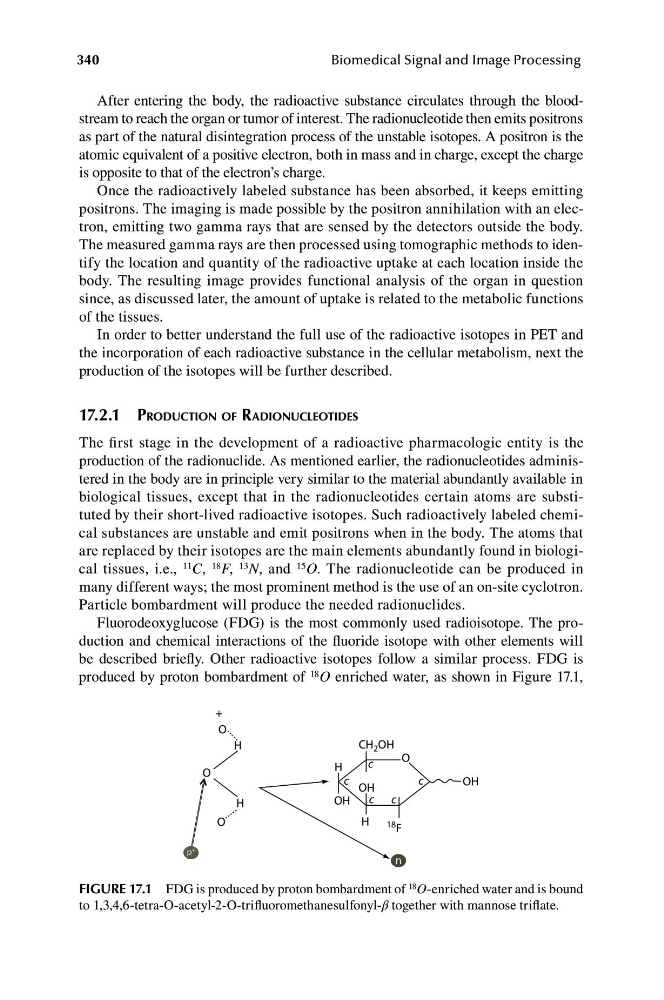
Fluorodeoxyglucose (FDG) is the most commonly used radioisotope. The production and chemical interactions of the fluoride isotope with other elements will
be described briefly. Other radioactive isotopes follow a similar process. FDG is
produced by proton bombardment of 18 O enriched water, as shown in Figure 17.1,
+
O
O
O
H
H
H
OH
OH
OH
O
CH 2 OH
c
c
c
c
c
n
18 F
p
+
H
FIGURE 17.1 FDG is produced by proton bombardment of 18 O-enriched water and is bound
to 1,3,4,6-tetra-O-acetyl-2-O-trifluoromethanesulfonyl-β together with mannose triflate.
Biomedical Signal and Image Processing
After entering the body, the radioactive substance circulates through the bloodstream to reach the organ or tumor of interest. The radionucleotide then emits positrons
as part of the natural disintegration process of the unstable isotopes. A positron is the
atomic equivalent of a positive electron, both in mass and in charge, except the charge
is opposite to that of the electron’s charge.
Once the radioactively labeled substance has been absorbed, it keeps emitting
positrons. The imaging is made possible by the positron annihilation with an electron, emitting two gamma rays that are sensed by the detectors outside the body.
The measured gamma rays are then processed using tomographic methods to identify the location and quantity of the radioactive uptake at each location inside the
body. The resulting image provides functional analysis of the organ in question
since, as discussed later, the amount of uptake is related to the metabolic functions
of the tissues.
In order to better understand the full use of the radioactive isotopes in PET and
the incorporation of each radioactive substance in the cellular metabolism, next the
production of the isotopes will be further described.
17.2.1 PRODUCTION OF RADIONUCLEOTIDES
The first stage in the development of a radioactive pharmacologic entity is the
production of the radionuclide. As mentioned earlier, the radionucleotides administered in the body are in principle very similar to the material abundantly available in
biological tissues, except that in the radionucleotides certain atoms are substituted by their short-lived radioactive isotopes. Such radioactively labeled chemical substances are unstable and emit positrons when in the body. The atoms that
are replaced by their isotopes are the main elements abundantly found in biological tissues, i.e., 11 C, 18 F, 13 N, and 15 O. The radionucleotide can be produced in
many different ways; the most prominent method is the use of an on-site cyclotron.
Particle bombardment will produce the needed radionuclides.
Fluorodeoxyglucose (FDG) is the most commonly used radioisotope. The production and chemical interactions of the fluoride isotope with other elements will
be described briefly. Other radioactive isotopes follow a similar process. FDG is
produced by proton bombardment of 18 O enriched water, as shown in Figure 17.1,
+
O
O
O
H
H
H
OH
OH
OH
O
CH 2 OH
c
c
c
c
c
n
18 F
p
+
H
FIGURE 17.1 FDG is produced by proton bombardment of 18 O-enriched water and is bound
to 1,3,4,6-tetra-O-acetyl-2-O-trifluoromethanesulfonyl-β together with mannose triflate.