

331
Ultrasound Imaging
interpolates the space between the stacked images to create a virtual 3-D model of
the tissue. In order to perform this, one must know exactly how far the ultrasound
sensor or beam has moved between sequential scans. Unlike computed tomography (CT) and magnetic resonance (MR) imaging, in which 2-D images are usually
acquired at a slow rate as a stack of parallel slices, in a fixed orientation, ultrasound
provides topographic images at a high rate, and in arbitrary orientations. The high
acquisition rate and arbitrary orientation of the images provide unique problems to
overcome and opportunities to exploit in extending 2-D ultrasound imaging to 3-D
visualization.
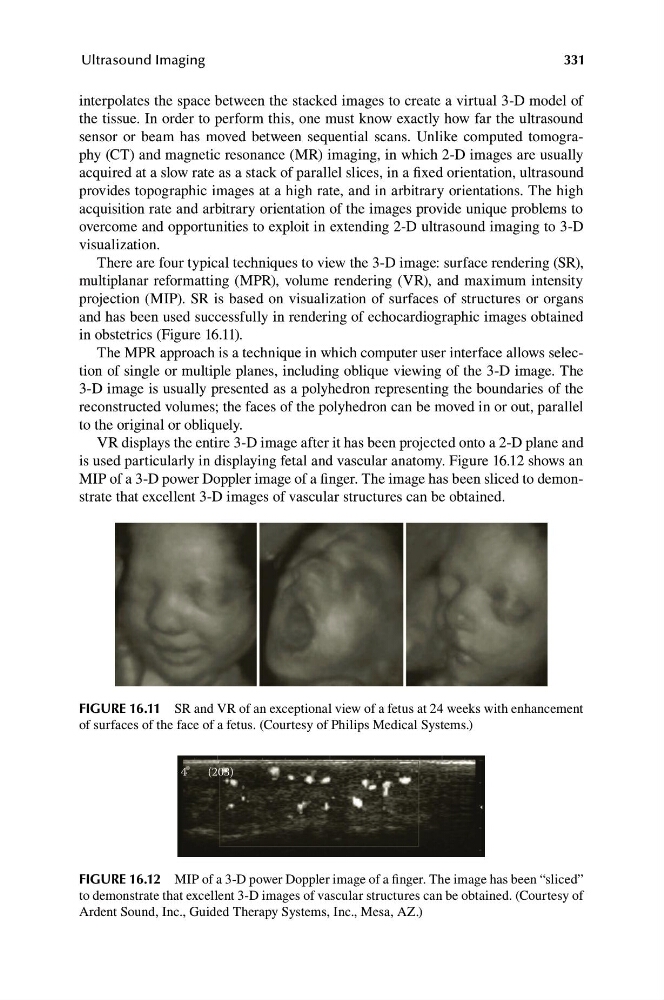
There are four typical techniques to view the 3-D image: surface rendering (SR),
multiplanar reformatting (MPR), volume rendering (VR), and maximum intensity
projection (MIP). SR is based on visualization of surfaces of structures or organs
and has been used successfully in rendering of echocardiographic images obtained
in obstetrics (Figure 16.11).
The MPR approach is a technique in which computer user interface allows selection of single or multiple planes, including oblique viewing of the 3-D image. The
3-D image is usually presented as a polyhedron representing the boundaries of the
reconstructed volumes; the faces of the polyhedron can be moved in or out, parallel
to the original or obliquely.
VR displays the entire 3-D image after it has been projected onto a 2-D plane and
is used particularly in displaying fetal and vascular anatomy. Figure 16.12 shows an
MIP of a 3-D power Doppler image of a finger. The image has been sliced to demonstrate that excellent 3-D images of vascular structures can be obtained.
FIGURE 16.11 SR and VR of an exceptional view of a fetus at 24 weeks with enhancement
of surfaces of the face of a fetus. (Courtesy of Philips Medical Systems.)
4
(203)
FIGURE 16.12 MIP of a 3-D power Doppler image of a finger. The image has been “sliced”
to demonstrate that excellent 3-D images of vascular structures can be obtained. (Courtesy of
Ardent Sound, Inc., Guided Therapy Systems, Inc., Mesa, AZ.)
Ultrasound Imaging
interpolates the space between the stacked images to create a virtual 3-D model of
the tissue. In order to perform this, one must know exactly how far the ultrasound
sensor or beam has moved between sequential scans. Unlike computed tomography (CT) and magnetic resonance (MR) imaging, in which 2-D images are usually
acquired at a slow rate as a stack of parallel slices, in a fixed orientation, ultrasound
provides topographic images at a high rate, and in arbitrary orientations. The high
acquisition rate and arbitrary orientation of the images provide unique problems to
overcome and opportunities to exploit in extending 2-D ultrasound imaging to 3-D
visualization.
There are four typical techniques to view the 3-D image: surface rendering (SR),
multiplanar reformatting (MPR), volume rendering (VR), and maximum intensity
projection (MIP). SR is based on visualization of surfaces of structures or organs
and has been used successfully in rendering of echocardiographic images obtained
in obstetrics (Figure 16.11).
The MPR approach is a technique in which computer user interface allows selection of single or multiple planes, including oblique viewing of the 3-D image. The
3-D image is usually presented as a polyhedron representing the boundaries of the
reconstructed volumes; the faces of the polyhedron can be moved in or out, parallel
to the original or obliquely.
VR displays the entire 3-D image after it has been projected onto a 2-D plane and
is used particularly in displaying fetal and vascular anatomy. Figure 16.12 shows an
MIP of a 3-D power Doppler image of a finger. The image has been sliced to demonstrate that excellent 3-D images of vascular structures can be obtained.
FIGURE 16.11 SR and VR of an exceptional view of a fetus at 24 weeks with enhancement
of surfaces of the face of a fetus. (Courtesy of Philips Medical Systems.)
4
(203)
FIGURE 16.12 MIP of a 3-D power Doppler image of a finger. The image has been “sliced”
to demonstrate that excellent 3-D images of vascular structures can be obtained. (Courtesy of
Ardent Sound, Inc., Guided Therapy Systems, Inc., Mesa, AZ.)