

Pressure
Time
(a)
T: period
Pressure
Distance
(b)
λ: wavelength
Pressure
Pulse repetition period
Time
312
Biomedical Signal and Image Processing
where V is the local speed of sound. The frequency, f, describes how many times
per second a pattern repeats itself. This concept is essentially the reciprocal of the
period, i.e.,
1
f =
(16.2)
T
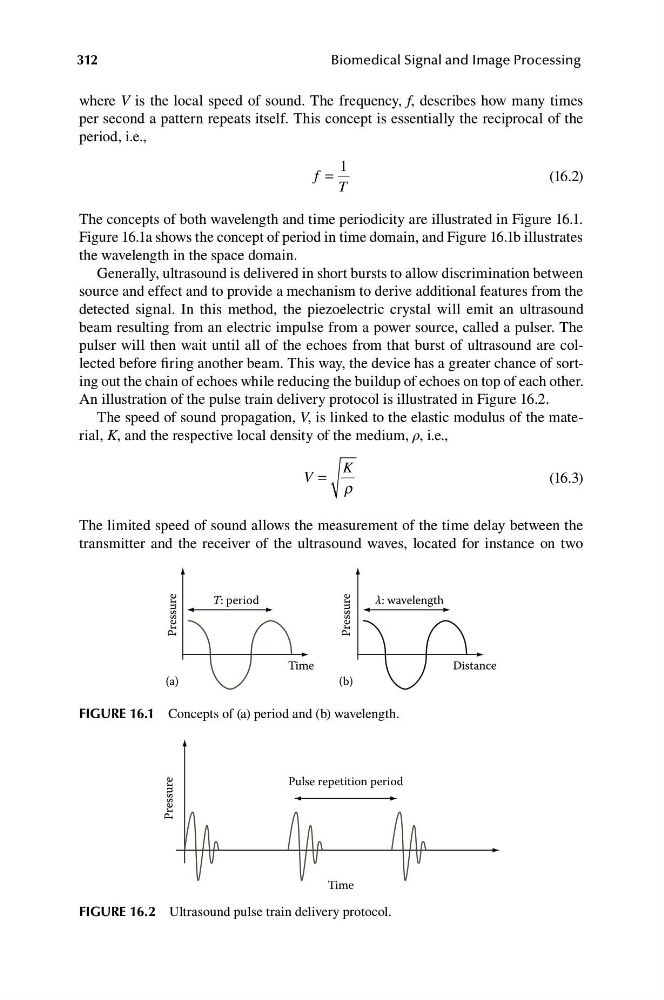
The concepts of both wavelength and time periodicity are illustrated in Figure 16.1.
Figure 16.1a shows the concept of period in time domain, and Figure 16.1b illustrates
the wavelength in the space domain.
Generally, ultrasound is delivered in short bursts to allow discrimination between
source and effect and to provide a mechanism to derive additional features from the
detected signal. In this method, the piezoelectric crystal will emit an ultrasound
beam resulting from an electric impulse from a power source, called a pulser. The
pulser will then wait until all of the echoes from that burst of ultrasound are collected before firing another beam. This way, the device has a greater chance of sorting out the chain of echoes while reducing the buildup of echoes on top of each other.
An illustration of the pulse train delivery protocol is illustrated in Figure 16.2.
The speed of sound propagation, V, is linked to the elastic modulus of the material, K, and the respective local density of the medium, ρ, i.e.,
K
V =
(16.3)
r
The limited speed of sound allows the measurement of the time delay between the
transmitter and the receiver of the ultrasound waves, located for instance on two
FIGURE 16.1 Concepts of (a) period and (b) wavelength.
FIGURE 16.2 Ultrasound pulse train delivery protocol.
Time
(a)
T: period
Pressure
Distance
(b)
λ: wavelength
Pressure
Pulse repetition period
Time
312
Biomedical Signal and Image Processing
where V is the local speed of sound. The frequency, f, describes how many times
per second a pattern repeats itself. This concept is essentially the reciprocal of the
period, i.e.,
1
f =
(16.2)
T
The concepts of both wavelength and time periodicity are illustrated in Figure 16.1.
Figure 16.1a shows the concept of period in time domain, and Figure 16.1b illustrates
the wavelength in the space domain.
Generally, ultrasound is delivered in short bursts to allow discrimination between
source and effect and to provide a mechanism to derive additional features from the
detected signal. In this method, the piezoelectric crystal will emit an ultrasound
beam resulting from an electric impulse from a power source, called a pulser. The
pulser will then wait until all of the echoes from that burst of ultrasound are collected before firing another beam. This way, the device has a greater chance of sorting out the chain of echoes while reducing the buildup of echoes on top of each other.
An illustration of the pulse train delivery protocol is illustrated in Figure 16.2.
The speed of sound propagation, V, is linked to the elastic modulus of the material, K, and the respective local density of the medium, ρ, i.e.,
K
V =
(16.3)
r
The limited speed of sound allows the measurement of the time delay between the
transmitter and the receiver of the ultrasound waves, located for instance on two
FIGURE 16.1 Concepts of (a) period and (b) wavelength.
FIGURE 16.2 Ultrasound pulse train delivery protocol.