

291
Magnetic Resonance Imaging
M xy
M z
T 1
T 2
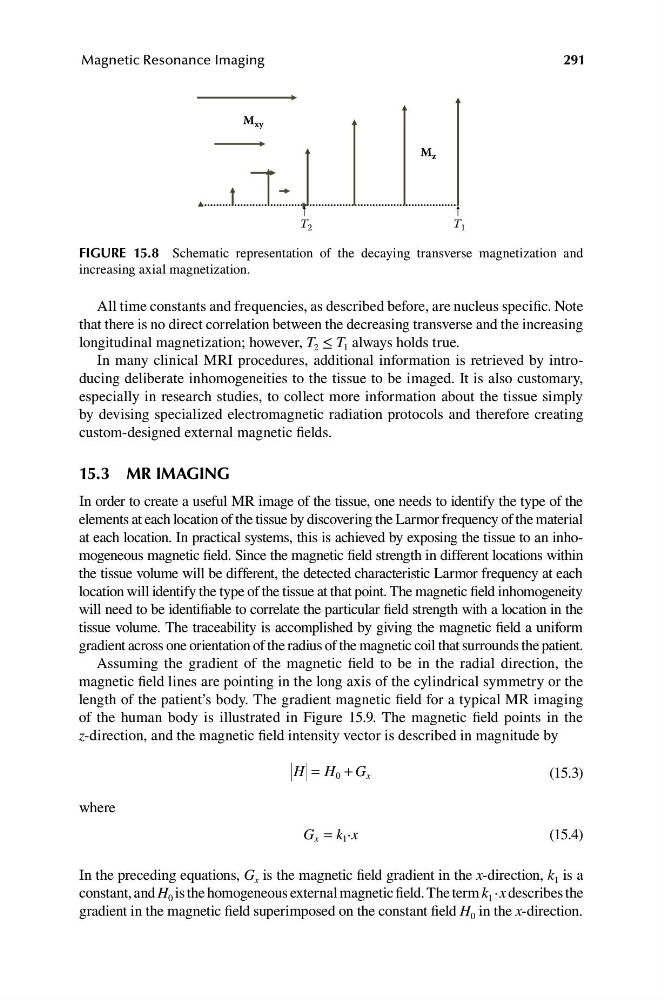
FIGURE 15.8 Schematic representation of the decaying transverse magnetization and
increasing axial magnetization.
All time constants and frequencies, as described before, are nucleus specific. Note
that there is no direct correlation between the decreasing transverse and the increasing
longitudinal magnetization; however, T 2 ≤ T 1 always holds true.
In many clinical MRI procedures, additional information is retrieved by introducing deliberate inhomogeneities to the tissue to be imaged. It is also customary,
especially in research studies, to collect more information about the tissue simply
by devising specialized electromagnetic radiation protocols and therefore creating
custom-designed external magnetic fields.
15.3 MR IMAGING
In order to create a useful MR image of the tissue, one needs to identify the type of the
elements at each location of the tissue by discovering the Larmor frequency of the material
at each location. In practical systems, this is achieved by exposing the tissue to an inhomogeneous magnetic field. Since the magnetic field strength in different locations within
the tissue volume will be different, the detected characteristic Larmor frequency at each
location will identify the type of the tissue at that point. The magnetic field inhomogeneity
will need to be identifiable to correlate the particular field strength with a location in the
tissue volume. The traceability is accomplished by giving the magnetic field a uniform
gradient across one orientation of the radius of the magnetic coil that surrounds the patient.
Assuming the gradient of the magnetic field to be in the radial direction, the
magnetic field lines are pointing in the long axis of the cylindrical symmetry or the
length of the patient’s body. The gradient magnetic field for a typical MR imaging
of the human body is illustrated in Figure 15.9. The magnetic field points in the
z-direction, and the magnetic field intensity vector is described in magnitude by
H = H 0 + G x
(15.3)
where
G x = k 1 . x
(15.4)
In the preceding equations, G x is the magnetic field gradient in the x-direction, k 1 is a
constant, and H 0 is the homogeneous external magnetic field. The term k 1 . x describes the
gradient in the magnetic field superimposed on the constant field H 0 in the x-direction.
Magnetic Resonance Imaging
M xy
M z
T 1
T 2
FIGURE 15.8 Schematic representation of the decaying transverse magnetization and
increasing axial magnetization.
All time constants and frequencies, as described before, are nucleus specific. Note
that there is no direct correlation between the decreasing transverse and the increasing
longitudinal magnetization; however, T 2 ≤ T 1 always holds true.
In many clinical MRI procedures, additional information is retrieved by introducing deliberate inhomogeneities to the tissue to be imaged. It is also customary,
especially in research studies, to collect more information about the tissue simply
by devising specialized electromagnetic radiation protocols and therefore creating
custom-designed external magnetic fields.
15.3 MR IMAGING
In order to create a useful MR image of the tissue, one needs to identify the type of the
elements at each location of the tissue by discovering the Larmor frequency of the material
at each location. In practical systems, this is achieved by exposing the tissue to an inhomogeneous magnetic field. Since the magnetic field strength in different locations within
the tissue volume will be different, the detected characteristic Larmor frequency at each
location will identify the type of the tissue at that point. The magnetic field inhomogeneity
will need to be identifiable to correlate the particular field strength with a location in the
tissue volume. The traceability is accomplished by giving the magnetic field a uniform
gradient across one orientation of the radius of the magnetic coil that surrounds the patient.
Assuming the gradient of the magnetic field to be in the radial direction, the
magnetic field lines are pointing in the long axis of the cylindrical symmetry or the
length of the patient’s body. The gradient magnetic field for a typical MR imaging
of the human body is illustrated in Figure 15.9. The magnetic field points in the
z-direction, and the magnetic field intensity vector is described in magnitude by
H = H 0 + G x
(15.3)
where
G x = k 1 . x
(15.4)
In the preceding equations, G x is the magnetic field gradient in the x-direction, k 1 is a
constant, and H 0 is the homogeneous external magnetic field. The term k 1 . x describes the
gradient in the magnetic field superimposed on the constant field H 0 in the x-direction.