

278
Biomedical Signal and Image Processing
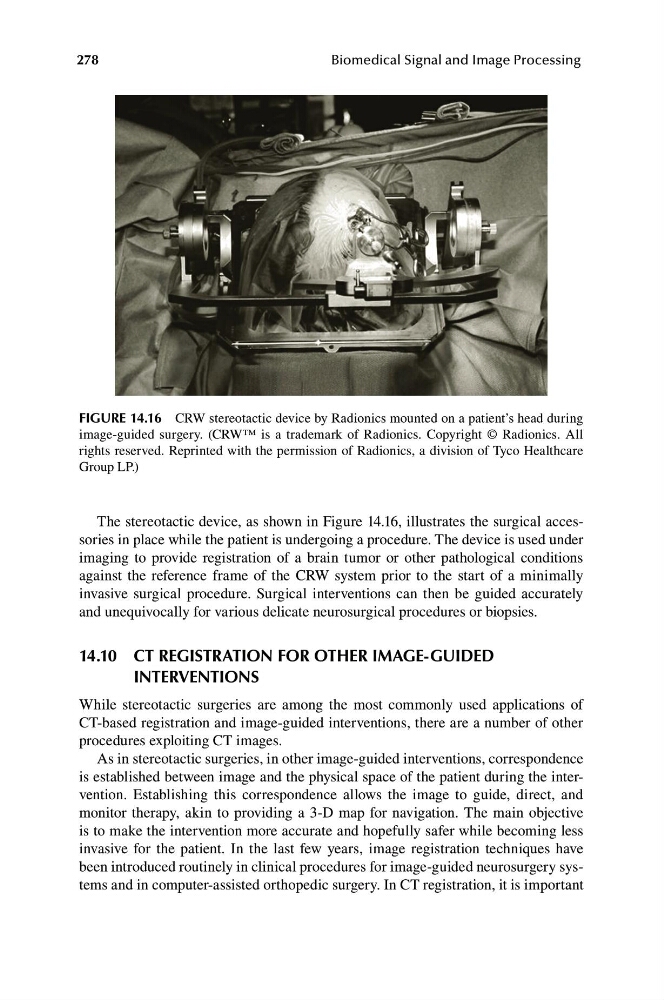
FIGURE 14.16 CRW stereotactic device by Radionics mounted on a patient’s head during
image-guided surgery. (CRW™ is a trademark of Radionics. Copyright © Radionics. All
rights reserved. Reprinted with the permission of Radionics, a division of Tyco Healthcare
Group LP.)
The stereotactic device, as shown in Figure 14.16, illustrates the surgical accessories in place while the patient is undergoing a procedure. The device is used under
imaging to provide registration of a brain tumor or other pathological conditions
against the reference frame of the CRW system prior to the start of a minimally
invasive surgical procedure. Surgical interventions can then be guided accurately
and unequivocally for various delicate neurosurgical procedures or biopsies.
14.10
CT REGISTRATION FOR OTHER IMAGE- GUIDED
INTERVENTIONS
While stereotactic surgeries are among the most commonly used applications of
CT-based registration and image-guided interventions, there are a number of other
procedures exploiting CT images.
As in stereotactic surgeries, in other image-guided interventions, correspondence
is established between image and the physical space of the patient during the intervention. Establishing this correspondence allows the image to guide, direct, and
monitor therapy, akin to providing a 3-D map for navigation. The main objective
is to make the intervention more accurate and hopefully safer while becoming less
invasive for the patient. In the last few years, image registration techniques have
been introduced routinely in clinical procedures for image-guided neurosurgery systems and in computer-assisted orthopedic surgery. In CT registration, it is important
Biomedical Signal and Image Processing
FIGURE 14.16 CRW stereotactic device by Radionics mounted on a patient’s head during
image-guided surgery. (CRW™ is a trademark of Radionics. Copyright © Radionics. All
rights reserved. Reprinted with the permission of Radionics, a division of Tyco Healthcare
Group LP.)
The stereotactic device, as shown in Figure 14.16, illustrates the surgical accessories in place while the patient is undergoing a procedure. The device is used under
imaging to provide registration of a brain tumor or other pathological conditions
against the reference frame of the CRW system prior to the start of a minimally
invasive surgical procedure. Surgical interventions can then be guided accurately
and unequivocally for various delicate neurosurgical procedures or biopsies.
14.10
CT REGISTRATION FOR OTHER IMAGE- GUIDED
INTERVENTIONS
While stereotactic surgeries are among the most commonly used applications of
CT-based registration and image-guided interventions, there are a number of other
procedures exploiting CT images.
As in stereotactic surgeries, in other image-guided interventions, correspondence
is established between image and the physical space of the patient during the intervention. Establishing this correspondence allows the image to guide, direct, and
monitor therapy, akin to providing a 3-D map for navigation. The main objective
is to make the intervention more accurate and hopefully safer while becoming less
invasive for the patient. In the last few years, image registration techniques have
been introduced routinely in clinical procedures for image-guided neurosurgery systems and in computer-assisted orthopedic surgery. In CT registration, it is important