

xcos θ + ysin θ = t
x
y
t
θ
f (x, y)
θ
x
y
P θ (t 1 )
P θ (t 2 )
t 1
t 2
255
Principles of Computed Tomography
13.2.1 ATTENUATION TOMOGRAPHY
In this section, while focusing on attenuation tomography, the main principles of
tomography are described. The first step is to device a suitable formulation of “line
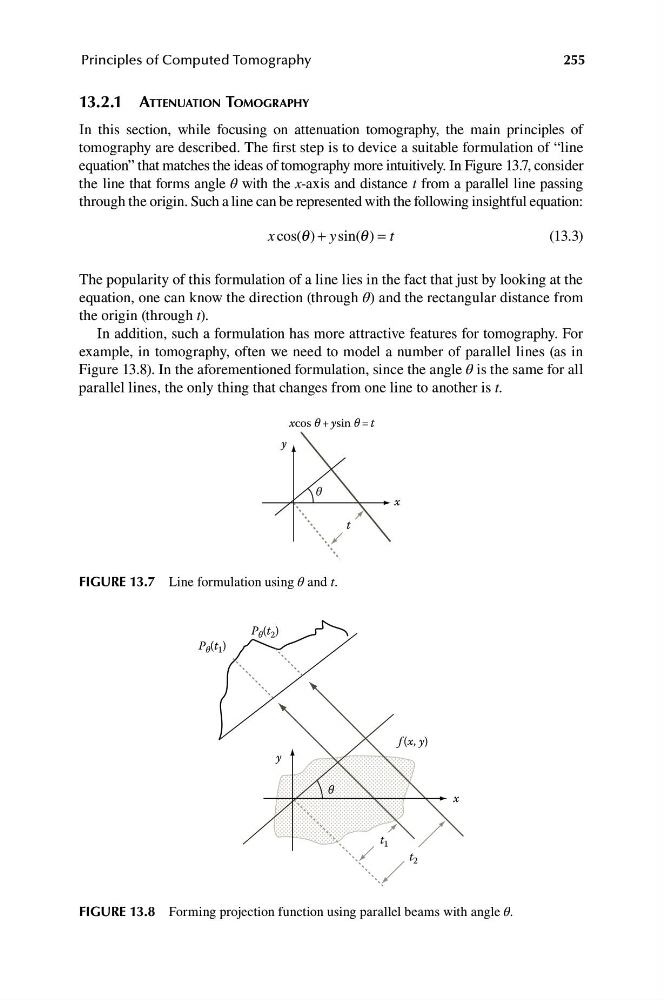
equation” that matches the ideas of tomography more intuitively. In Figure 13.7, consider
the line that forms angle θ with the x-axis and distance t from a parallel line passing
through the origin. Such a line can be represented with the following insightful equation:
x cos( )
q + y sin( ) = t
(13.3)
q
The popularity of this formulation of a line lies in the fact that just by looking at the
equation, one can know the direction (through θ) and the rectangular distance from
the origin (through t).
In addition, such a formulation has more attractive features for tomography. For
example, in tomography, often we need to model a number of parallel lines (as in
Figure 13.8). In the aforementioned formulation, since the angle θ is the same for all
parallel lines, the only thing that changes from one line to another is t.
FIGURE 13.7 Line formulation using θ and t.
FIGURE 13.8 Forming projection function using parallel beams with angle θ.
x
y
t
θ
f (x, y)
θ
x
y
P θ (t 1 )
P θ (t 2 )
t 1
t 2
255
Principles of Computed Tomography
13.2.1 ATTENUATION TOMOGRAPHY
In this section, while focusing on attenuation tomography, the main principles of
tomography are described. The first step is to device a suitable formulation of “line
equation” that matches the ideas of tomography more intuitively. In Figure 13.7, consider
the line that forms angle θ with the x-axis and distance t from a parallel line passing
through the origin. Such a line can be represented with the following insightful equation:
x cos( )
q + y sin( ) = t
(13.3)
q
The popularity of this formulation of a line lies in the fact that just by looking at the
equation, one can know the direction (through θ) and the rectangular distance from
the origin (through t).
In addition, such a formulation has more attractive features for tomography. For
example, in tomography, often we need to model a number of parallel lines (as in
Figure 13.8). In the aforementioned formulation, since the angle θ is the same for all
parallel lines, the only thing that changes from one line to another is t.
FIGURE 13.7 Line formulation using θ and t.
FIGURE 13.8 Forming projection function using parallel beams with angle θ.