

205
Electroencephalogram
1
100 ms
5 μV
5
6
7
8
4
3
2
1
2
3
4
5
6
7
8
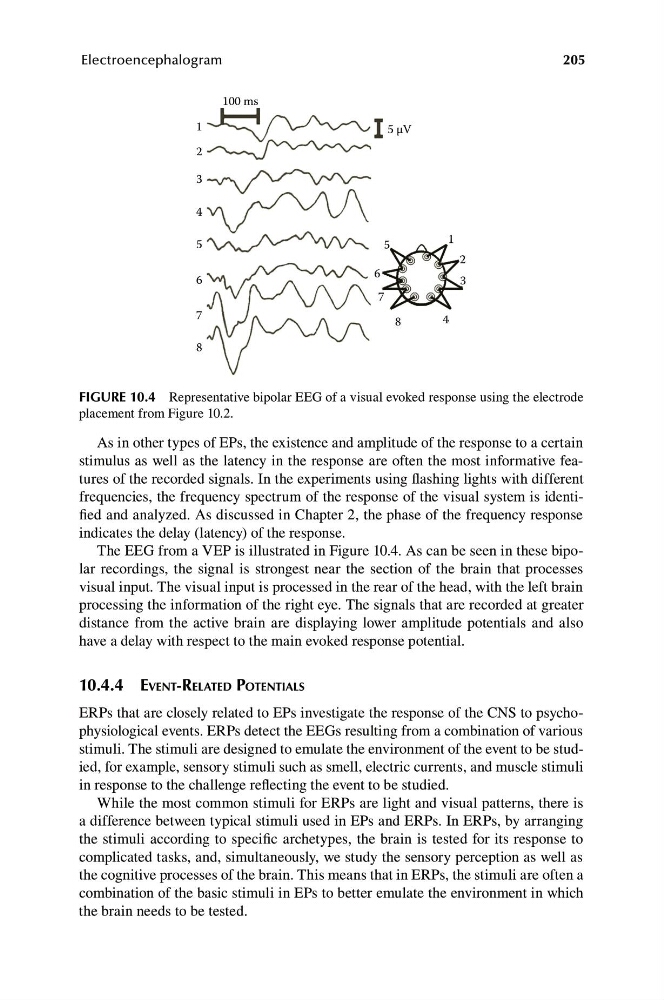
FIGURE 10.4 Representative bipolar EEG of a visual evoked response using the electrode
placement from Figure 10.2.
As in other types of EPs, the existence and amplitude of the response to a certain
stimulus as well as the latency in the response are often the most informative features of the recorded signals. In the experiments using flashing lights with different
frequencies, the frequency spectrum of the response of the visual system is identified and analyzed. As discussed in Chapter 2, the phase of the frequency response
indicates the delay (latency) of the response.
The EEG from a VEP is illustrated in Figure 10.4. As can be seen in these bipolar recordings, the signal is strongest near the section of the brain that processes
visual input. The visual input is processed in the rear of the head, with the left brain
processing the information of the right eye. The signals that are recorded at greater
distance from the active brain are displaying lower amplitude potentials and also
have a delay with respect to the main evoked response potential.
10.4.4 EVENT-RELATED POTENTIALS
ERPs that are closely related to EPs investigate the response of the CNS to psychophysiological events. ERPs detect the EEGs resulting from a combination of various
stimuli. The stimuli are designed to emulate the environment of the event to be studied, for example, sensory stimuli such as smell, electric currents, and muscle stimuli
in response to the challenge reflecting the event to be studied.
While the most common stimuli for ERPs are light and visual patterns, there is
a difference between typical stimuli used in EPs and ERPs. In ERPs, by arranging
the stimuli according to specific archetypes, the brain is tested for its response to
complicated tasks, and, simultaneously, we study the sensory perception as well as
the cognitive processes of the brain. This means that in ERPs, the stimuli are often a
combination of the basic stimuli in EPs to better emulate the environment in which
the brain needs to be tested.
Electroencephalogram
1
100 ms
5 μV
5
6
7
8
4
3
2
1
2
3
4
5
6
7
8
FIGURE 10.4 Representative bipolar EEG of a visual evoked response using the electrode
placement from Figure 10.2.
As in other types of EPs, the existence and amplitude of the response to a certain
stimulus as well as the latency in the response are often the most informative features of the recorded signals. In the experiments using flashing lights with different
frequencies, the frequency spectrum of the response of the visual system is identified and analyzed. As discussed in Chapter 2, the phase of the frequency response
indicates the delay (latency) of the response.
The EEG from a VEP is illustrated in Figure 10.4. As can be seen in these bipolar recordings, the signal is strongest near the section of the brain that processes
visual input. The visual input is processed in the rear of the head, with the left brain
processing the information of the right eye. The signals that are recorded at greater
distance from the active brain are displaying lower amplitude potentials and also
have a delay with respect to the main evoked response potential.
10.4.4 EVENT-RELATED POTENTIALS
ERPs that are closely related to EPs investigate the response of the CNS to psychophysiological events. ERPs detect the EEGs resulting from a combination of various
stimuli. The stimuli are designed to emulate the environment of the event to be studied, for example, sensory stimuli such as smell, electric currents, and muscle stimuli
in response to the challenge reflecting the event to be studied.
While the most common stimuli for ERPs are light and visual patterns, there is
a difference between typical stimuli used in EPs and ERPs. In ERPs, by arranging
the stimuli according to specific archetypes, the brain is tested for its response to
complicated tasks, and, simultaneously, we study the sensory perception as well as
the cognitive processes of the brain. This means that in ERPs, the stimuli are often a
combination of the basic stimuli in EPs to better emulate the environment in which
the brain needs to be tested.