

134
Biomedical Signal and Image Processing
5
4
3
2
1
0
–1
–2
–3
–5
–4
–5
–4
–3
–2
–1
0
1
2
3
4
5
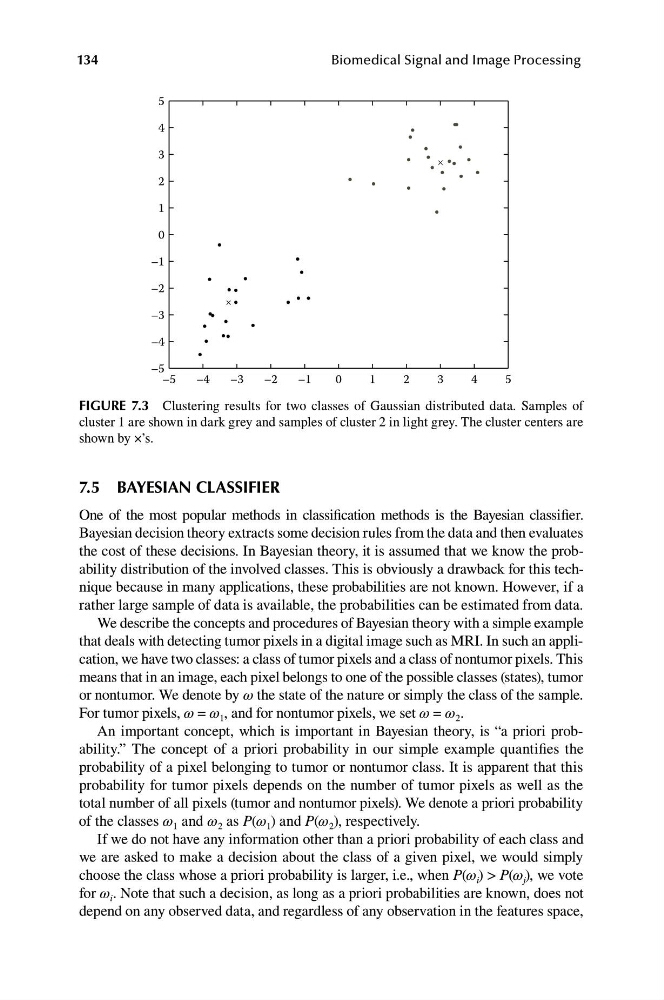
FIGURE 7.3 Clustering results for two classes of Gaussian distributed data. Samples of
cluster 1 are shown in dark grey and samples of cluster 2 in light grey. The cluster centers are
shown by ×’s.
7.5 BAYESIAN CLASSIFIER
One of the most popular methods in classification methods is the Bayesian classifier.
Bayesian decision theory extracts some decision rules from the data and then evaluates
the cost of these decisions. In Bayesian theory, it is assumed that we know the probability distribution of the involved classes. This is obviously a drawback for this technique because in many applications, these probabilities are not known. However, if a
rather large sample of data is available, the probabilities can be estimated from data.
We describe the concepts and procedures of Bayesian theory with a simple example
that deals with detecting tumor pixels in a digital image such as MRI. In such an application, we have two classes: a class of tumor pixels and a class of nontumor pixels. This
means that in an image, each pixel belongs to one of the possible classes (states), tumor
or nontumor. We denote by ω the state of the nature or simply the class of the sample.
For tumor pixels, ω = ω 1 , and for nontumor pixels, we set ω = ω 2 .
An important concept, which is important in Bayesian theory, is “a priori probability.” The concept of a priori probability in our simple example quantifies the
probability of a pixel belonging to tumor or nontumor class. It is apparent that this
probability for tumor pixels depends on the number of tumor pixels as well as the
total number of all pixels (tumor and nontumor pixels). We denote a priori probability
of the classes ω 1 and ω 2 as P(ω 1 ) and P(ω 2 ), respectively.
If we do not have any information other than a priori probability of each class and
we are asked to make a decision about the class of a given pixel, we would simply
choose the class whose a priori probability is larger, i.e., when P(ω i ) > P(ω j ), we vote
for ω i . Note that such a decision, as long as a priori probabilities are known, does not
depend on any observed data, and regardless of any observation in the features space,
Biomedical Signal and Image Processing
5
4
3
2
1
0
–1
–2
–3
–5
–4
–5
–4
–3
–2
–1
0
1
2
3
4
5
FIGURE 7.3 Clustering results for two classes of Gaussian distributed data. Samples of
cluster 1 are shown in dark grey and samples of cluster 2 in light grey. The cluster centers are
shown by ×’s.
7.5 BAYESIAN CLASSIFIER
One of the most popular methods in classification methods is the Bayesian classifier.
Bayesian decision theory extracts some decision rules from the data and then evaluates
the cost of these decisions. In Bayesian theory, it is assumed that we know the probability distribution of the involved classes. This is obviously a drawback for this technique because in many applications, these probabilities are not known. However, if a
rather large sample of data is available, the probabilities can be estimated from data.
We describe the concepts and procedures of Bayesian theory with a simple example
that deals with detecting tumor pixels in a digital image such as MRI. In such an application, we have two classes: a class of tumor pixels and a class of nontumor pixels. This
means that in an image, each pixel belongs to one of the possible classes (states), tumor
or nontumor. We denote by ω the state of the nature or simply the class of the sample.
For tumor pixels, ω = ω 1 , and for nontumor pixels, we set ω = ω 2 .
An important concept, which is important in Bayesian theory, is “a priori probability.” The concept of a priori probability in our simple example quantifies the
probability of a pixel belonging to tumor or nontumor class. It is apparent that this
probability for tumor pixels depends on the number of tumor pixels as well as the
total number of all pixels (tumor and nontumor pixels). We denote a priori probability
of the classes ω 1 and ω 2 as P(ω 1 ) and P(ω 2 ), respectively.
If we do not have any information other than a priori probability of each class and
we are asked to make a decision about the class of a given pixel, we would simply
choose the class whose a priori probability is larger, i.e., when P(ω i ) > P(ω j ), we vote
for ω i . Note that such a decision, as long as a priori probabilities are known, does not
depend on any observed data, and regardless of any observation in the features space,