

126
Biomedical Signal and Image Processing
the previously diagnosed cases to be used for training and testing of a classifier.
For example, many automated diagnostic systems for processing of MR images
are available in which the system discovers the existence of different types of
malignant and benign images. These systems are trained and tested with a number
of previously diagnosed cases that radiologists have been provided by the designers of the automated system. Such automated systems, once reliably trained and
tested, are capable of assisting physicians in processing and diagnostics of many
cases in a very short period of time and, unlike physicians, are not susceptible to
issues such as fatigue.
Clustering is a similar process but is often more difficult than classification. In
clustering, the examples provided to the clustering method as the training set are
not labeled; however, the clustering technique is asked not only to cluster (group)
the data but also to provide a set of rules or mathematical equations to distinguish the
groups from each other. At first glance, this task might seem unreasonable or even
impossible, but as we show later in this chapter, clustering is even more natural and
more useful in medical research. Next, a simple example is given that intuitively
indicates the possibility and the need for clustering. The example is intentionally
chosen to be nonbiomedical such that the importance and feasibility of clustering
in all areas of signal processing is better portrayed.
Example 7.1
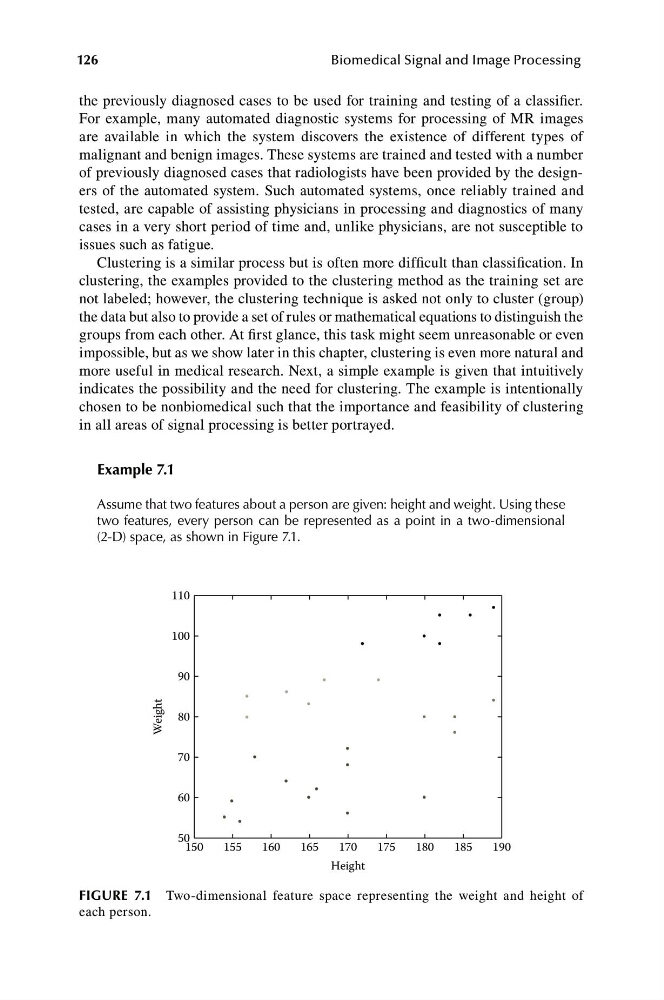
Assume that two features about a person are given: height and weight. Using these
two features, every person can be represented as a point in a two-dimensional
(2-D) space, as shown in Figure 7.1.
110
100
90
80
70
60
50
150
155
160
165
170
Height
Weight
175
180
185
190
FIGURE 7.1 Two-dimensional feature space representing the weight and height of
each person.
Biomedical Signal and Image Processing
the previously diagnosed cases to be used for training and testing of a classifier.
For example, many automated diagnostic systems for processing of MR images
are available in which the system discovers the existence of different types of
malignant and benign images. These systems are trained and tested with a number
of previously diagnosed cases that radiologists have been provided by the designers of the automated system. Such automated systems, once reliably trained and
tested, are capable of assisting physicians in processing and diagnostics of many
cases in a very short period of time and, unlike physicians, are not susceptible to
issues such as fatigue.
Clustering is a similar process but is often more difficult than classification. In
clustering, the examples provided to the clustering method as the training set are
not labeled; however, the clustering technique is asked not only to cluster (group)
the data but also to provide a set of rules or mathematical equations to distinguish the
groups from each other. At first glance, this task might seem unreasonable or even
impossible, but as we show later in this chapter, clustering is even more natural and
more useful in medical research. Next, a simple example is given that intuitively
indicates the possibility and the need for clustering. The example is intentionally
chosen to be nonbiomedical such that the importance and feasibility of clustering
in all areas of signal processing is better portrayed.
Example 7.1
Assume that two features about a person are given: height and weight. Using these
two features, every person can be represented as a point in a two-dimensional
(2-D) space, as shown in Figure 7.1.
110
100
90
80
70
60
50
150
155
160
165
170
Height
Weight
175
180
185
190
FIGURE 7.1 Two-dimensional feature space representing the weight and height of
each person.