

108
Biomedical Signal and Image Processing
of a random sequence and therefore may not be used to represent all aspects of
the stochastic process. The question then becomes how a stochastic process can be
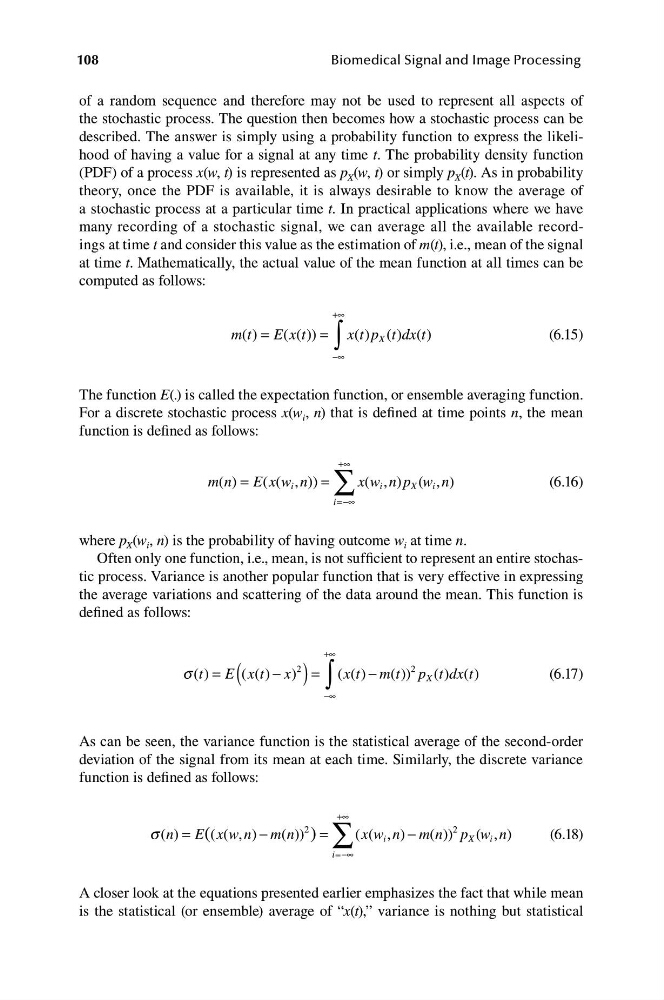
described. The answer is simply using a probability function to express the likelihood of having a value for a signal at any time t. The probability density function
(PDF) of a process x(w, t) is represented as p X (w, t) or simply p X (t). As in probability
theory, once the PDF is available, it is always desirable to know the average of
a stochastic process at a particular time t. In practical applications where we have
many recording of a stochastic signal, we can average all the available recordings at time t and consider this value as the estimation of m(t), i.e., mean of the signal
at time t. Mathematically, the actual value of the mean function at all times can be
computed as follows:
+∞
m t
( ) = E( x( )
t ) =
∫
x( )
t p X ( )
t dx( )
t
(6.15)
−∞
The function E(.) is called the expectation function, or ensemble averaging function.
For a discrete stochastic process x(w i , n) that is defined at time points n, the mean
function is defined as follows:
+∞
m( )
n = E( (
x w n
i , )) = ∑ x( w n
i , ) p X ( w n
i , )
(6.16)
i=−∞
where p X (w i , n) is the probability of having outcome w i at time n.
Often only one function, i.e., mean, is not sufficient to represent an entire stochastic process. Variance is another popular function that is very effective in expressing
the average variations and scattering of the data around the mean. This function is
defined as follows:
+∞
s ( )
t = E ( ( x t
( ) − x)
2
) = ∫
( x t
( ) − m( t ))
2 p X ( )
t dx t
( )
(6.17)
−∞
As can be seen, the variance function is the statistical average of the second-order
deviation of the signal from its mean at each time. Similarly, the discrete variance
function is defined as follows:
,
n ) = ∑
+∞
s ( )
n = E ( ( (
x w n ) − m( ))
2
( (
x w
2
i , n ) − m( n )) p X ( w i , n )
(6.18)
i=−∞
A closer look at the equations presented earlier emphasizes the fact that while mean
is the statistical (or ensemble) average of “x(t),” variance is nothing but statistical
Biomedical Signal and Image Processing
of a random sequence and therefore may not be used to represent all aspects of
the stochastic process. The question then becomes how a stochastic process can be
described. The answer is simply using a probability function to express the likelihood of having a value for a signal at any time t. The probability density function
(PDF) of a process x(w, t) is represented as p X (w, t) or simply p X (t). As in probability
theory, once the PDF is available, it is always desirable to know the average of
a stochastic process at a particular time t. In practical applications where we have
many recording of a stochastic signal, we can average all the available recordings at time t and consider this value as the estimation of m(t), i.e., mean of the signal
at time t. Mathematically, the actual value of the mean function at all times can be
computed as follows:
+∞
m t
( ) = E( x( )
t ) =
∫
x( )
t p X ( )
t dx( )
t
(6.15)
−∞
The function E(.) is called the expectation function, or ensemble averaging function.
For a discrete stochastic process x(w i , n) that is defined at time points n, the mean
function is defined as follows:
+∞
m( )
n = E( (
x w n
i , )) = ∑ x( w n
i , ) p X ( w n
i , )
(6.16)
i=−∞
where p X (w i , n) is the probability of having outcome w i at time n.
Often only one function, i.e., mean, is not sufficient to represent an entire stochastic process. Variance is another popular function that is very effective in expressing
the average variations and scattering of the data around the mean. This function is
defined as follows:
+∞
s ( )
t = E ( ( x t
( ) − x)
2
) = ∫
( x t
( ) − m( t ))
2 p X ( )
t dx t
( )
(6.17)
−∞
As can be seen, the variance function is the statistical average of the second-order
deviation of the signal from its mean at each time. Similarly, the discrete variance
function is defined as follows:
,
n ) = ∑
+∞
s ( )
n = E ( ( (
x w n ) − m( ))
2
( (
x w
2
i , n ) − m( n )) p X ( w i , n )
(6.18)
i=−∞
A closer look at the equations presented earlier emphasizes the fact that while mean
is the statistical (or ensemble) average of “x(t),” variance is nothing but statistical