

b. Ca lculate the DWT of the signal using “dwt” command (use as many
levels of decomposition as you need for better results). Use Harr mother
wavelet, which is the same as Daubechies 1 (“db1” in MATLAB).
c. Apply soft thresholding for denoising of the signal assuming ξ = 0.01, ξ = 0.05,
and ξ = 0.1.
d.
Use “idwt” command to reconstruct the filtered signal for all three values
of ξ, compare the results, and identify the setting with the best results.
5.3 We are to compress an image given in “p_5_3.mat.” This image shows a multislice tomographic image of the pulmonary vein in a patient with fibrillation. In
this problem, we will explore the effects of using different mother wavelets for
compression of the given image.*
a. Read the image using “load” command and show it using “image”.
b. Calculate the 2-D DWT of the image using “dwt2” command (assume
two levels of decomposition). Use the following three mother wavelets for this purpose: Daubechies 2, Harr, and Coiflets 1 (“coif1” in
MATLAB).
c. A pply hard thresholding for denoising of the image assuming ξ = 0.01, ξ = 0.05,
and ξ = 0.1.
d.
Use “idwt2” command to reconstruct the compressed image for all three
values of ξ for all mother wavelets, compare the results, and identify the
setting with the best results.
5.4 In this problem, we explore forming QMF algorithm for a given filter h(n). This
problem also allows us to generate a new mother wavelet. Assume that this
filter is given as
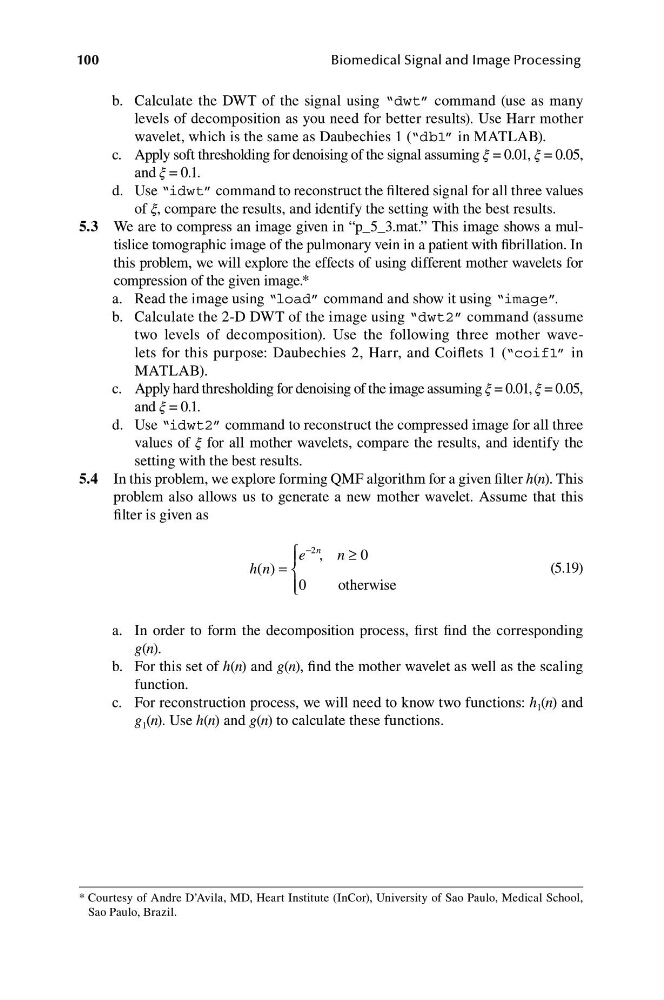
⎧ ⎪ e
−2n
,
n
≥
0
h( )
n =
⎨
(5.19)
⎪0
otherwise
⎩
a. In order to form the decomposition process, first find the corresponding
g(n).
b. For this set of h(n) and g(n), find the mother wavelet as well as the scaling
function.
c.
For reconstruction process, we will need to know two functions: h 1 (n) and
g 1 (n). Use h(n) and g(n) to calculate these functions.
100
Biomedical Signal and Image Processing
* Courtesy of Andre D’Avila, MD, Heart Institute (InCor), University of Sao Paulo, Medical School,
Sao Paulo, Brazil.
levels of decomposition as you need for better results). Use Harr mother
wavelet, which is the same as Daubechies 1 (“db1” in MATLAB).
c. Apply soft thresholding for denoising of the signal assuming ξ = 0.01, ξ = 0.05,
and ξ = 0.1.
d.
Use “idwt” command to reconstruct the filtered signal for all three values
of ξ, compare the results, and identify the setting with the best results.
5.3 We are to compress an image given in “p_5_3.mat.” This image shows a multislice tomographic image of the pulmonary vein in a patient with fibrillation. In
this problem, we will explore the effects of using different mother wavelets for
compression of the given image.*
a. Read the image using “load” command and show it using “image”.
b. Calculate the 2-D DWT of the image using “dwt2” command (assume
two levels of decomposition). Use the following three mother wavelets for this purpose: Daubechies 2, Harr, and Coiflets 1 (“coif1” in
MATLAB).
c. A pply hard thresholding for denoising of the image assuming ξ = 0.01, ξ = 0.05,
and ξ = 0.1.
d.
Use “idwt2” command to reconstruct the compressed image for all three
values of ξ for all mother wavelets, compare the results, and identify the
setting with the best results.
5.4 In this problem, we explore forming QMF algorithm for a given filter h(n). This
problem also allows us to generate a new mother wavelet. Assume that this
filter is given as
⎧ ⎪ e
−2n
,
n
≥
0
h( )
n =
⎨
(5.19)
⎪0
otherwise
⎩
a. In order to form the decomposition process, first find the corresponding
g(n).
b. For this set of h(n) and g(n), find the mother wavelet as well as the scaling
function.
c.
For reconstruction process, we will need to know two functions: h 1 (n) and
g 1 (n). Use h(n) and g(n) to calculate these functions.
100
Biomedical Signal and Image Processing
* Courtesy of Andre D’Avila, MD, Heart Institute (InCor), University of Sao Paulo, Medical School,
Sao Paulo, Brazil.