

86
Biomedical Signal and Image Processing
5.3 ONE-DIMENSIONAL CONTINUOUS WAVELET TRANSFORM
Before introducing WT, we need to take a closer look at the basic definition of “frequency” as the fundamental concept of the FT. We need to focus on the definition of
frequency at this point because we are to use time-limited basis functions for the new
transform as opposed to the periodic time-unlimited functions used in the FT. This
means that since we will not be using periodic sinusoidal basis functions for the new
transform, we need to think of a concept that replaces frequency. Time-limited basis
functions are obviously not periodic, and therefore, we need to invent a new concept
that can represent a concept similar to frequency.
In order to find a replacement for frequency, we need to see what interesting
features are captured by frequency. Consider a sinusoidal basis function with frequency 0.1 Hz. Having a basis function with this frequency, another basis function in the Fourier decomposition of the signal would be the second harmonic of
this basis function, i.e., a sinusoidal basis function with frequency 0.2 Hz. The
harmonic relation among the basis signals is the fundamental concept of signal
transformation and decomposition. Therefore, the relation among harmonics is
something that we need to somehow represent by our new concept that will replace
frequency.
In order to find this new concept, we make the following important observation
about harmonics: warping the time axis “t” allows us to obtain the harmonics from
the original signal, for example, replacing the time axis “t” in the original signal with
“2t” time axis results in the second harmonic. This is essentially “scaling” the signal
in time to generate other basis functions. We claim here that the main characteristic of
harmonic frequencies can be drawn from a more general concept that we call “scale.”
Scale, as a replacement of frequency, can reflect the same interesting properties in
terms of the harmonic relation among the basis functions. The interesting part is that
unlike frequency that is defined only for periodic signals, scale is equally applicable
to nonperiodic signals. This proves that we have found a new concept, i.e., scale, to
replace frequency. Using scale as a variable, the new transform, which will be based
on time-limited basis function, can be meaningfully applied to both time-unlimited
and time-limited signals.
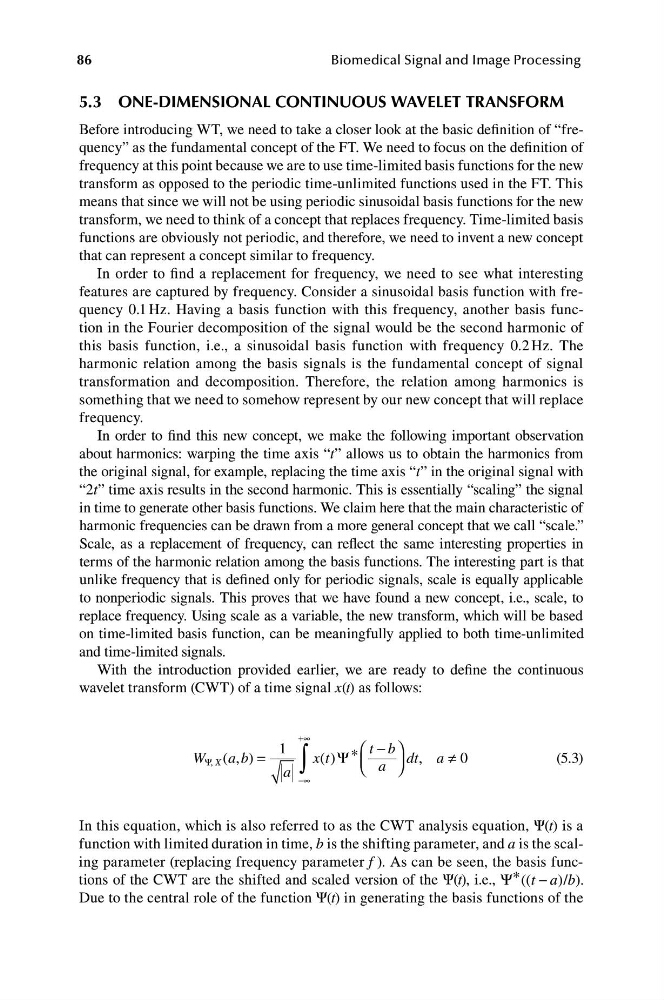
With the introduction provided earlier, we are ready to define the continuous
wavelet transform (CWT) of a time signal x(t) as follows:
+∞
1
⎛ t b
− ⎞
W Ψ, X ( ,
a b )
∗
=
∫
x t
( ) Ψ ⎜ a ⎟ dt, a ≠ 0
(5.3)
a
⎝
⎠
−∞
In this equation, which is also referred to as the CWT analysis equation, Ψ(t) is a
function with limited duration in time, b is the shifting parameter, and a is the scaling parameter (replacing frequency parameter f ). As can be seen, the basis functions of the CWT are the shifted and scaled version of the Ψ(t), i.e., Ψ ∗ (( t a
− )/ b).
Due to the central role of the function Ψ(t) in generating the basis functions of the
Biomedical Signal and Image Processing
5.3 ONE-DIMENSIONAL CONTINUOUS WAVELET TRANSFORM
Before introducing WT, we need to take a closer look at the basic definition of “frequency” as the fundamental concept of the FT. We need to focus on the definition of
frequency at this point because we are to use time-limited basis functions for the new
transform as opposed to the periodic time-unlimited functions used in the FT. This
means that since we will not be using periodic sinusoidal basis functions for the new
transform, we need to think of a concept that replaces frequency. Time-limited basis
functions are obviously not periodic, and therefore, we need to invent a new concept
that can represent a concept similar to frequency.
In order to find a replacement for frequency, we need to see what interesting
features are captured by frequency. Consider a sinusoidal basis function with frequency 0.1 Hz. Having a basis function with this frequency, another basis function in the Fourier decomposition of the signal would be the second harmonic of
this basis function, i.e., a sinusoidal basis function with frequency 0.2 Hz. The
harmonic relation among the basis signals is the fundamental concept of signal
transformation and decomposition. Therefore, the relation among harmonics is
something that we need to somehow represent by our new concept that will replace
frequency.
In order to find this new concept, we make the following important observation
about harmonics: warping the time axis “t” allows us to obtain the harmonics from
the original signal, for example, replacing the time axis “t” in the original signal with
“2t” time axis results in the second harmonic. This is essentially “scaling” the signal
in time to generate other basis functions. We claim here that the main characteristic of
harmonic frequencies can be drawn from a more general concept that we call “scale.”
Scale, as a replacement of frequency, can reflect the same interesting properties in
terms of the harmonic relation among the basis functions. The interesting part is that
unlike frequency that is defined only for periodic signals, scale is equally applicable
to nonperiodic signals. This proves that we have found a new concept, i.e., scale, to
replace frequency. Using scale as a variable, the new transform, which will be based
on time-limited basis function, can be meaningfully applied to both time-unlimited
and time-limited signals.
With the introduction provided earlier, we are ready to define the continuous
wavelet transform (CWT) of a time signal x(t) as follows:
+∞
1
⎛ t b
− ⎞
W Ψ, X ( ,
a b )
∗
=
∫
x t
( ) Ψ ⎜ a ⎟ dt, a ≠ 0
(5.3)
a
⎝
⎠
−∞
In this equation, which is also referred to as the CWT analysis equation, Ψ(t) is a
function with limited duration in time, b is the shifting parameter, and a is the scaling parameter (replacing frequency parameter f ). As can be seen, the basis functions of the CWT are the shifted and scaled version of the Ψ(t), i.e., Ψ ∗ (( t a
− )/ b).
Due to the central role of the function Ψ(t) in generating the basis functions of the